
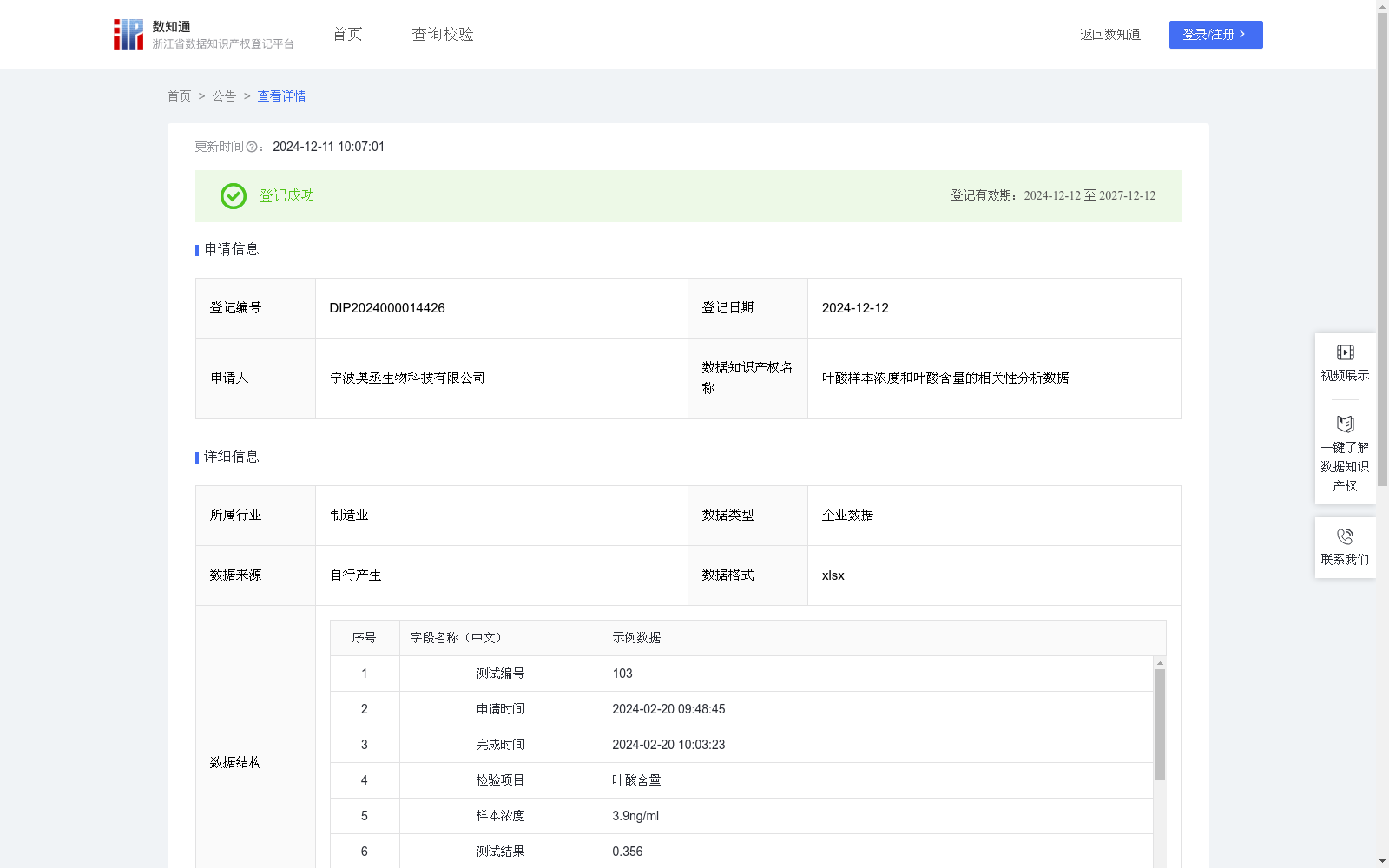
叶酸样本浓度和叶酸含量的相关性分析数据
收藏浙江省数据知识产权登记平台2024-12-11 更新2024-12-12 收录
下载链接:
https://www.zjip.org.cn/home/announce/trends/99495
下载链接
链接失效反馈官方服务:
资源简介:
相关性指数是一个从0到100的数值,用来表示两个变量之间的相关性的强度和方向,越接近于0代表越强的负相关,越接近于1代表越强的正相关。
将叶酸样本浓度测试结果和免疫荧光法测试结果的相关性指数集成到临床决策支持系统中,帮助医生更快地识别检查结果的可靠性,从而做出更加精准的临床决策;相关性指数可以作为质量控制的指标,帮助实验室监控测试过程,确保测试结果的一致性和可靠性;利用相关性指数训练AI模型,提高自动分析测试结果的准确性。1. 数据采集和预处理:公司内部的测试数据库采集测试编号、申请时间、完成时间、检验项目、样本浓度、测试结果和样本数量。数据预处理:对样本浓度和测试结果数据进行清洗,去除异常值,平滑数据,以确保数据的准确性和可用性。 2.相关性指数计算:1)计算平均值和标准差:对于样本浓度和叶酸含量测试结果,分别计算其平均值,(μx和μy)和标准差(σx和σy);2)计算协方差:协方差表示两个变量的共同变异趋势,计算公式为: Cov(x,y)=n−(∑ (xi−μx)(yi−μy))/(n-1),其中 xi和yi分别是单个样本的样本浓度和叶酸含量测试结果,n是样本数量;3)计算皮尔逊相关系数:皮尔逊相关系数(r)是度量两个变量线性相关程度的统计指标,计算公式为:r=Cov(x,y)/σxσy;4)转换为相关性指数:将皮尔逊相关系数转换为0到100的范围,以创建相关性指数=(r+1)×50。相关性指数的值介于0和100之间,用来表示两个变量之间的相关性的强度和方向,越接近于0代表越强的负相关,越接近于100代表越强的正相关。
Correlation Index is a numerical value ranging from 0 to 100 that indicates the strength and direction of the correlation between two variables: closer to 0 represents a stronger negative correlation, while closer to 100 represents a stronger positive correlation.
Integrating the Correlation Index between folic acid sample concentration test results and immunofluorescence assay test results into clinical decision support systems can help clinicians more quickly identify the reliability of test results, thereby enabling more precise clinical decision-making. The Correlation Index can also serve as a quality control metric to assist laboratories in monitoring test processes and ensuring the consistency and reliability of test results. Additionally, training AI models using the Correlation Index can improve the accuracy of automated test result analysis.
1. Data Collection and Preprocessing
Internal company test databases collect information including test ID, application time, completion time, test items, sample concentration, test results, and sample quantity. For data preprocessing: clean the sample concentration and test result data by removing outliers and smoothing the data, to ensure the accuracy and availability of the dataset.
2. Correlation Index Calculation
1) Calculate mean and standard deviation: For folic acid sample concentration and folic acid content test results, calculate their respective means ($mu_x$ and $mu_y$) and standard deviations ($sigma_x$ and $sigma_y$).
2) Calculate covariance: Covariance represents the common variation trend of two variables, with the calculation formula: $Cov(x,y) = frac{sum_{i=1}^{n} (x_i - mu_x)(y_i - mu_y)}{n-1}$, where $x_i$ and $y_i$ are the sample concentration and folic acid content test result of a single sample respectively, and $n$ is the total number of samples.
3) Calculate Pearson correlation coefficient: The Pearson correlation coefficient ($r$) is a statistical metric that measures the degree of linear correlation between two variables, with the calculation formula: $r = frac{Cov(x,y)}{sigma_x sigma_y}$.
4) Convert to Correlation Index: Convert the Pearson correlation coefficient to a range of 0 to 100 to derive the Correlation Index: $Correlation Index = (r + 1) imes 50$. The Correlation Index ranges from 0 to 100, which indicates the strength and direction of the correlation between two variables: closer to 0 represents a stronger negative correlation, while closer to 100 represents a stronger positive correlation.
提供机构:
宁波奥丞生物科技有限公司
创建时间:
2024-10-31
搜集汇总
数据集介绍
以上内容由遇见数据集搜集并总结生成



