
Speechreading affects Mandarin tone perception (Zhang et al., 2025)
收藏DataCite Commons2025-02-05 更新2025-04-15 收录
下载链接:
https://asha.figshare.com/articles/dataset/Speechreading_affects_Mandarin_tone_perception_Zhang_et_al_2025_/28207784/1
下载链接
链接失效反馈官方服务:
资源简介:
<b>Purpose: </b>This cross-sectional study explored how the speechreading ability of adults with hearing impairment (HI) in China would affect their perception of the four Mandarin Chinese lexical tones: high (Tone 1), rising (Tone 2), falling–rising (Tone 3), and falling (Tone 4). We predicted that higher speechreading ability would result in better tone performance and that accuracy would vary among individual tones.<b>Method: </b>A total of 136 young adults with HI (ages 18–25 years) in China participated in the study and completed Chinese speechreading and tone awareness tests. The participants were divided into three groups on their basis of their speechreading performance (HIGH, MIDDLE, and LOW speechreading ability), and their ability to recognize the four Mandarin tones was compared.<b>Results: </b>HI adults with high speechreading ability identified tones more accurately than HI adults with low speechreading ability. The overall performance for Tone 2 was the lowest across all the groups. We found a significant interaction between speechreading ability groups and tone levels; the high speechreading ability group performed significantly better than the low ability group when identifying Tones 1 and 4, and performance on Tone 3 also differed by speechreading ability.<b>Conclusions: </b>These results suggest that speechreading ability affects Mandarin tone perception in adults with HI in China. Higher speechreading ability was associated with better overall tone perception. Tone 2 was the most difficult tone to identify, while identification of the other three lexical tones depended on speechreading ability. In visual language processing, adults with HI must reconstitute phonological units from visual and auditory fragments. To determine the generalizability of these results, they should be examined in languages beyond Mandarin Chinese.<b>Supplemental Material S1.</b> Demographic details of the participantsZhang, F., Wei, X., Jiang, X., Chen, L., Wang, H., & Lei, J. (2025). Speechreading ability affects Mandarin tone perception in young adults with prelingual hearing impairment in China. <i>Journal of Speech, Language, and Hearing Research</i>, <i>68</i>(2), 654–664. https://doi.org/10.1044/2024_JSLHR-23-00676<br>
一、研究目的:本横断面研究探讨了中国听力损伤(hearing impairment, HI)成人的唇读(speechreading)能力如何影响其对汉语普通话四类声调的感知,即阴平(Tone 1)、阳平(Tone 2)、上声(Tone 3)与去声(Tone 4)。本研究假设:唇读能力越高者的声调识别表现越好,且不同声调的识别准确率存在个体差异。
二、研究方法:本研究共招募136名中国年轻听力损伤成人(年龄18~25岁),所有受试者均完成了汉语唇读测试与声调感知测试。根据受试者的唇读表现将其分为高、中、低三组唇读能力组,并对比三组对普通话四类声调的识别能力。
三、研究结果:唇读能力较高的听力损伤成人的声调识别准确率显著高于唇读能力较低的受试者。所有组别中,阳平(Tone 2)的整体识别准确率最低。研究发现唇读能力组与声调类型间存在显著交互效应:在识别阴平(Tone 1)与去声(Tone 4)时,高唇读能力组的表现显著优于低能力组;且上声(Tone 3)的识别表现也随唇读能力不同而存在差异。
四、研究结论:上述结果表明,唇读能力会影响中国听力损伤成人对普通话声调的感知。唇读能力越高者的整体声调感知表现越好。阳平(Tone 2)是四类声调中最难识别的,其余三类声调的识别准确率则依赖于唇读能力。在视觉语言加工过程中,听力损伤成人需要从视觉与听觉片段中重构语音单元。为验证本研究结果的可推广性,未来应在汉语以外的其他语言中开展相关验证研究。
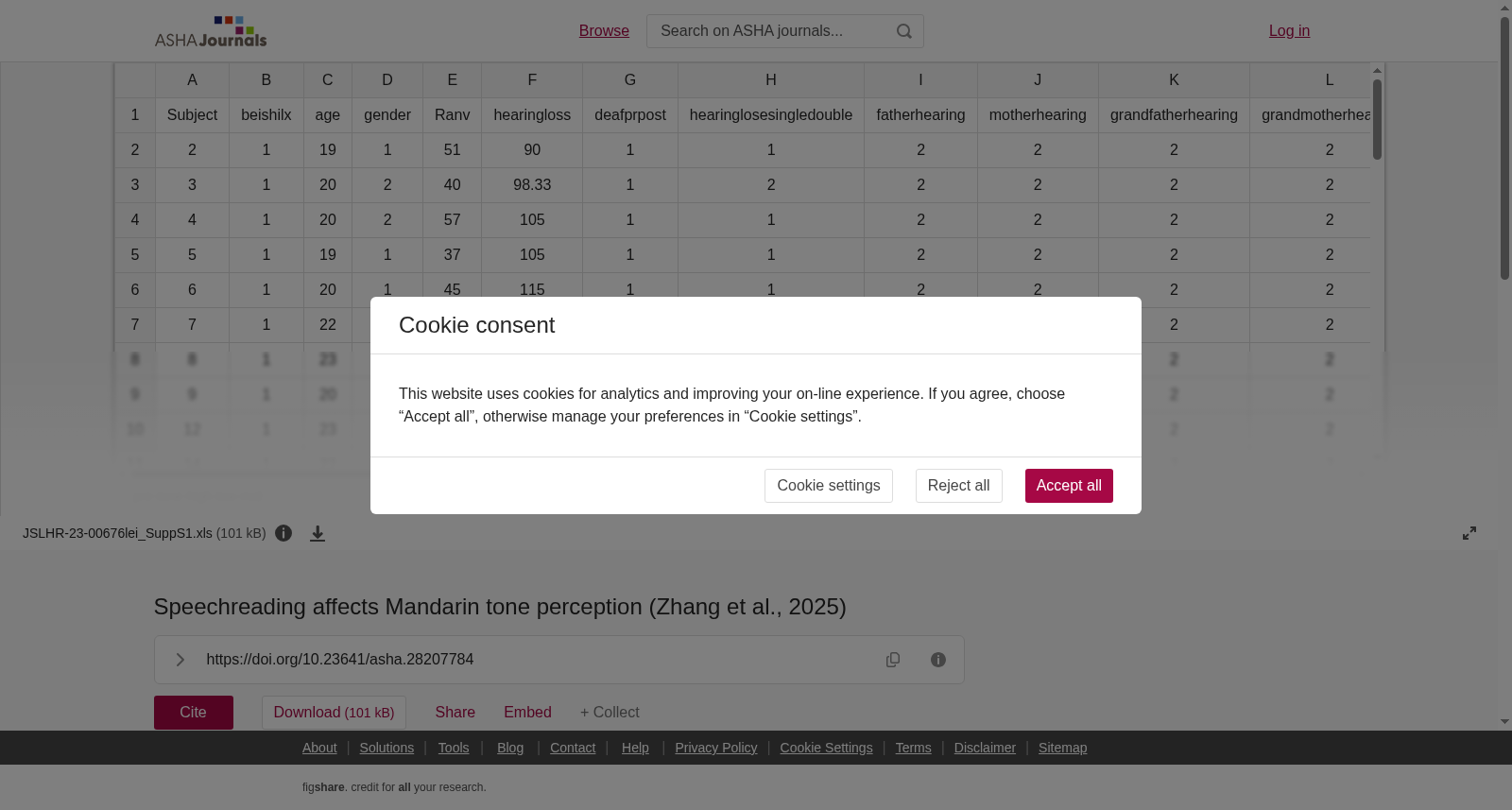
补充材料S1:受试者人口统计学详情
参考文献:张帆, 魏曦, 江晓, 陈丽, 王浩, 雷杰. (2025). 唇读能力影响中国语前听力损伤年轻成人的普通话声调感知. 《言语、语言与听力研究杂志》, 68(2), 654–664. https://doi.org/10.1044/2024_JSLHR-23-00676
提供机构:
ASHA journals创建时间:
2025-01-21
搜集汇总
数据集介绍
以上内容由遇见数据集搜集并总结生成

暂无相关数据集


