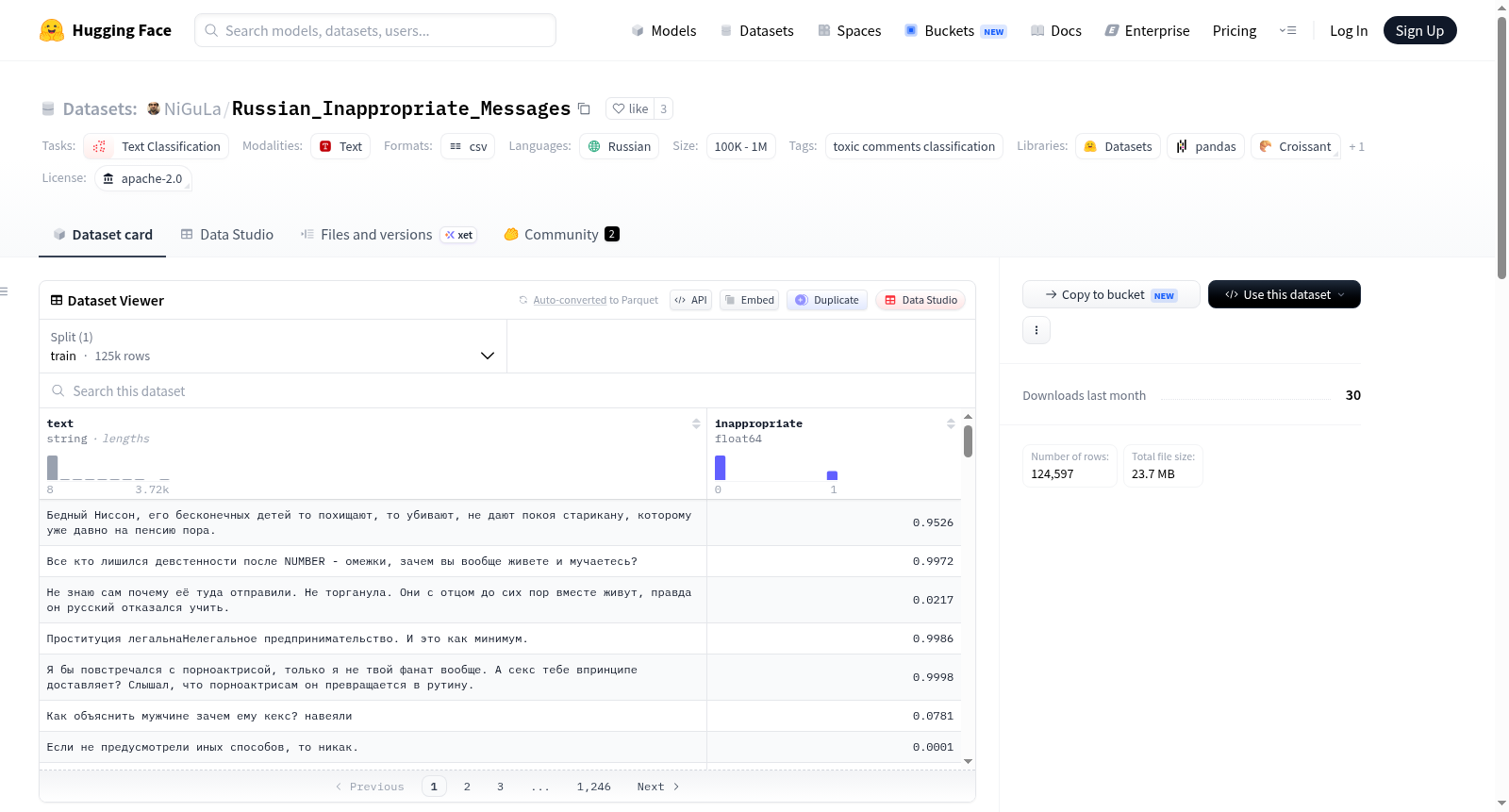
NiGuLa/Russian_Inappropriate_Messages
收藏资源简介:
--- language: - ru tags: - toxic comments classification license: cc task_categories: - text-classification size_categories: - 100K<n<1M --- ## General concept The **'inappropriateness'** substance we tried to collect in the dataset and detect with the model **is NOT a substitution of toxicity**, it is rather a derivative of toxicity. So the model based on our dataset could serve as **an additional layer of inappropriateness filtering after toxicity and obscenity filtration**. You can detect the exact sensitive topic by using [this model](https://huggingface.co/Skoltech/russian-sensitive-topics). Generally, an inappropriate utterance is an utterance that has not obscene words or any kind of toxic intent but can still harm the reputation of the speaker. Find some samples for more intuition in the table below. Learn more about the concept of inappropriateness [in this article ](https://www.aclweb.org/anthology/2021.bsnlp-1.4/) presented at the workshop for Balto-Slavic NLP at the EACL-2021 conference. Please note that this article describes the first version of the dataset, while the model is trained on the extended version of the dataset open-sourced on our [GitHub](https://github.com/skoltech-nlp/inappropriate-sensitive-topics/blob/main/Version2/appropriateness/Appropriateness.csv) or on [kaggle](https://www.kaggle.com/nigula/russianinappropriatemessages). The properties of the dataset are the same as the one described in the article, the only difference is the size. | Text | Inappropriate | Comment | Unsafe topic | |------------------------------------------------------------------------------------------------------|---------------|----------------------------------------------------------------|---------------| | Ладно бы видного деятеля завалили а тут какого то ноунейм нигру преступника | yes | Оправдание убийства | offline crime | | Это нарушение УКРФ! | no | Осуждение нарушения закона | offline crime | | Религия - это насилие высшего уровня. Верующего принуждают к вере еще в младенчестве. | yes | Оскорбление чувств верующих | religion | | Христиане, как вы относитесь к иноверцам, в частности к Гамалиилу и к уверовавшим в Иисуса фарисеям? | no | Обычные вопросы к верующим без намека на оскорбление их чувств | religion | | Хорошо что проституция запрещена | no | Осуждение простуитуции | prostitution | | Возьму бабки и сниму шлюх на выходных | yes | Популяризация проституции | prostitution | ## Licensing Information [Creative Commons Attribution-NonCommercial-ShareAlike 4.0 International License][cc-by-nc-sa]. [![CC BY-NC-SA 4.0][cc-by-nc-sa-image]][cc-by-nc-sa] [cc-by-nc-sa]: http://creativecommons.org/licenses/by-nc-sa/4.0/ [cc-by-nc-sa-image]: https://i.creativecommons.org/l/by-nc-sa/4.0/88x31.png ## Citation If you find this repository helpful, feel free to cite our publication: ``` @inproceedings{babakov-etal-2021-detecting, title = "Detecting Inappropriate Messages on Sensitive Topics that Could Harm a Company{'}s Reputation", author = "Babakov, Nikolay and Logacheva, Varvara and Kozlova, Olga and Semenov, Nikita and Panchenko, Alexander", booktitle = "Proceedings of the 8th Workshop on Balto-Slavic Natural Language Processing", month = apr, year = "2021", address = "Kiyv, Ukraine", publisher = "Association for Computational Linguistics", url = "https://www.aclweb.org/anthology/2021.bsnlp-1.4", pages = "26--36", abstract = "Not all topics are equally {``}flammable{''} in terms of toxicity: a calm discussion of turtles or fishing less often fuels inappropriate toxic dialogues than a discussion of politics or sexual minorities. We define a set of sensitive topics that can yield inappropriate and toxic messages and describe the methodology of collecting and labelling a dataset for appropriateness. While toxicity in user-generated data is well-studied, we aim at defining a more fine-grained notion of inappropriateness. The core of inappropriateness is that it can harm the reputation of a speaker. This is different from toxicity in two respects: (i) inappropriateness is topic-related, and (ii) inappropriate message is not toxic but still unacceptable. We collect and release two datasets for Russian: a topic-labelled dataset and an appropriateness-labelled dataset. We also release pre-trained classification models trained on this data.", } ``` ## Contacts If you have any questions please contact [Nikolay](mailto:bbkhse@gmail.com)
--- 语言: - 俄语 标签: - 恶意评论分类(toxic comments classification) 许可协议:cc 任务类别: - 文本分类(text-classification) 数据规模: - 10万<n<100万 --- ## 核心概念 我们在本数据集中收集并拟通过模型检测的**‘不当性(inappropriateness)’**并非“恶意性(toxicity)”的替代概念,而是恶意性的衍生范畴。基于本数据集训练的模型,可作为恶意内容与低俗内容过滤后的**额外不当性过滤层级**。您可通过[该模型](https://huggingface.co/Skoltech/russian-sensitive-topics)识别具体的敏感话题。 一般而言,不当言论指不含低俗词汇或任何恶意意图,但仍可能损害发言者声誉的言论。您可通过下表的示例获得更直观的理解;如需深入了解不当性的概念,可参阅[EACL-2021会议波罗的海-斯拉夫语自然语言处理研讨会](https://www.aclweb.org/anthology/2021.bsnlp-1.4/)上发表的相关论文。 请注意,该论文描述的是本数据集的第一版,而模型训练所用的是扩展版数据集,该扩展版已在我们的[GitHub仓库](https://github.com/skoltech-nlp/inappropriate-sensitive-topics/blob/main/Version2/appropriateness/Appropriateness.csv)或[Kaggle平台](https://www.kaggle.com/nigula/russianinappropriatemessages)上开源。本数据集的属性与论文中描述的版本完全一致,唯一差异在于数据规模。 | 文本 | 是否不当 | 备注 | 敏感话题类别 | |------------------------------------------------------------------------------------------------------|---------------|----------------------------------------------------------------|---------------| | 就算把知名人士拉下马也就算了,可这次却是个无名小卒的黑人罪犯 | 是 | 为谋杀辩解 | 线下犯罪 | | 这是违反俄罗斯联邦刑法的行为! | 否 | 对违法行为的合法谴责 | 线下犯罪 | | 宗教是最高级别的暴力。信徒在婴儿时期就被强迫信仰宗教。 | 是 | 伤害信徒的宗教情感 | 宗教 | | 基督徒们,你们如何看待其他信仰者,尤其是迦玛列和信奉耶稣的法利赛人? | 否 | 向信徒提出的普通问题,未暗示伤害其宗教情感 | 宗教 | | 幸好卖淫是被禁止的 | 否 | 对卖淫行为的谴责 | 卖淫 | | 周末我要找些姑娘,找个妓女玩玩 | 是 | 宣扬卖淫行为 | 卖淫 | ## 许可信息 [知识共享署名-非商业性使用-相同方式共享4.0国际许可协议(Creative Commons Attribution-NonCommercial-ShareAlike 4.0 International License)][cc-by-nc-sa]. [![CC BY-NC-SA 4.0][cc-by-nc-sa-image]][cc-by-nc-sa] [cc-by-nc-sa]: http://creativecommons.org/licenses/by-nc-sa/4.0/ [cc-by-nc-sa-image]: https://i.creativecommons.org/l/by-nc-sa/4.0/88x31.png ## 引用信息 若您认为本仓库的内容对您的研究有所帮助,可引用我们的论文: @inproceedings{babakov-etal-2021-detecting, title = "Detecting Inappropriate Messages on Sensitive Topics that Could Harm a Company{'}s Reputation", author = "Babakov, Nikolay and Logacheva, Varvara and Kozlova, Olga and Semenov, Nikita and Panchenko, Alexander", booktitle = "Proceedings of the 8th Workshop on Balto-Slavic Natural Language Processing", month = apr, year = "2021", address = "Kiyv, Ukraine", publisher = "Association for Computational Linguistics", url = "https://www.aclweb.org/anthology/2021.bsnlp-1.4", pages = "26--36", abstract = "Not all topics are equally ``flammable`` in terms of toxicity: a calm discussion of turtles or fishing less often fuels inappropriate toxic dialogues than a discussion of politics or sexual minorities. We define a set of sensitive topics that can yield inappropriate and toxic messages and describe the methodology of collecting and labelling a dataset for appropriateness. While toxicity in user-generated data is well-studied, we aim at defining a more fine-grained notion of inappropriateness. The core of inappropriateness is that it can harm the reputation of a speaker. This is different from toxicity in two respects: (i) inappropriateness is topic-related, and (ii) inappropriate message is not toxic but still unacceptable. We collect and release two datasets for Russian: a topic-labelled dataset and an appropriateness-labelled dataset. We also release pre-trained classification models trained on this data.", } ## 联系方式 如有任何疑问,请联系[尼古拉(Nikolay)](mailto:bbkhse@gmail.com)
数据集概述
数据集名称
- 未明确提供数据集的具体名称。
数据集内容
- 该数据集专注于收集和检测“不适当”内容,这些内容并非直接的毒性或淫秽,而是毒性的衍生。
- 数据集用于训练模型,该模型作为毒性和淫秽过滤后的额外不适当内容过滤层。
- 数据集包含一系列敏感话题的不适当言论样本,如宗教、犯罪、性交易等。
数据集特点
- 数据集中的不适当言论不包含淫秽词汇或明显的毒性意图,但仍可能损害发言者的声誉。
- 数据集的扩展版本已开源,可在GitHub或Kaggle上获取。
数据集使用
- 用户可以通过使用特定的模型来检测具体的敏感话题。
- 数据集适用于文本分类任务。
数据集规模
- 数据集大小介于10万到100万之间。
语言
- 数据集主要使用俄语。
许可证
引用信息
-
如需引用,请参考以下出版物:
@inproceedings{babakov-etal-2021-detecting, title = "Detecting Inappropriate Messages on Sensitive Topics that Could Harm a Company{}s Reputation", author = "Babakov, Nikolay and Logacheva, Varvara and Kozlova, Olga and Semenov, Nikita and Panchenko, Alexander", booktitle = "Proceedings of the 8th Workshop on Balto-Slavic Natural Language Processing", month = apr, year = "2021", address = "Kiyv, Ukraine", publisher = "Association for Computational Linguistics", url = "https://www.aclweb.org/anthology/2021.bsnlp-1.4", pages = "26--36", abstract = "Not all topics are equally {``}flammable{} in terms of toxicity: a calm discussion of turtles or fishing less often fuels inappropriate toxic dialogues than a discussion of politics or sexual minorities. We define a set of sensitive topics that can yield inappropriate and toxic messages and describe the methodology of collecting and labelling a dataset for appropriateness. While toxicity in user-generated data is well-studied, we aim at defining a more fine-grained notion of inappropriateness. The core of inappropriateness is that it can harm the reputation of a speaker. This is different from toxicity in two respects: (i) inappropriateness is topic-related, and (ii) inappropriate message is not toxic but still unacceptable. We collect and release two datasets for Russian: a topic-labelled dataset and an appropriateness-labelled dataset. We also release pre-trained classification models trained on this data.", }
联系方式
- 如有疑问,请联系Nikolay。