
2013-2020年喜马拉雅山中段和东段Landsat 8积雪覆盖范围数据
收藏www.doi.org2025-03-25 收录
下载链接:
https://www.doi.org/10.11922/sciencedb.j00001.00369
下载链接
链接失效反馈官方服务:
资源简介:
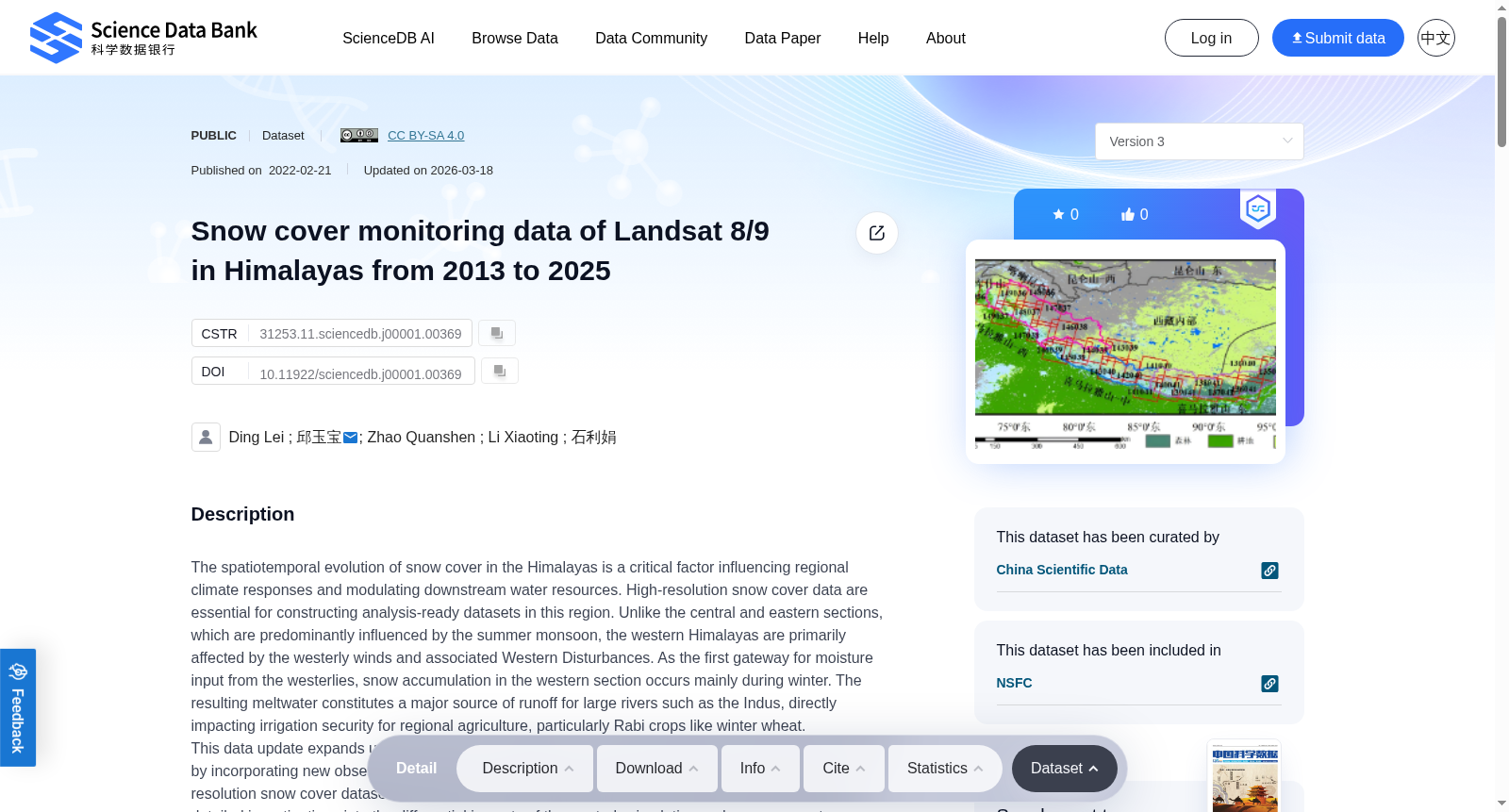
Located on the southern edge of the Tibetan Plateau, the Himalayas are the highest mountains in the world, and their snow cover and its changes affect the regional climate, water resources and ecological environment. In order to better understand the changes of snow cover in this area and overcome the problems of insufficient detailed description of snow cover monitoring in mountainous areas with complex terrain by medium and low resolution remote sensing, snow cover monitoring was carried out using Landsat 8 clear sky condition data with a spatial resolution of 30m. Due to the complex terrain of the mountainous area, in view of the general overestimation problem of the normalized snow cover index method in the Himalayas, the support vector machine (SVM) classification method is used to select the snow cover characteristic training samples of different terrain, shadow and other conditions on a scene-by-scene basis for snow accumulation. Classification, combined with auxiliary data such as glacial lakes, surface water bodies and other auxiliary data and spatial neighborhood analysis for data post-processing, a 30m-resolution snow cover dataset was constructed in the middle and eastern sections of the Himalayas from 2013 to 2020. By comparing the high-resolution snow cover classification of Sentinel-2, within a grid of 900*900m, the correlation coefficient of snow cover rate is above 0.95, and the root mean square error is about 0.1%. The snow cover identification results constructed by the two are as follows better consistency. The snow cover data set includes a total of 607 snow cover data covering the central and eastern sections of the Himalayas for 8 years, mainly distributed in the winter snow season from October of the current year to April of the following year. This dataset can provide a basis for verification and optimization of snow cover spatiotemporal and characteristic analysis, and low- and medium-resolution snow cover data, and provide support for studies on climate change, water resources management, and ecological benefits in the Himalayas and downstream regions.
坐落于青藏高原的南缘,喜马拉雅山脉是世界上最高的山脉,其积雪覆盖及其变化影响着区域气候、水资源和生态环境。为了更深入地理解该地区积雪覆盖的变化,并克服由中低分辨率遥感在复杂地形山区积雪监测中描述不够详细的问题,本研究利用Landsat 8晴空条件下的数据,以30米的空间分辨率进行了积雪监测。鉴于喜马拉雅山脉地形复杂,且该地区归一化积雪指数方法普遍存在高估问题,本研究采用支持向量机(SVM)分类方法,基于场景对积雪覆盖特征训练样本进行选取,考虑不同地形、阴影等条件进行积雪累积分类。结合冰川湖泊、地表水体等辅助数据,以及空间邻域分析进行数据后处理,构建了2013年至2020年间喜马拉雅山脉中东部地区的30米分辨率积雪数据集。通过与Sentinel-2高分辨率积雪分类的比较,在900*900米的网格内,积雪覆盖率的关联系数超过0.95,均方根误差约为0.1%,两种方法构建的积雪识别结果具有更高的一致性。该积雪数据集包含607个覆盖喜马拉雅山脉中东部地区8年的积雪数据,主要分布在本年度10月至下一年度4月的冬季积雪季节。本数据集可为积雪时空特征分析和低中分辨率积雪数据的验证与优化提供依据,并为喜马拉雅山脉及其下游地区的气候变化、水资源管理和生态效益研究提供支持。
提供机构:
www.doi.org
搜集汇总
数据集介绍
背景与挑战
背景概述
该数据集提供了2013-2025年喜马拉雅山中段和东段的高分辨率积雪覆盖范围数据,采用SVM分类方法并经过严格质量控制,特别扩展了西喜马拉雅地区和近年来的Landsat 8/9影像数据。这些数据对于研究喜马拉雅地区积雪时空演变及其对区域气候和水资源的影响具有重要意义。
以上内容由遇见数据集搜集并总结生成


