Diabetes Recipe Suitability Dataset
收藏资源简介:
该数据集名为Diabetes Recipe Suitability Dataset,由南卡罗来纳大学·人工智能研究所创建,旨在评估大型语言模型对食谱是否适合糖尿病患者的分析能力。数据集包含7607条食谱,其中3807条来自MayoClinic、Diabetes UK等权威医学来源的糖尿病适宜食谱,另外3800条基于Recipe1M数据集通过关键词筛选得到的不适宜食谱。数据集构建过程严谨,首先收集医学网站推荐的糖尿病食谱,然后依据糖尿病饮食指南中的禁忌关键词(如高糖、高饱和脂肪食物)从Recipe1M中检索并随机选取等量非适宜食谱。该数据集主要用于研究LLMs在医学知识检索、概念理解和演绎推理方面的能力,以支持糖尿病膳食管理的人工智能应用。
This dataset, named Diabetes Recipe Suitability Dataset, was developed by the Artificial Intelligence Institute of the University of South Carolina. Its core purpose is to evaluate the analytical capabilities of Large Language Models (LLMs) to assess whether recipes are suitable for diabetes patients. The dataset contains a total of 7,607 recipes: 3,807 are diabetes-appropriate recipes sourced from authoritative medical resources including Mayo Clinic and Diabetes UK, while the remaining 3,800 are inappropriate recipes randomly selected from the Recipe1M dataset via keyword filtering. The dataset was constructed through a rigorous workflow: first, recipes recommended for diabetes patients by medical websites were collected; then, an equal number of non-suitable recipes were retrieved and randomly selected from the Recipe1M dataset based on taboo keywords specified in diabetes dietary guidelines, such as terms associated with high-sugar or high-saturated-fat foods. This dataset is primarily utilized to study the capabilities of LLMs in medical knowledge retrieval, conceptual understanding and deductive reasoning, thereby supporting AI-powered applications for diabetes dietary management.
数据集概述
基本信息
- 数据集名称: LLMs-Diabetes-Recipes
- 任务目标: 评估大型语言模型(LLMs)判断食谱是否适合糖尿病患者食用的能力
- 数据规模: 共 7,607 条食谱(类别均衡)
- 作者: Revathy Venkataramanan, Aditya Luthra, Venkatesan Nadimuthu, Amit Sheth
- 机构: 美国南卡罗来纳大学 AI 研究所
数据构成
| 列名 | 描述 |
|---|---|
Title |
食谱标题 |
Ingredients |
食材列表(逗号分隔) |
Instructions |
制作步骤 |
Safe_for_Diabetes |
真实标签 — YES(适合)或 NO(不适合) |
类别分布:
- 3,807 条适合糖尿病的食谱,来源为 MayoClinic、Diabetes UK、Diabetes Food Hub 等医学来源。
- 3,800 条不适合的食谱,通过关键词检索 Recipe1M 数据集(如 ribs、bacon、sausage 等 MayoClinic 建议避免的词汇)并随机抽样,以实现类别平衡。
评估方法
每条食谱使用三种提示方式逐一评估,逐步增加膳食指南上下文:
- Direct Query Prompt (Prompt-1) — 单行问题,完全依赖模型内部知识。
- Context-Guided Prompt (Prompt-2) — 加入糖尿病膳食指南(推荐与避免食品),要求模型基于关键词推理。
- Exemplary Context Prompt (Prompt-3) — 在 Prompt-2 基础上,为每个膳食概念提供具体示例。
评估模型: Mistral (7B, 12B)、Gemma2 (2B, 9B, 27B)、Llama (3.1 8B, 3.1 70B, 3.2 2B)、ChatGPT-3.5
主要结果
- 整体表现: 多数模型在判断食谱是否适合糖尿病时趋于保守,即倾向于将食谱标记为“不适合”,以避免将有害食谱误判为安全的风险。
- 性能最优模型: Mistral-7B 和 Llama3.1-70B 在准确率、精确率和召回率综合表现最佳且最稳定。例如:
- Mistral 7B 在 Prompt-1 下准确率达 0.84,召回率 0.84。
- Llama3.1 70B 在 Prompt-2 下准确率 0.83,召回率 0.72;在 Prompt-3 下准确率 0.85,召回率 0.79。
- 推理能力与表现正相关: 能在推理中应用更多膳食指南关键词的模型,其 F1 分数和稳定性更高。
- 模型规模并非决定性因素: 较小模型(如 Mistral-7B)与较大模型(如 Llama3.1-70B)均表现突出,而 ChatGPT-3.5 在 Prompt-2 场景下因外部指南与内部知识冲突而出现不稳定。
附加信息
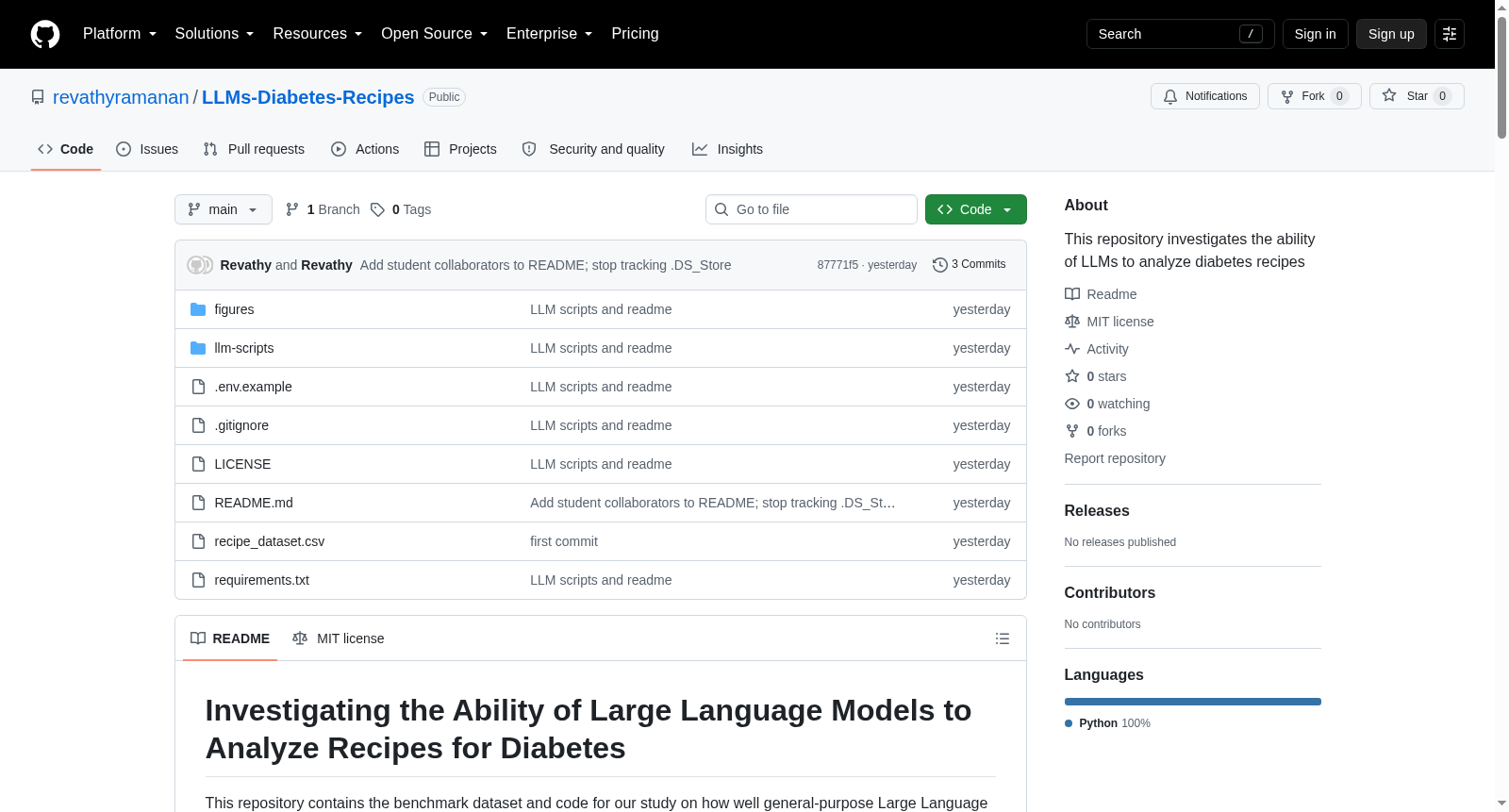
- 文件结构: 数据文件为
recipe_dataset.csv;图表存放于figures/目录。 - Citation: Venkataramanan et al., 2025。
- 许可证: 代码采用 MIT 许可证;数据集仅限非商业研究用途,底层医疗来源和 Recipe1M 数据集保留其原始使用条款。
- 免责声明: 本工作为研究基准,非医学建议,不可用于实际饮食或临床决策。