Otolith morphology reveals ontogenetic complexity during early life history in the sand goby, <i>Pomatoschistus minutus</i>
收藏资源简介:
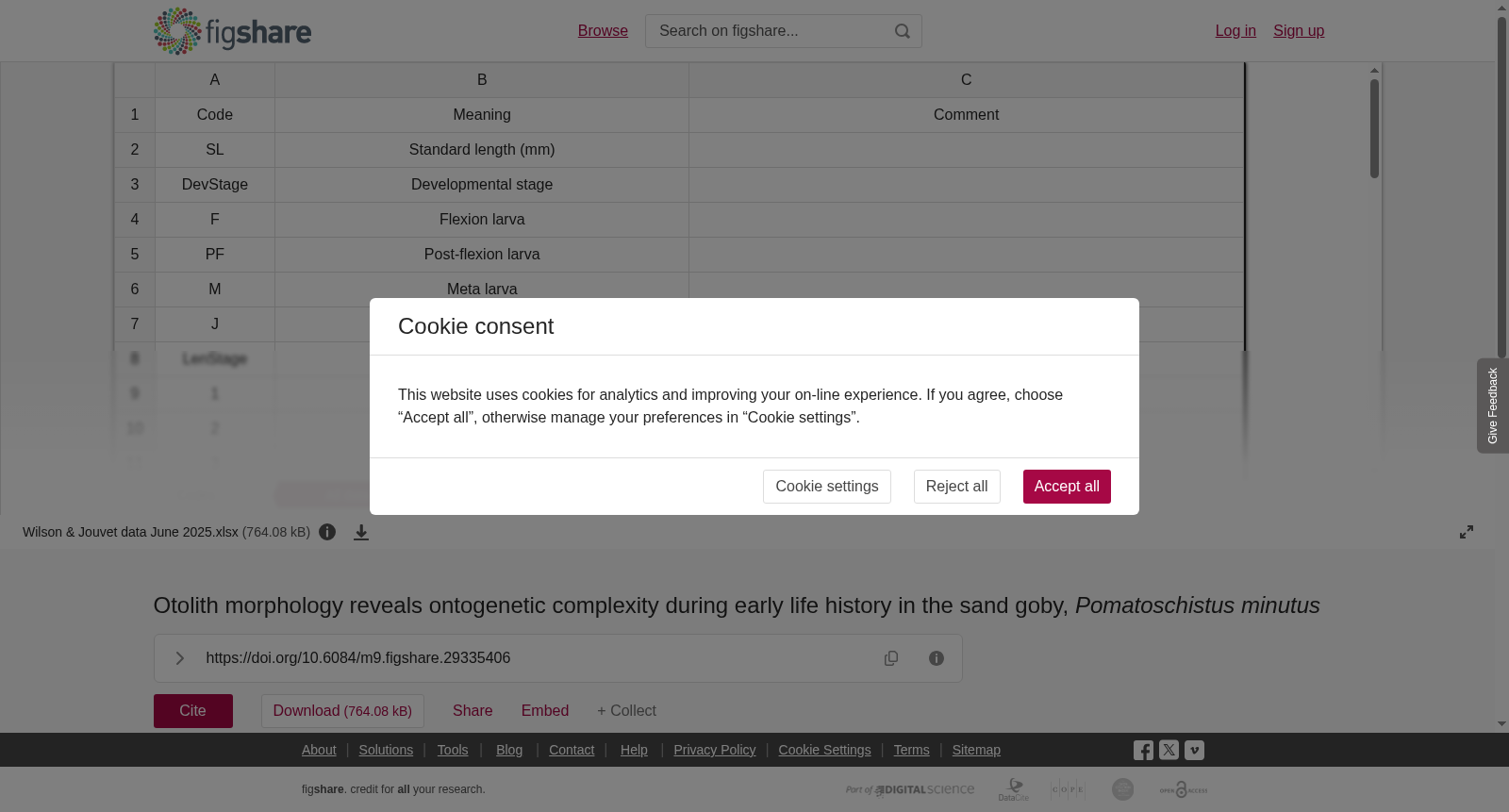
We examined variation in the size and shape of sagittal otoliths from flexion larvae to post-settlement juveniles in the sand goby, <i>Pomatoschistus minutus</i> (Pallas, 1770). Sand gobies obtain their scalation and fins by around 10 mm standard length (SL), followed by a protracted pelagic interval before settlement at 16-18 mm SL. Using image analysis, we investigated whether these life-history transitions were associated with shifts in otolith size, shape, and growth. The image analysis freeware ImageJ Version 1.54 was used to obtain size and shape data from each otolith. Statistical analyses were undertaken using SPSS version 29 (univariate analyses) while multivariate analyses were undertaken using PRIMER version 7.The data file is divided into six worksheets: (1) a list and explanation of all codes; (2) a copy of the full raw data set; (3) means calculated for individual fish; (4) calculations of lateral symmetry within an otolith pair; (5) raw output from the ImageJ software for each otolith; and (6) conversion scales used to obtain metric data from pixel measurements for each otolith.
本研究以小眼沙𫚥虎(*Pomatoschistus minutus*,Pallas, 1770)为对象,分析其从屈曲期幼体至定居后稚鱼的矢状耳石(sagittal otolith)大小与形态变异情况。沙𫚥虎在标准体长(standard length, SL)约10 mm时完成鳞片与鳍的发育,随后进入漫长的浮游阶段,直至体长16~18 mm SL时完成底栖定居。本研究采用图像分析法,探究上述生活史转变是否与耳石大小、形态及生长的变化存在关联。本研究使用图像分析免费软件ImageJ 1.54版,从每一枚耳石中获取大小与形态数据。统计分析环节,单变量分析采用SPSS 29版,多元分析则采用PRIMER 7版。本数据集文件分为6个工作表:(1) 所有编码的列表及说明;(2) 完整原始数据集副本;(3) 单尾个体鱼的计算均值;(4) 耳石对的侧向对称性计算结果;(5) 每枚耳石的ImageJ软件原始输出结果;(6) 用于将每枚耳石的像素测量值转换为度量数据的换算标尺。