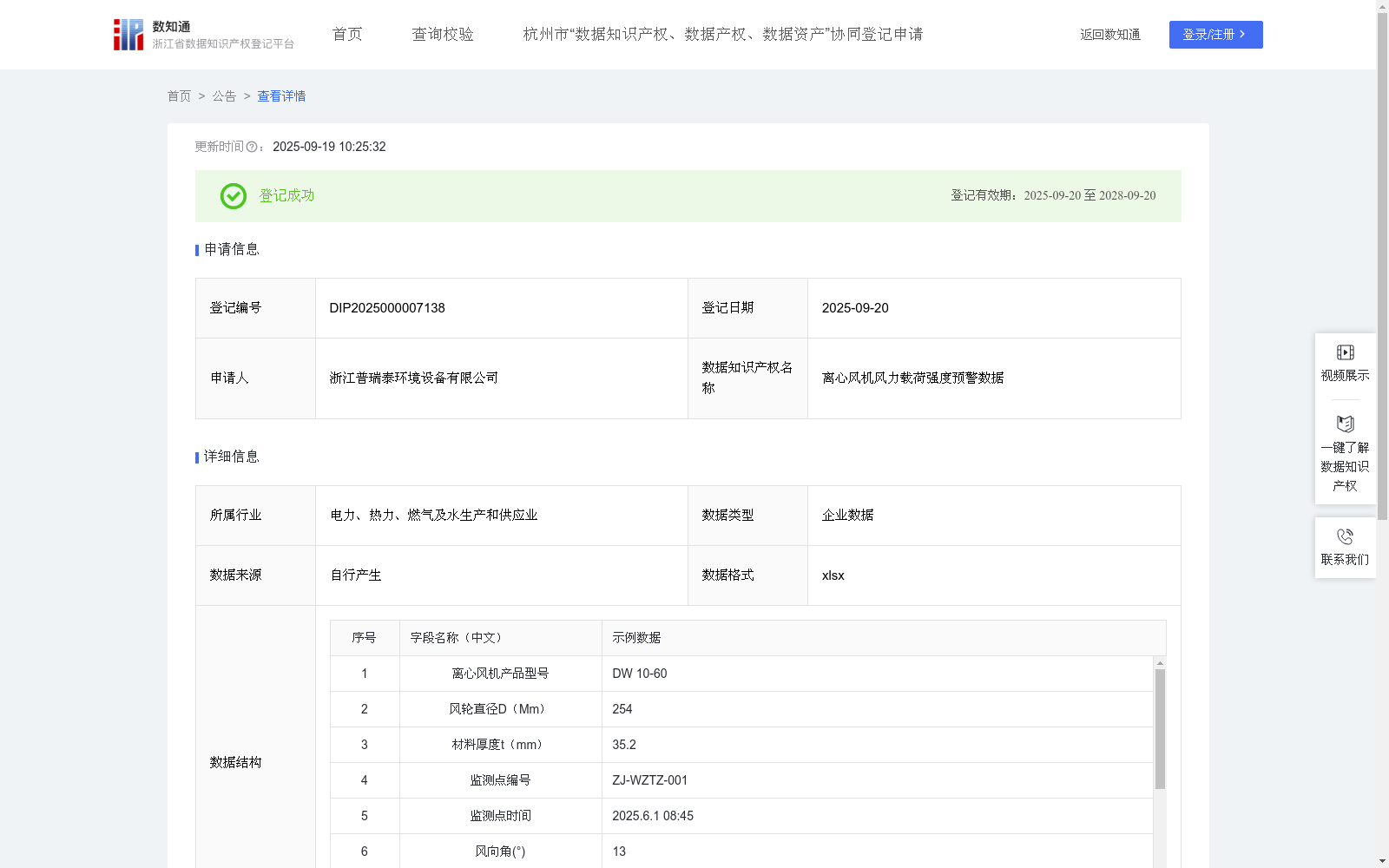
离心风机风力载荷强度预警数据
收藏资源简介:
通过对离心风机风力载荷检测,来保证离心风机的平稳安全运行,避免因荷载超负荷导致的事故,确保离心风机的使用寿命和结构安全,为系统优化和施工提供重要依据。例如对运行状态中的离心风机,通过每15分钟采集1次空气密度、叶轮面等效风速等情况)计算周期性风力载荷数据构建动态风力载荷模型,有以下作用:预测极端风况(如风速>25m/s)下的应力结构失效风险(如风力载荷大于载荷设计值),提前2至5小时触发停机指令,降低风险;利用本数据集合,预测风轮疲劳损伤风险,提前规划备件更换周期,减少非计划停机损失。1数据采集:针对不同型号的离心风机在工作状态时,通过监测点每15分钟采集原始数据,可以得到此时的空气密度、叶轮面等效风速等情况。2数据计算:根据应力公式:σmax=K*ρ*(v^2)*{(D/t) ^1.5},可以进一步计算得出此时的离心风机受到的风力载荷数值,风力载荷数值达到离心风机载荷设计值(30N/㎡)的80%则发送二级预警信号,风力载荷数值达到设计标准的90%则发送一级预警信号,否则预警情况为否,由此我们可以评估此时离心风机的运行安全情况,减少事故情况的发生。另外将历史计算数据(>20万条)打包为“离心风机风速-载荷强度“数据库 ,从而可构建可视化的“风力-载荷”机器学习模型。
Centrifugal fan wind load detection is conducted to ensure stable and safe operation of centrifugal fans, avoid overload-induced accidents, guarantee their service life and structural safety, and provide an important basis for system optimization and construction. For example, for operating centrifugal fans, collect data such as air density and equivalent wind speed at the impeller surface once every 15 minutes, calculate periodic wind load data to build a dynamic wind load model, which has the following functions: predicting structural stress failure risks under extreme wind conditions (e.g., wind speed >25 m/s, such as when wind load exceeds the design load value), triggering shutdown instructions 2 to 5 hours in advance to reduce risks; using this dataset to predict impeller fatigue damage risks, plan spare parts replacement cycles in advance, and reduce losses from unplanned shutdowns. 1. Data Collection: For centrifugal fans of different models under operating conditions, collect raw data every 15 minutes via monitoring points to obtain real-time air density, equivalent wind speed at the impeller surface, and other relevant parameters. 2. Data Calculation: Calculate the wind load acting on the centrifugal fan using the stress formula: σ_max = K·ρ·v²·(D/t)^1.5. When the wind load value reaches 80% of the centrifugal fan's design load (30 N/㎡), a secondary warning signal is sent; when it reaches 90% of the design standard, a primary warning signal is sent; otherwise, no warning is triggered. In this way, the operating safety status of the centrifugal fan can be evaluated to reduce the occurrence of accidents. In addition, package the historical calculated data (over 200,000 entries) into the "Centrifugal Fan Wind Speed-Load Strength" database, thereby enabling the construction of a visualized "Wind Load-Load Strength" machine learning model.