
Supporting Data for “<b>Riverine modulation of volatile sulfur compound distributions: A case study in the Bohai and Yellow Seas</b>”
收藏DataCite Commons2025-06-22 更新2025-09-08 收录
下载链接:
https://figshare.com/articles/dataset/Supporting_Data_for_b_Riverine_modulation_of_volatile_sulfur_compound_distributions_A_case_study_in_the_Bohai_and_Yellow_Seas_b_/29377307
下载链接
链接失效反馈官方服务:
资源简介:
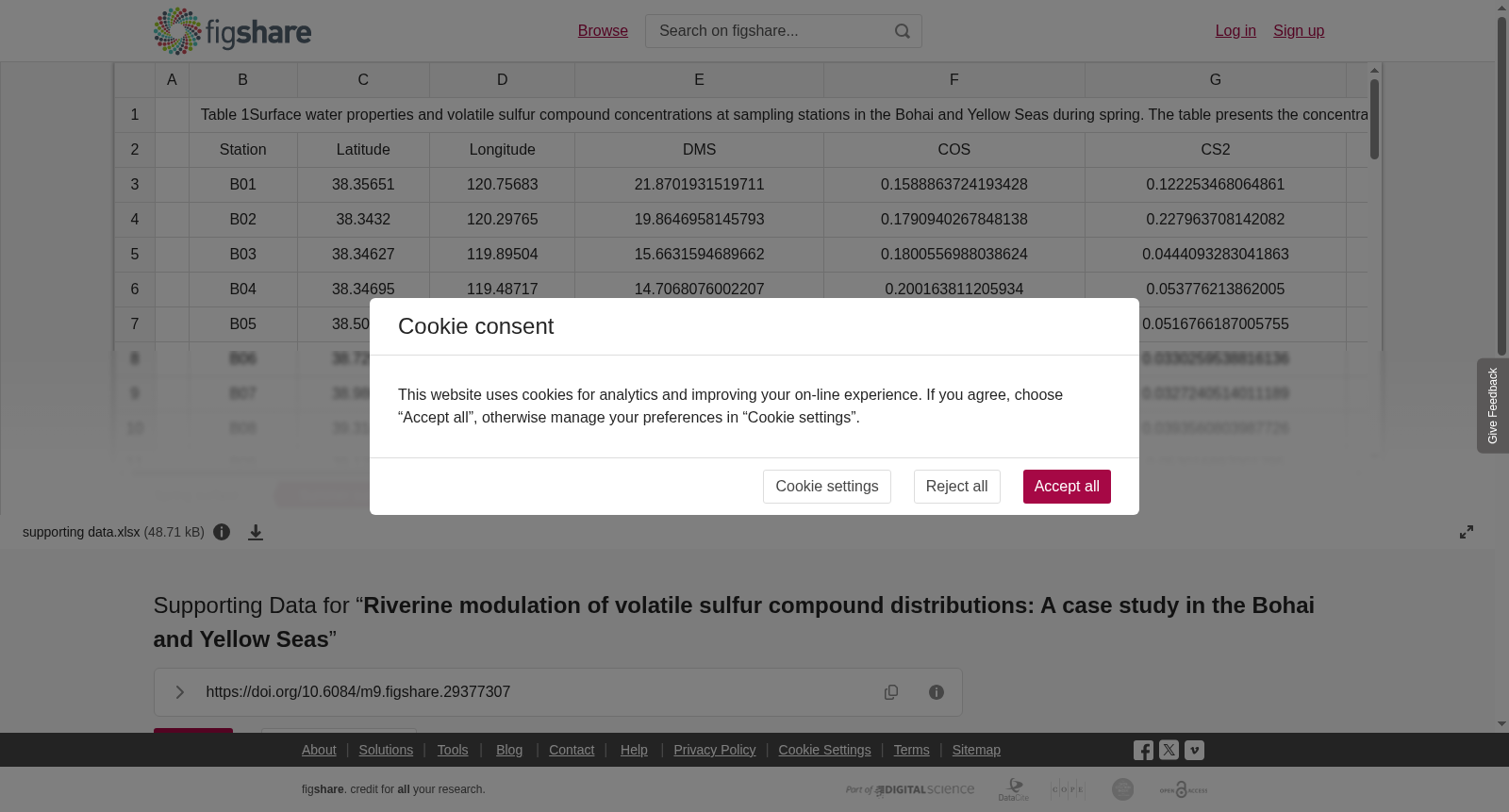
Volatile sulfur compounds (VSCs), including dimethyl sulfide (DMS), carbonyl sulfide (COS), and carbon disulfide (CS<sub>2</sub>), play key roles in atmospheric chemistry and climate regulation Although riverine inputs theoretically promote VSCs production by supplying nutrients and chromophoric dissolved organic matter (CDOM), unexpectedly low VSCs concentrations are frequently observed in estuarine waters, suggesting the presence of additional limiting factors that remain poorly understood. In this study, concentrations of DMS, COS, and CS<sub>2</sub> were quantified in surface waters, vertical profiles, and the overlying atmosphere of the Bohai and Yellow Seas during spring and summer 2024. Average surface concentrations of DMS, COS, and CS<sub>2</sub> were 6.3, 0.11, and 0.09 nmol L<sup>-1</sup> in spring, increasing to 9.7, 0.35, and 0.19 nmol L<sup>-1</sup> in summer. DMS showed strong positive correlation with chlorophyll-<i>a</i>, while COS correlated with CDOM. Riverine inputs of nutrients and CDOM from the Yellow River enhanced VSCs production, although elevated turbidity limited light availability and thus suppressed biological and photochemical pathways. Atmospheric mixing ratios in spring averaged 61.1, 408.7, and 105.5 pptv for DMS, COS, and CS<sub>2</sub>, respectively. Sea-to-air flux measurements demonstrated that DMS was the dominant contributor to atmospheric sulfur in the study region, with fluxes of 5.4 µmol m<sup>-2</sup> d<sup>-1</sup> in spring and increasing to 15.0 µmol m<sup>-2</sup> d<sup>-1</sup> in summer. By contrast, COS and CS<sub>2</sub> contributed smaller but non-negligible sulfur fluxes in spring, averaging 0.6 and 0.4 µmol m<sup>-2</sup> d<sup>-1</sup>, respectively. The results underscore the role of coastal marginal seas as active sources of atmospheric VSCs and highlight the critical influence of riverine input in sharping the production and emission of VSCs in coastal region.
挥发性硫化物(Volatile sulfur compounds, VSCs)包括二甲基硫(dimethyl sulfide, DMS)、羰基硫(carbonyl sulfide, COS)与二硫化碳(carbon disulfide, CS₂),在大气化学与气候调控中发挥关键作用。尽管理论上河流输入通过供给营养盐与有色溶解有机物(chromophoric dissolved organic matter, CDOM)可促进VSCs的生成,但河口水体中频繁观测到异常偏低的VSCs浓度,这表明存在尚未被充分认知的额外限制因子。本研究于2024年春夏季,在渤海与黄海的表层水体、垂直剖面及上覆大气中,定量测定了DMS、COS与CS₂的浓度。春季时,DMS、COS与CS₂的表层平均浓度分别为6.3、0.11与0.09纳摩尔每升(nmol L⁻¹),夏季时分别升高至9.7、0.35与0.19纳摩尔每升。DMS与叶绿素a(chlorophyll-a)呈显著正相关,而COS则与CDOM具有相关性。黄河输入的营养盐与CDOM可促进VSCs的生成,但升高的浊度会限制光照可用性,进而抑制生物与光化学过程。春季时,DMS、COS与CS₂的大气体积混合比平均分别为61.1、408.7与105.5万亿分之一体积(pptv)。海-气通量测定结果显示,DMS是研究区域大气硫的主要贡献者,春季通量为5.4微摩尔每平方米每天(µmol m⁻² d⁻¹),夏季升高至15.0微摩尔每平方米每天。相较之下,COS与CS₂在春季的硫通量贡献虽小但不可忽略,平均分别为0.6与0.4微摩尔每平方米每天。本研究结果强调了近岸边缘海作为大气VSCs活跃源的重要性,并揭示了河流输入对近岸区域VSCs生成与排放的关键调控作用。
提供机构:
figshare创建时间:
2025-06-22
搜集汇总
数据集介绍
背景与挑战
背景概述
该数据集为支持性研究数据,聚焦于渤海和黄海区域挥发性硫化物(VSCs,包括DMS、COS和CS2)的分布与河流输入影响。数据量化了2024年春夏季VSCs在表层水、垂直剖面和大气中的浓度,揭示DMS与叶绿素a正相关、COS与CDOM相关,并强调黄河输入促进VSCs生产但受浊度限制;同时,海气通量测量表明DMS是大气硫的主要贡献者,通量在夏季显著增加。
以上内容由遇见数据集搜集并总结生成

暂无相关数据集


