---
annotations_creators:
- no-annotation
language_creators:
- found
language:
- en
license:
- apache-2.0
multilinguality:
- monolingual
size_categories:
- 100K<n<1M
source_datasets:
- original
task_categories:
- summarization
- text-generation
task_ids: []
paperswithcode_id: cnn-daily-mail-1
pretty_name: CNN / Daily Mail
tags:
- conditional-text-generation
---
## Data Summary
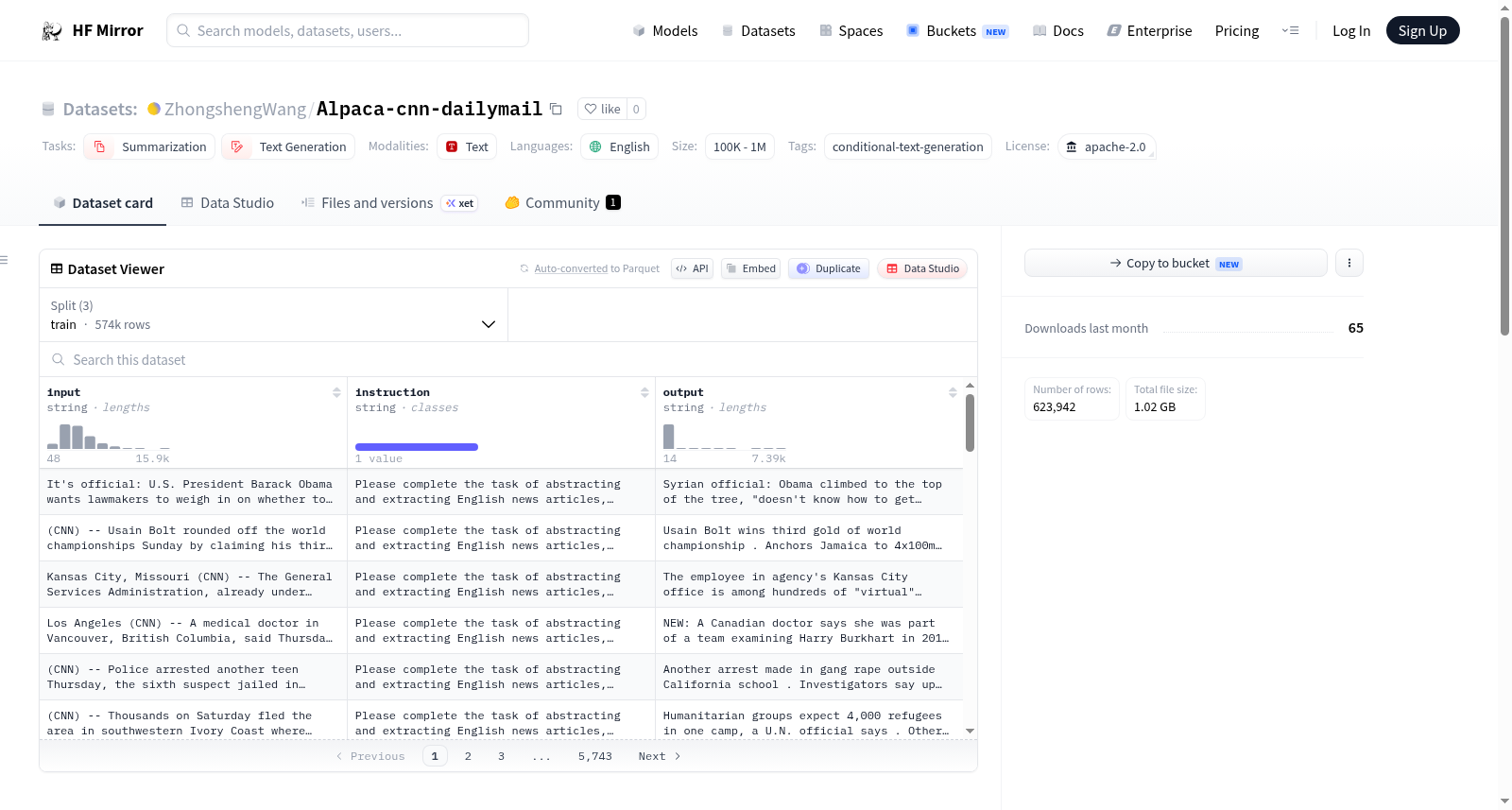
Data set Alpaca-cnn-dailymail is a data set version format changed by [ccdv/cnn_dailymail](https://huggingface.co/datasets/ccdv/cnn_dailymail) to meet Alpaca fine-tuning Llama2. Only versions 3.0.0 and 2.0.0 were used for merging and as a key data set for the summary extraction task.
## Licensing Information
The Alpaca-cnn-dailymail dataset version 1.0.0 is released under the Apache-2.0 License.
## Citation Information
```
@inproceedings{see-etal-2017-get,
title = "Get To The Point: Summarization with Pointer-Generator Networks",
author = "See, Abigail and
Liu, Peter J. and
Manning, Christopher D.",
booktitle = "Proceedings of the 55th Annual Meeting of the Association for Computational Linguistics (Volume 1: Long Papers)",
month = jul,
year = "2017",
address = "Vancouver, Canada",
publisher = "Association for Computational Linguistics",
url = "https://www.aclweb.org/anthology/P17-1099",
doi = "10.18653/v1/P17-1099",
pages = "1073--1083",
abstract = "Neural sequence-to-sequence models have provided a viable new approach for abstractive text summarization (meaning they are not restricted to simply selecting and rearranging passages from the original text). However, these models have two shortcomings: they are liable to reproduce factual details inaccurately, and they tend to repeat themselves. In this work we propose a novel architecture that augments the standard sequence-to-sequence attentional model in two orthogonal ways. First, we use a hybrid pointer-generator network that can copy words from the source text via pointing, which aids accurate reproduction of information, while retaining the ability to produce novel words through the generator. Second, we use coverage to keep track of what has been summarized, which discourages repetition. We apply our model to the CNN / Daily Mail summarization task, outperforming the current abstractive state-of-the-art by at least 2 ROUGE points.",
}
```
```
@inproceedings{DBLP:conf/nips/HermannKGEKSB15,
author={Karl Moritz Hermann and Tomás Kociský and Edward Grefenstette and Lasse Espeholt and Will Kay and Mustafa Suleyman and Phil Blunsom},
title={Teaching Machines to Read and Comprehend},
year={2015},
cdate={1420070400000},
pages={1693-1701},
url={http://papers.nips.cc/paper/5945-teaching-machines-to-read-and-comprehend},
booktitle={NIPS},
crossref={conf/nips/2015}
}
```
注释生成方式:
- 无注释
语言生成方式:
- 现有资源获取(found)
语言:
- 英语(en)
许可证:
- Apache-2.0
多语言属性:
- 单语言(monolingual)
数据规模:
- 100K<n<1M(10万~100万条)
源数据集:
- 原始数据集(original)
任务类别:
- 摘要生成
- 文本生成
任务子类别:
- 无
paperswithcode 编号:cnn-daily-mail-1
展示名称:CNN / 每日邮报(CNN / Daily Mail)
标签:
- 条件文本生成(conditional-text-generation)
## 数据集概述
Alpaca-cnn-dailymail 数据集由 [ccdv/cnn_dailymail](https://huggingface.co/datasets/ccdv/cnn_dailymail) 调整格式而来,适配 Alpaca 微调大语言模型(Large Language Model)Llama2。本次仅使用其2.0.0与3.0.0版本进行合并,并将其作为摘要抽取任务的核心数据集。
## 许可证信息
Alpaca-cnn-dailymail 数据集的1.0.0版本采用 Apache-2.0 许可证发布。
## 引用信息
@inproceedings{see-etal-2017-get,
title = "Get To The Point: Summarization with Pointer-Generator Networks",
author = "See, Abigail and
Liu, Peter J. and
Manning, Christopher D.",
booktitle = "Proceedings of the 55th Annual Meeting of the Association for Computational Linguistics (Volume 1: Long Papers)",
month = jul,
year = "2017",
address = "Vancouver, Canada",
publisher = "Association for Computational Linguistics",
url = "https://www.aclweb.org/anthology/P17-1099",
doi = "10.18653/v1/P17-1099",
pages = "1073--1083",
abstract = "Neural sequence-to-sequence models have provided a viable new approach for abstractive text summarization (meaning they are not restricted to simply selecting and rearranging passages from the original text). However, these models have two shortcomings: they are liable to reproduce factual details inaccurately, and they tend to repeat themselves. In this work we propose a novel architecture that augments the standard sequence-to-sequence attentional model in two orthogonal ways. First, we use a hybrid pointer-generator network that can copy words from the source text via pointing, which aids accurate reproduction of information, while retaining the ability to produce novel words through the generator. Second, we use coverage to keep track of what has been summarized, which discourages repetition. We apply our model to the CNN / Daily Mail summarization task, outperforming the current abstractive state-of-the-art by at least 2 ROUGE points.",
}
@inproceedings{DBLP:conf/nips/HermannKGEKSB15,
author={Karl Moritz Hermann and Tomás Kociský and Edward Grefenstette and Lasse Espeholt and Will Kay and Mustafa Suleyman and Phil Blunsom},
title={Teaching Machines to Read and Comprehend},
year={2015},
cdate={1420070400000},
pages={1693-1701},
url={http://papers.nips.cc/paper/5945-teaching-machines-to-read-and-comprehend},
booktitle={NIPS},
crossref={conf/nips/2015}
}