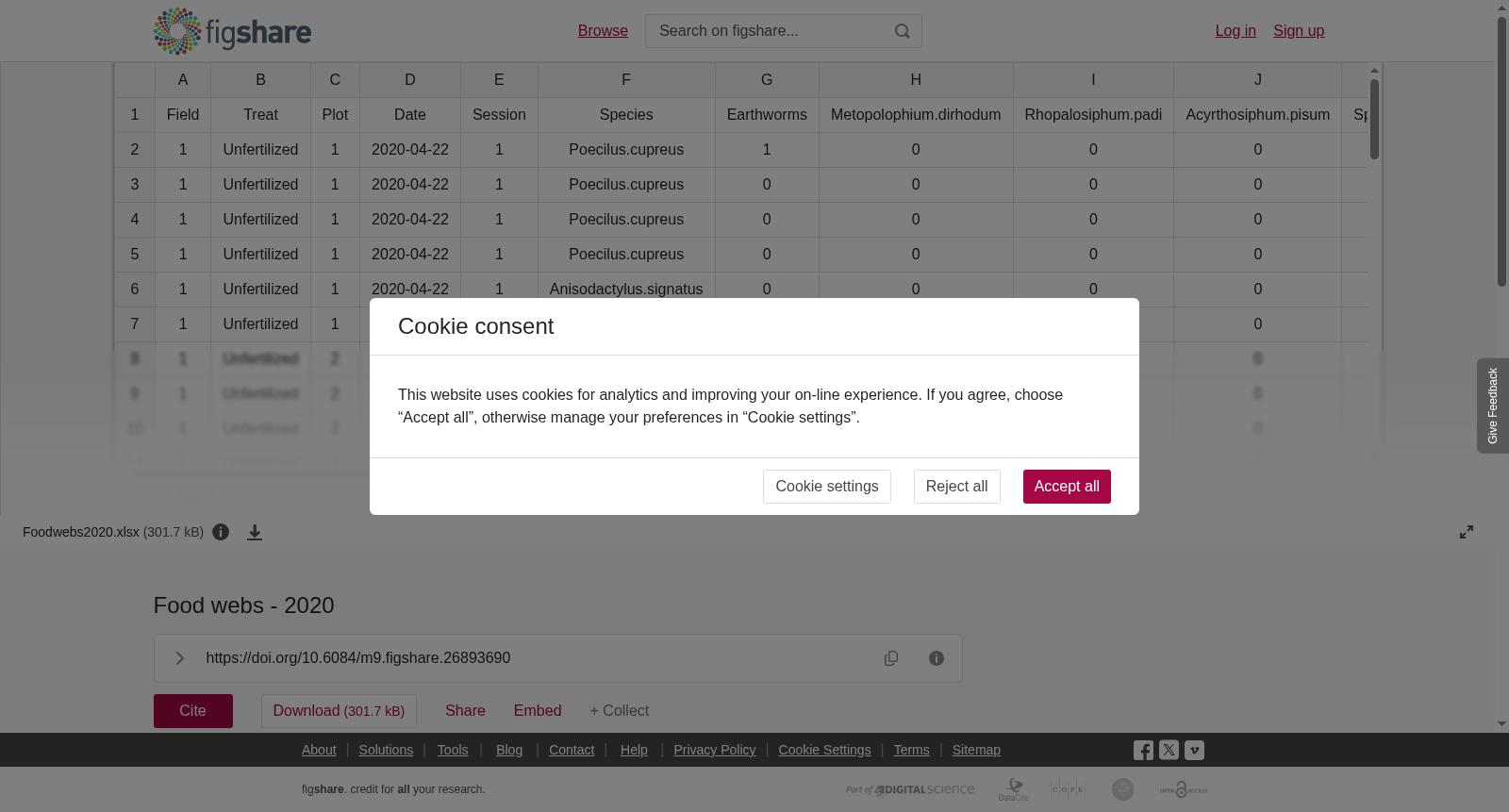
Food webs - 2020
收藏资源简介:
Sampling was conducted in Kematen in Tirol, Austria, where spring barley (Hordeum vulgare L.) was grown in six fields that have had organic management for the past ten years, three in 2020 and 2021, respectively. Each field was split in half, one side being fertilized with manure and the other remaining unfertilized, as a negative control. The manure treatment was independently applied by each field’s respective owner, at a standard rate of 1.5 metric tons (1 500kg) per hectare, using manure spreaders, after tilling and pressing the soil. Four 5x5m plots per treatment were delimited, to carry out all sampling. These plots had no barriers or fences surrounding them that would impede or limit movement between the inside of the plots and the rest of the field area. Additionally, the plots were at least 5m from the field edge, to avoid edge effects. They were at least 10m way from each other along the field’s width, and between 15 to 20m along the length of the field. To avoid any spillover of treatment effects, plots were set at least 25m away from the border between the two treatments within the same field.Sampling was conducted every two weeks, with one week of sampling and one of rest. The sampling period started on the 21st of April and ended on the 14th of July in 2020, while it started on the 3rd of May and ended on the 16th of July in 2021, to encompass almost the entire crop season. This resulted in seven sampling time points for the first year and six for the second.A total of 2404 ground beetles, 913 rove beetles and 567 spiders were captured in 2020, and 1977 ground beetles, 891 rove beetles and 250 spiders in 2021. The beetles’ gut content and the spiders’ full bodies were extracted with a BioSprint 96 DNA Blood Kit (Qiagen, Hilden, Germany) on a QIAGEN Biosprint96® workstation for automated DNA extraction, following the manufacturer’s recommendations. After extraction, three different multiplex-PCR assays were run per sample. The first assay targeted several herbivore and detritivore taxa (assay in Rennstam Rubbmark et al. 2019), the second targeted generalist and specialist predators, such as spiders and ladybeetles, as intra- and extraguild predation (primers from Sint et al. 2014 and Staudacher et al. 2016). Lastly the third assay identified the genus of beetles consumed, also as intraguild predation, from a selected set of common taxa consisting of Bembidion spp., Harpalus spp., Poecilus spp., Pterostichus spp., Philonthus carbonarius and Philonthus cognatus. The intraguild interactions, and implications on competition, have been analysed in greater detail elsewhere (Leote et al. 2024).<br>Following Rennstam Rubbmark et al. (2019) a diagnostic multiplex-PCR was chosen over metabarcoding, as our regurgitate samples contain not only different amounts of DNA from several food sources, but also a lot of consumer DNA. This drastically lowers the detection of food DNA, as the primers targeting consumed taxa also bind to the taxonomically closely related consumer. Therefore, to ensure a more reliable and robust consumed DNA detection, we employed the three PCR assays described above and in the supplementary tables.After the multiplex-PCRs, the samples were screened using capillary electrophoresis on an QIAxcel Advanced system and the ScreenGel software, with a DNA Screening Kit (2400) using a 15-3k base pair alignment marker, following the manufacturer’s recommendations. The screening profile on ScreenGel was set to the standard AM320 method, with the relative fluorescence units (RFU) detection threshold defined at 0.07, as opposed to the default 0.1, to account for the fact the samples were extracted from gut content and thus partially digested.
采样工作于奥地利蒂罗尔州克马滕(Kematen in Tirol)开展,试验共设置6块连续10年采用有机种植管理的田块,2020年、2021年各3块,种植作物为春大麦(Hordeum vulgare L.)。每块田被均分为两个区域:一侧施加粪肥处理,另一侧作为不施肥的阴性对照。粪肥处理由各田块的种植户独立实施,在翻耕压平土壤后,使用粪肥撒施机按每公顷1.5公吨(1500千克)的标准用量施加。 每个处理设置4个5×5米的样方,用于全部采样工作。样方周围未设置任何阻碍或限制样方内外与田块其他区域连通的屏障或围栏。此外,样方距田块边缘至少5米,以规避边缘效应;沿田块宽度方向,样方间距不小于10米,沿田块长度方向间距为15至20米。为避免处理效应的溢出干扰,同一块田内的两个处理区域间的样方至少相隔25米。 采样每两周开展一次,采用“采样一周、休整一周”的节奏。2020年采样周期为4月21日至7月14日,2021年为5月3日至7月16日,覆盖了几乎整个作物生长季。因此第一年共设置7个采样时间点,第二年为6个。 2020年共捕获2404只步甲(ground beetles)、913只隐翅甲(rove beetles)以及567只蜘蛛;2021年则捕获1977只步甲、891只隐翅甲以及250只蜘蛛。 研究人员使用BioSprint 96 DNA血液提取试剂盒(Qiagen, Hilden, Germany),搭配QIAGEN Biosprint96®自动化核酸提取工作站,按照制造商的操作指南,从甲虫的肠道内容物及蜘蛛的完整躯体中提取脱氧核糖核酸(DNA)。提取完成后,对每个样本开展3组多重聚合酶链式反应(multiplex-PCR)检测:第一组检测靶向多种植食性和腐食性类群(检测方法参考Rennstam Rubbmark等2019年的研究);第二组靶向广食性和专食性捕食者(如蜘蛛和瓢虫)的集团内与集团间捕食关系,所用引物来自Sint等2014年及Staudacher等2016年的研究;第三组则用于鉴定被捕食甲虫的属级分类单元,同样针对集团内捕食关系,所选类群均为常见类群,包括Bembidion属、Harpalus属、Poecilus属、Pterostichus属、Philonthus carbonarius及Philonthus cognatus。相关集团内互作及其对种间竞争的影响已在其他研究中得到详细分析(Leote等2024年)。 参考Rennstam Rubbmark等(2019)的研究,本研究选择诊断性多重PCR而非元条形码(metabarcoding)技术,原因在于本研究的反流样本中不仅含有来自多种食物源的不同含量的DNA,还包含大量捕食者自身的DNA,这会大幅降低食物DNA的检测成功率——因为靶向被捕食物种的引物会同时与分类学上亲缘关系较近的捕食者DNA结合。因此,为确保被捕食DNA检测的可靠性与稳定性,本研究采用了前文所述及补充表格中的3组PCR检测方案。 多重PCR扩增完成后,按照制造商的操作指南,使用DNA筛查试剂盒(2400)搭配15-3kb碱基对校准标记物,在QIAxcel Advanced系统及ScreenGel软件上通过毛细管电泳对样本进行筛查。ScreenGel软件的筛查参数设置为标准AM320方法,将相对荧光单位(relative fluorescence units, RFU)检测阈值设为0.07,而非默认的0.1,以适配从肠道内容物中提取的样本因部分降解导致的荧光信号偏弱问题。