HSSBench
收藏资源简介:
HSSBench是一个大规模基准,跨越六个不同的类别和45种类型,包括联合国六种官方语言收集的13,152个样本。该数据集旨在评估多模态大型语言模型(MLLMs)在人文和社会科学(HSS)领域的多语言能力。数据集包括六个关键类别,如地理、艺术、文化、社会科学、历史和经济。数据集的创建过程涉及多个领域专家和自动化代理的合作,以生成和迭代改进每个样本。HSSBench旨在解决MLLMs在HSS领域中的挑战,尤其是在抽象概念与相应视觉表示之间的链接方面。
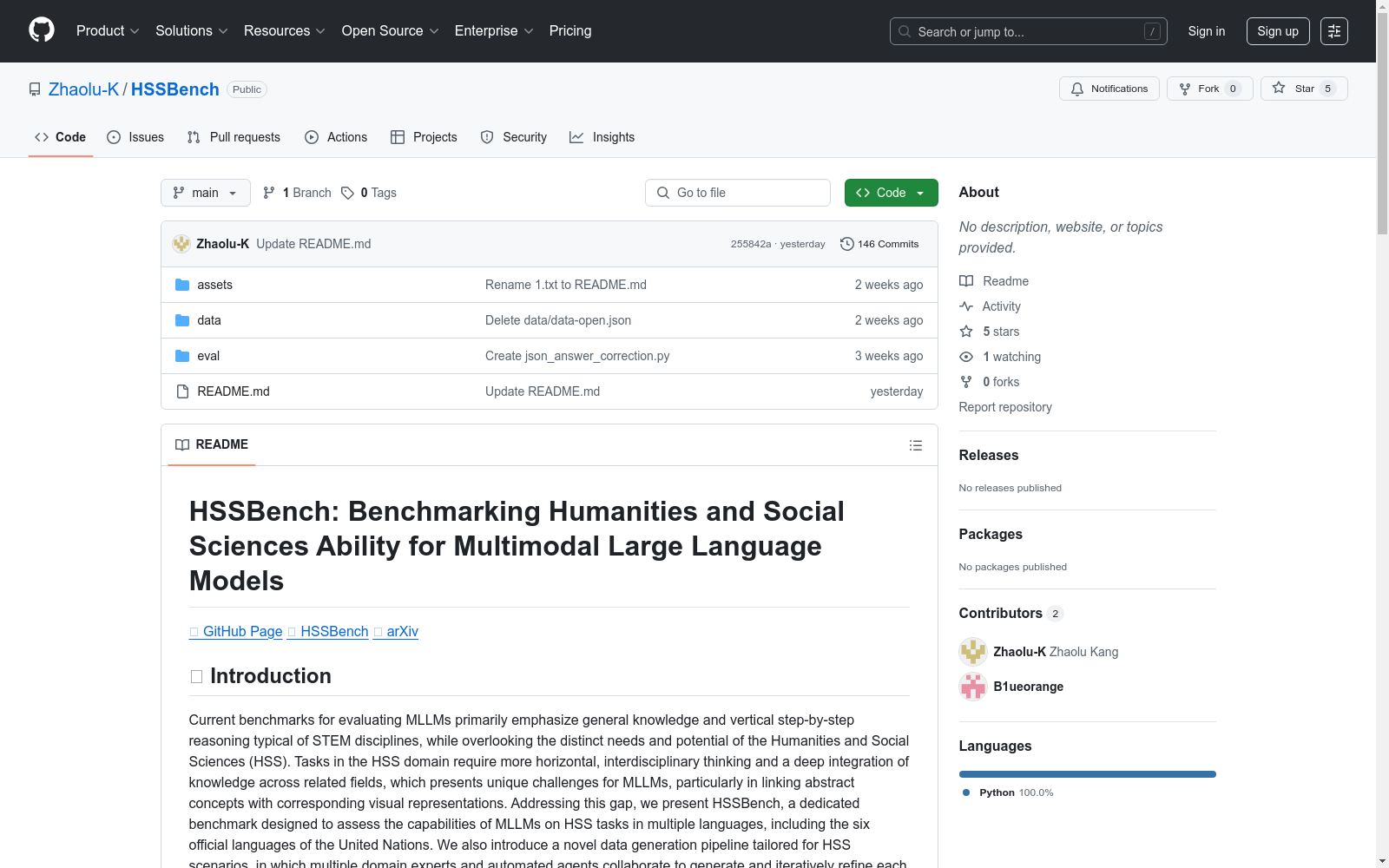
HSSBench is a large-scale benchmark spanning 6 distinct categories and 45 types, comprising 13,152 samples collected from the six official languages of the United Nations. This dataset is designed to evaluate the multilingual capabilities of Multimodal Large Language Models (MLLMs) in the fields of Humanities and Social Sciences (HSS). It includes six core categories: Geography, Art, Culture, Social Sciences, History, and Economics. The creation of the dataset involved collaboration between multiple domain experts and automated agents to generate and iteratively refine each sample. HSSBench aims to address the challenges faced by MLLMs in the HSS domain, particularly in linking abstract concepts to their corresponding visual representations.
HSSBench数据集概述
数据集简介
- 名称: HSSBench
- 目的: 评估多模态大语言模型在人文与社会科学(HSS)领域的能力
- 特点:
- 关注人文社科领域特有的横向、跨学科思维需求
- 强调抽象概念与视觉表征的深度结合
- 支持联合国六种官方语言的评估
核心特性
-
评估场景:
- 直接回答(Dr.)与思维链回答(Ct.)
- 多选题(C.)与开放题(O.)
-
数据生成:
- 采用专家与自动化代理协作的生成流程
- 迭代式样本优化机制
技术规格
- 数据格式: JSON json { "id": "问题ID", "question": "问题内容", "category": "学科类别", "correct_answer": "正确答案", "options": { "A": "选项A内容", "B": "选项B内容", "C": "选项C内容", "D": "选项D内容" }, "results": { "模型名称": { "output": "模型生成的答案" } } }
评估方法
-
依赖环境: bash pip install openai tqdm pandas
-
评估模式:
- GPT评估模式(
--use-gpt) - 正则表达式评估模式(
--max-distance)
- GPT评估模式(
-
输出结果:
- 详细评估结果(JSON)
- 准确率统计(CSV)
- 文本格式统计报告
使用示例
-
多选题评估: bash python eval/json_answer_correction.py --input choice_questions.json --output choice_questions_eval.json --use-gpt --accuracy-csv choice_accuracy.csv
-
开放题评估: bash python eval/json_answer_correction.py --input open_questions.json --open-questions open_question_ids.jsonl --output data/data-open.jsonl --use-gpt --accuracy-csv open_accuracy.csv
-
批量评估: bash python eval/json_answer_correction.py --input model1_results.json model2_results.json --output model1_eval.json model2_eval.json --use-gpt --accuracy-csv all_models_accuracy.csv