DETECTOR_LINEARITY_RESPONSE.xlsx
收藏资源简介:
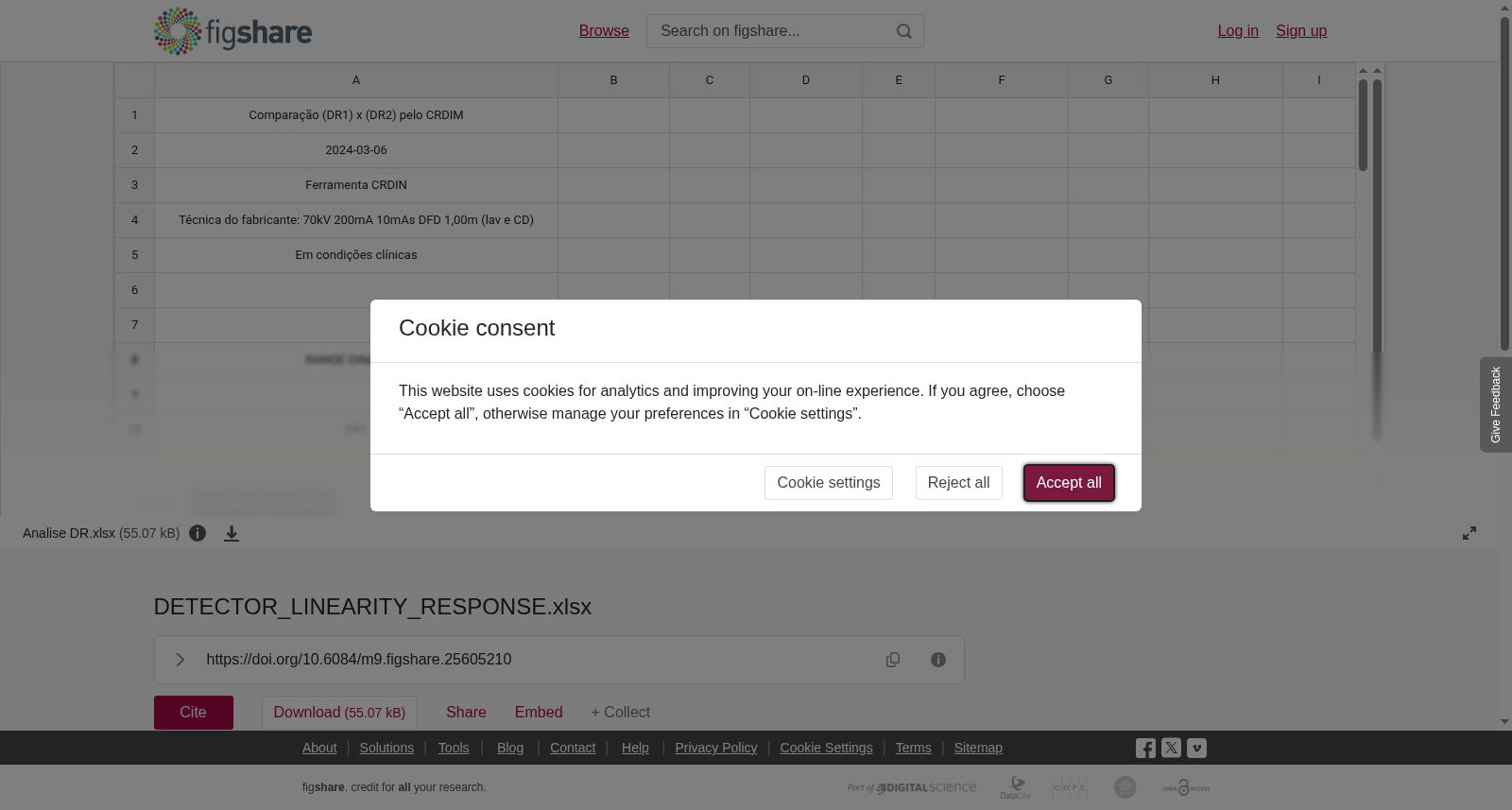
X-rays have been widely used in medicine, bringing undeniable benefits. Quality control tests (QCT) ensure that images produced by radiological systems are within acceptable standards, following national and international technical reports. Specifically, for digital radiographs using direct systems (DR), scintillators such as CsI and GOS are currently used as aerial image capture systems. These systems generate the latent image using a TFT (thin-film transistor) array and the scintillator. The aim of this study is to compare the linearity response of two DR systems (DR1 and DR2) with CsI present in this institution of teaching, research and assistance. The comparison of the two detectors was carried out using the linearity test, following the methodology of the manufacturer of the EZ-CRDIN<sup>®</sup> tool and the technical report “Protocolo Español de Control de Calidad en Radiodiagnóstico”.
X射线在医学领域应用广泛,其临床获益已得到广泛认可。质量控制测试(Quality Control Tests, QCT)需遵循国内外技术报告的规范要求,以确保放射成像系统生成的影像符合可接受的质量标准。具体到直接数字化X射线摄影系统(Direct Radiography, DR),目前碘化铯(Cesium Iodide, CsI)、硫氧钆(Gadolinium Oxyorthosilicate, GOS)等闪烁体被用作面阵影像采集系统。此类系统借助薄膜晶体管(Thin-Film Transistor, TFT)阵列与闪烁体生成潜影。本研究旨在对比本教学、科研与临床诊疗机构内两台搭载碘化铯闪烁体的DR系统(DR1与DR2)的响应线性度。本次两台探测器的线性性对比测试,严格遵循EZ-CRDIN<sup>®</sup>工具制造商的测试方法,以及《放射诊断质量控制西班牙规程》(Protocolo Español de Control de Calidad en Radiodiagnóstico)的技术要求。