
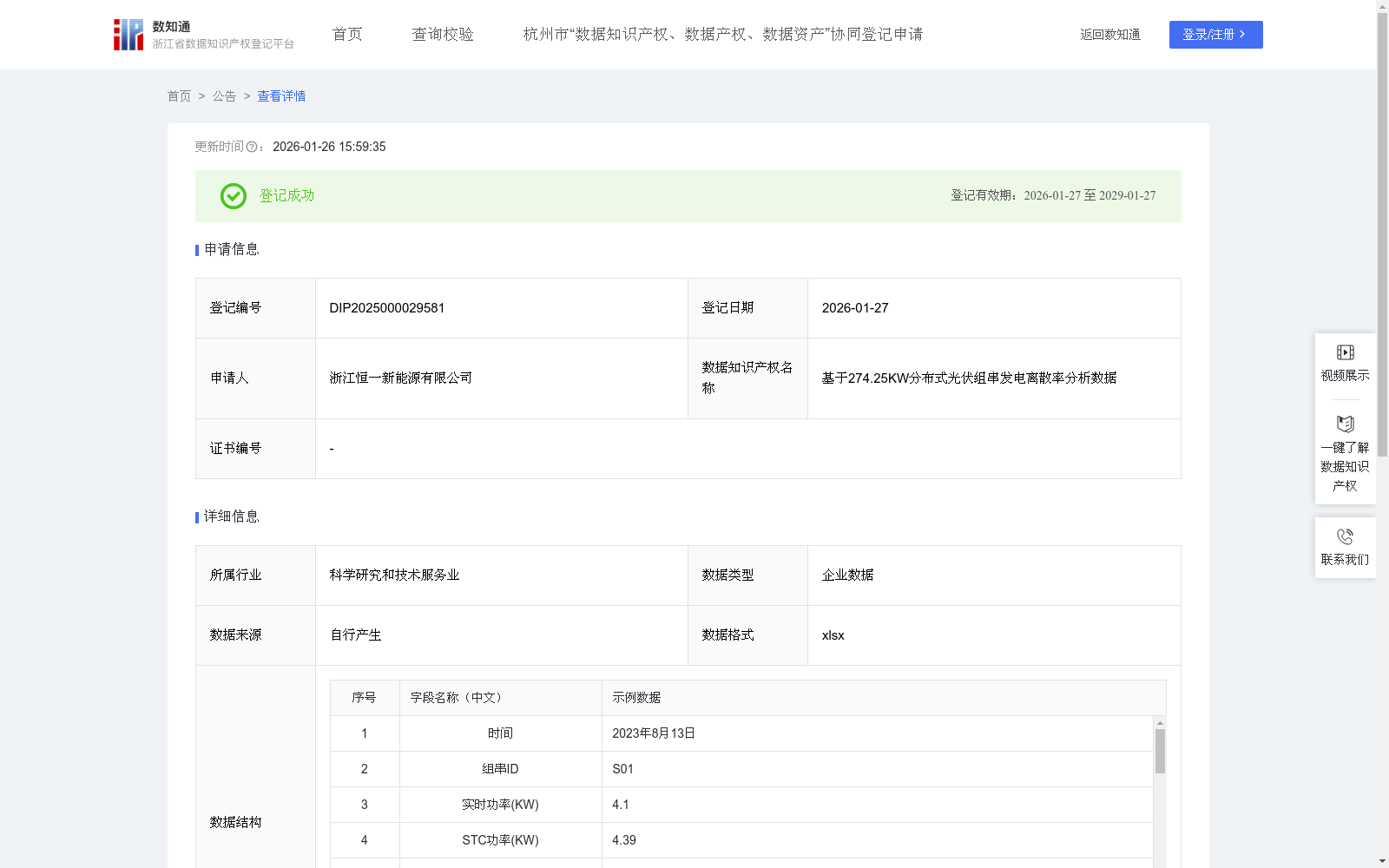
基于274.25KW分布式光伏组串发电离散率分析数据
收藏浙江省数据知识产权登记平台2026-01-26 更新2026-01-27 收录
下载链接:
https://www.zjip.org.cn/home/announce/trends/8424556
下载链接
链接失效反馈官方服务:
资源简介:
不同的光伏容量容量参数直接定义了数据所反映的系统规模边界,是理解数据复杂性和分析挑战性的首要技术指标。不同规模电站的离散率特征、成因及优化方案可能有显著差异。容量是解释离散率数据统计特性、异常模式多样性以及环境因素影响程度的核心背景参数。分析不同规模系统的离散率数据,有助于建立规模效应模型。通过分析不同批次、不同型号组件在真实电站中的离散率,可以精准定位哪些产品系列性能更稳定、衰减更一致。发现产品在设计或制造工艺上的潜在缺陷,为下一代产品的研发和现有产品的改进提供数据支撑。定位“短板”组件: 离散率分析能快速识别出性能远低于阵列平均水平的“短板”组件、热斑、遮挡或故障支路,指导运维团队进行精准维修,避免“大海捞针”,极大提升运维效率。驱动运维市场从“故障响应”转向 “一致性保障服务”,淘汰技术落后服务商,倒逼行业研发智能诊断机器人、AI优化算法等新技术,整体提升中国光伏电站年发电效率。行业价值定位:以数据知识产权为核心,驱动金融普惠化、运维智能化、制造高端化的行业基础设施,奠定中国光伏高质量发展新范式。通过公司自有智慧光伏能源管理平台,实时采集各光伏电站组串的发电功率(单位:kW)。
预处理:随机采集一天内对同一时间戳 t 下,区域内 N 个组串发电的实时功率分别为 P1, P2, P3, ..., Pn (对应字段里相应组窜的各个实时功率)进行有效性清洗(剔除通信中断、明显错误等异常数据)。
核心算法:离散率计算:
采用统计学中最常用的变异系数(Coefficient of Variation, CV) 来衡量离散程度,消除数据平均值本身大小对离散程度比较的影响。
步骤1:将实际功率转换至标准条件(STC: 1000W/m², 25℃)
计算公式如下:STC功率 =实时功率/{(辐照度 / 1000) * [1-0.004 * (组件温度-25)]}。分别转化成对应的STC功率为: S1, S2, S3, ..., Sn。
STC功率均值 = (S1 + S2 + ... + Sn) / N
步骤2:计算离散率(变异系数CV)
计算公式如下:离散率 = (标准差 / STC功率均值) * 100。
步骤3:标记异常组串(低于均值12%判定为异常,高于或等于12%判定为正常)
Different photovoltaic (PV) capacity parameters directly define the system scale boundaries reflected by the dataset, and serve as the primary technical indicator for understanding data complexity and analytical challenges. The characteristics, causes, and optimization schemes of discreteness rate may vary significantly among power stations of different scales. Capacity serves as the core background parameter for explaining the statistical characteristics of discreteness rate data, the diversity of abnormal patterns, and the degree of environmental factor impact.
Analyzing discreteness rate data of systems with different scales helps establish scale effect models. By analyzing the discreteness rate of components from different batches and models in real-world power stations, we can accurately identify which product series have more stable performance and more consistent degradation. Potential defects in product design or manufacturing processes can be identified, providing data support for the R&D of next-generation products and the improvement of existing products.
Locating "weak link" components: Discreteness rate analysis can quickly identify "weak link" components, hot spots, shading or faulty branches whose performance is far below the array average, guiding the operation and maintenance (O&M) team to carry out precise maintenance, avoiding "needle in a haystack" and greatly improving O&M efficiency.
Driving the O&M market to shift from "fault response" to "consistency guarantee services", eliminating technically backward service providers, forcing the industry to develop new technologies such as intelligent diagnostic robots and AI optimization algorithms, and overall improving the annual power generation efficiency of Chinese PV power stations.
Industry value positioning: Taking data intellectual property rights as the core, driving the industry infrastructure of financial inclusion, intelligent O&M and high-end manufacturing, and laying a new paradigm for the high-quality development of China's PV industry.
Power generation power (unit: kW) of each PV power station string is collected in real time through the company's self-owned intelligent PV energy management platform.
Preprocessing: Randomly collect the real-time power of N strings in the region at the same timestamp t within a day, which are P1, P2, P3, ..., Pn (corresponding to the real-time power of each string in the corresponding fields), and conduct validity cleaning (remove abnormal data such as communication interruptions and obvious errors).
Core Algorithm: Discreteness Rate Calculation
The most commonly used coefficient of variation (CV) in statistics is adopted to measure the degree of discreteness, eliminating the impact of the magnitude of the data average value on the comparison of discreteness degrees.
Step 1: Convert actual power to standard test conditions (STC: 1000W/m², 25℃)
The calculation formula is as follows: STC power = real-time power / {(irradiance / 1000) * [1 - 0.004 * (component temperature - 25)]}. The corresponding STC powers are converted into S1, S2, S3, ..., Sn respectively.
Average STC power = (S1 + S2 + ... + Sn) / N
Step 2: Calculate the discreteness rate (coefficient of variation CV)
The calculation formula is as follows: Discreteness rate = (standard deviation / average STC power) * 100.
Step 3: Mark abnormal strings (those lower than 12% of the average are judged as abnormal, and those higher than or equal to 12% are judged as normal)
提供机构:
浙江恒一新能源有限公司
创建时间:
2025-10-30
搜集汇总
数据集介绍
背景与挑战
背景概述
该数据集记录了274.25KW分布式光伏系统中多个组串的发电性能数据,包括实时功率、STC功率、辐照度和组件温度等关键指标,旨在通过计算离散率分析组串间发电一致性。数据可用于识别性能异常的组串,支持精准运维和效率优化,适用于光伏电站的智能监控和性能评估场景。
以上内容由遇见数据集搜集并总结生成


