Thyroarytenoid muscle gene expression in Pink1 knockout rats
收藏资源简介:
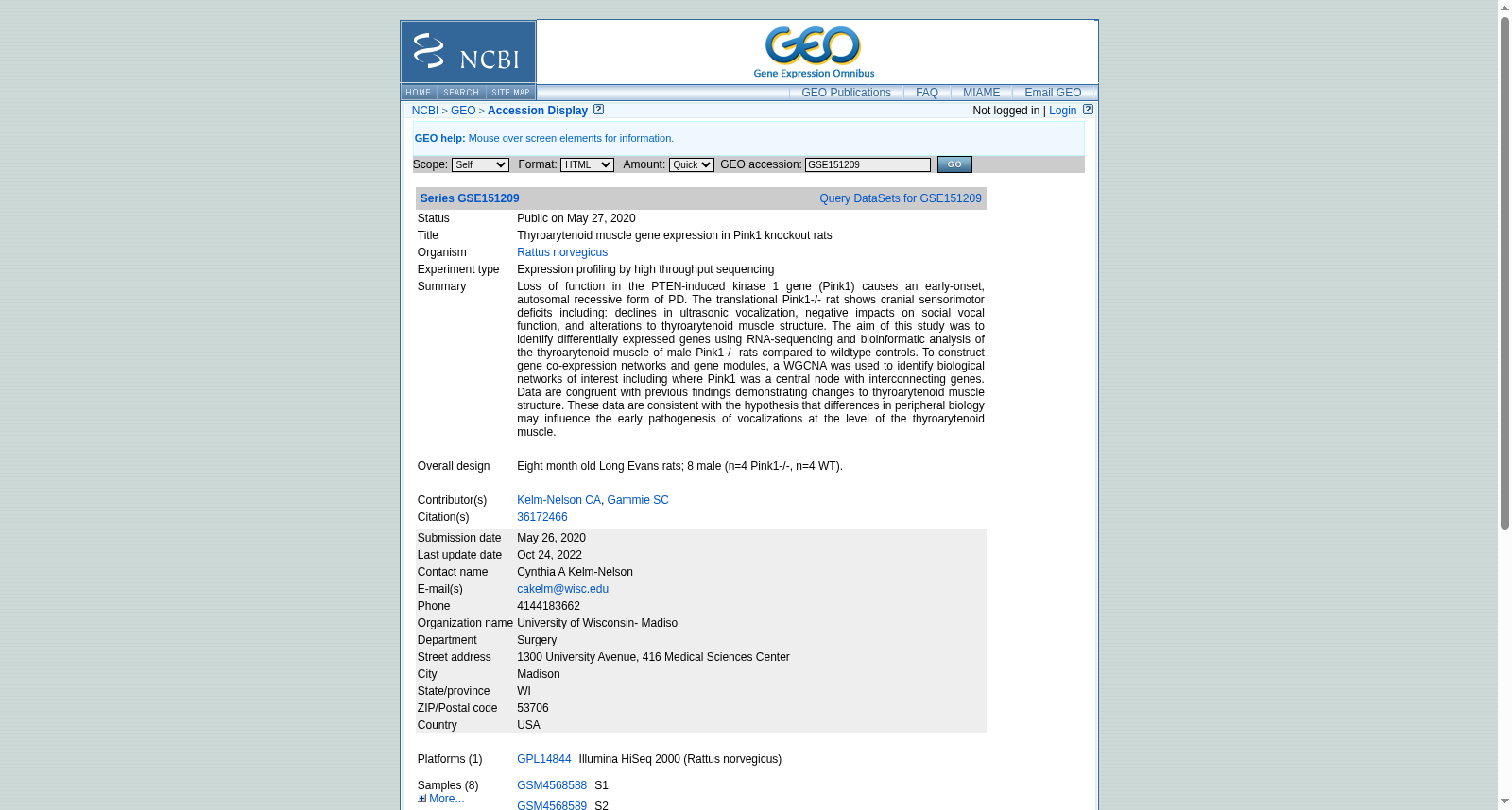
Loss of function in the PTEN-induced kinase 1 gene (Pink1) causes an early-onset, autosomal recessive form of PD. The translational Pink1-/- rat shows cranial sensorimotor deficits including: declines in ultrasonic vocalization, negative impacts on social vocal function, and alterations to thyroarytenoid muscle structure. The aim of this study was to identify differentially expressed genes using RNA-sequencing and bioinformatic analysis of the thyroarytenoid muscle of male Pink1-/- rats compared to wildtype controls. To construct gene co-expression networks and gene modules, a WGCNA was used to identify biological networks of interest including where Pink1 was a central node with interconnecting genes. Data are congruent with previous findings demonstrating changes to thyroarytenoid muscle structure. These data are consistent with the hypothesis that differences in peripheral biology may influence the early pathogenesis of vocalizations at the level of the thyroarytenoid muscle. Eight month old Long Evans rats; 8 male (n=4 Pink1-/-, n=4 WT).
PTEN诱导激酶1基因(Pink1)功能丧失会引发早发型常染色体隐性遗传性帕金森病(Parkinson's disease,PD)。本研究中的Pink1基因敲除(Pink1-/-)转化模型大鼠表现出颅部感觉运动缺陷,具体包括超声发声能力下降、社交发声功能受损以及甲状杓肌结构改变。本研究旨在通过对雄性Pink1-/-大鼠与野生型(wildtype,WT)对照组大鼠的甲状杓肌进行RNA测序(RNA-sequencing)及生物信息学分析,筛选差异表达基因。为构建基因共表达网络与基因模块,本研究采用加权基因共表达网络分析(Weighted Gene Co-expression Network Analysis,WGCNA)筛选目标生物学网络,其中Pink1作为核心节点与其他互作基因形成连接。本研究数据与此前已报道的甲状杓肌结构改变的研究结果一致。上述数据支持如下假说:外周生物学差异可通过甲状杓肌层面影响发声功能的早期发病机制。实验动物为8月龄Long Evans大鼠,共8只雄性个体,其中Pink1-/-组与WT组各4只。