PhySciBench
收藏资源简介:
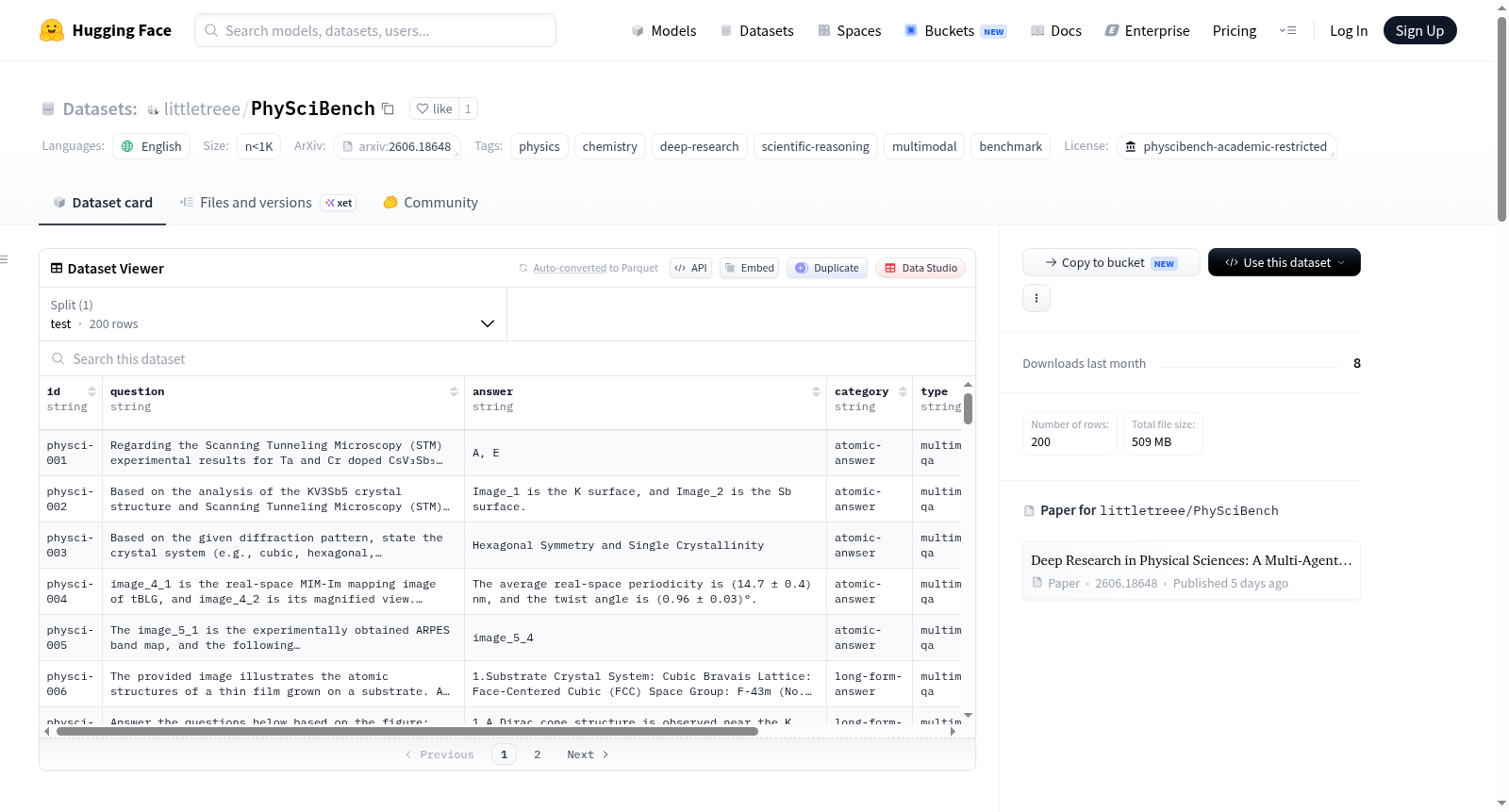
PhySciBench是一个用于评估物理科学领域深度研究能力的综合性基准测试数据集,源自论文《Deep Research in Physical Sciences: A Multi-Agent Framework and Comprehensive Benchmark》。该数据集旨在反映真实世界的科学工作流程,包含200个由专家精心策划的问题,均衡覆盖物理学和化学两大领域。数据内容围绕六个核心任务类别构建:multimodal-qa(基于科学图表的感知与推理)、long-context-qa(跨完整文档及补充材料的综合理解)、structured-information-extraction(符合模式的JSON/CSV解析)、scientific-reasoning(基于原理的多步推导)、experimental-design(完整的程序化合成/表征协议设计)以及code-generation(可执行的计算实现)。数据以单一测试集的形式提供,每条记录包含唯一标识符(id)、问题文本(question)、标准答案(answer)、报告标签(category,分为long-form-answer和atomic-answer)、任务类型(type)、引用的文件列表(files)以及评分规则(rubrics,部分项为null)。数据集主体文件为physcibench.json,同时附带一个files/目录,包含问题中引用的141个图表和PDF源文件。该基准测试挑战性高,现有最强基线模型的准确率仅为33.5%。数据集严格限定用于学术研究,禁止任何形式的商业使用。
PhySciBench is a comprehensive benchmark dataset for evaluating deep research capabilities in the physical sciences, originating from the paper Deep Research in Physical Sciences: A Multi-Agent Framework and Comprehensive Benchmark. It aims to reflect real-world scientific workflows, containing 200 expert-curated questions that evenly cover physics and chemistry. The data is structured around six core task categories: multimodal-qa (perception and reasoning based on scientific charts), long-context-qa (comprehensive understanding across full documents and supplementary materials), structured-information-extraction (parsing of JSON/CSV in compliance with schemas), scientific-reasoning (multi-step derivation based on principles), experimental-design (complete procedural synthesis/characterization protocol design), and code-generation (executable computational implementations). It is provided as a single test set, with each record including a unique identifier (id), question text (question), standard answer (answer), report label (category, divided into long-form-answer and atomic-answer), task type (type), referenced file list (files), and scoring rubrics (rubrics, with some items as null). The main dataset file is physcibench.json, accompanied by a files/ directory containing 141 referenced charts and PDF source files. This benchmark is highly challenging, with the current strongest baseline model achieving only 33.5% accuracy. The dataset is strictly limited to academic research and prohibits any commercial use.
数据集:PhySciBench
PhySciBench 是一个用于评估物理科学领域深度研究能力的基准测试,由论文 "Deep Research in Physical Sciences: A Multi-Agent Framework and Comprehensive Benchmark" (arXiv:2606.18648) 提出。
- 论文链接: https://arxiv.org/abs/2606.18648
- 代码与评估: https://github.com/yigengjiang/physci-deepresearch
基本信息
- 语言: 英语
- 标签: 物理、化学、深度研究、科学推理、多模态、基准测试
- 规模: 少于 1000 条记录(实际 200 条)
- 许可证: physcibench-academic-restricted(仅限学术研究,禁止商业使用)
数据集构成
- 数据文件:
physcibench.json,包含 200 条记录,作为唯一的test划分。 - 补充文件:
files/目录下包含 141 个引用的图表和源 PDF 文件。仅使用physcibench.json即可运行官方评分器。
任务类别
数据集平衡涵盖物理和化学两个学科,包含 六种任务类型:
- multimodal-qa:对科学图表进行感知与推理
- long-context-qa:综合全文及补充材料进行回答
- structured-information-extraction:按模式将信息解析为 JSON/CSV 格式
- scientific-reasoning:基于原理的多步骤推导
- experimental-design:程序完备的合成/表征方案设计
- code-generation:生成可执行的计算实现代码
记录字段说明
| 字段 | 描述 |
|---|---|
id |
唯一标识符,例如 physci-001 |
question |
问题文本 |
answer |
标准答案 |
category |
报告标签(long-form-answer 或 atomic-answer) |
type |
任务类别(上述六种之一) |
files |
files/ 目录下引用的图表/PDF 文件名 |
rubrics |
评分标准(用于基于评分规则的项目;否则为 null) |
基准性能
- 最强基线模型 Gemini Deep Research 的准确率仅为 33.5%,表明现有系统在该基准上表现困难。
使用方式
python from huggingface_hub import hf_hub_download import json
path = hf_hub_download("littletreee/PhySciBench", "physcibench.json", repo_type="dataset") data = json.load(open(path)) print(len(data), "records")
引用
@article{jiang2026physcidr, title = {Deep Research in Physical Sciences: A Multi-Agent Framework and Comprehensive Benchmark}, author = {Jiang, Yigeng and Yang, Tengchao and Cui, Taoyong and Wan, Jiaxing and Wang, Yuan and Wang, Weida and Liu, Zhiyu and Peng, Chuyi and Luo, Binzhao and Gao, Maoli and Huang, Huaihai and Zeng, Yuqianer and Zheng, Ziyang and Huang, Dongchen and Chen, Chao and Liu, Zichao and Shen, Weiping and Pu, Shuchen and Zhou, Siyu and Ma, Runmin and Hu, Yusong and Chao, Fei and Zhang, Bo and Zheng, Xiawu and Wang, Zifu and Bai, Lei and Cai, Yunqi and Zhang, Shufei}, journal = {arXiv preprint arXiv:2606.18648}, year = {2026} }