
The Geography of Oxia Planum 03 CTX DEM Mosaic
收藏Mendeley Data2024-06-25 更新2024-06-27 收录
下载链接:
https://ordo.open.ac.uk/articles/dataset/The_Geography_of_Oxia_Planum_03_CTX_DEM_Mosaic/16451220/1
下载链接
链接失效反馈官方服务:
资源简介:
This data is a mosaic of CTX DEM and ORI’s covering the ExoMars rover landing site in Oxia Planum. This data is a basemap for Oxia Planum and will act as a georeferencing base layer for future High resolution datasets of the rover landing site. Contents This data set contains 4 directories: 03_a Sets of elevation contours at 100 m and 25 m spacing made from the DEM and smoothed for use in map publications. 03_b Mosaic of orthorectified CTX images that accompany the DEM. These data are provided in an equirectangular projection centered at 335.45°E 03_c Hillshade model of the CTX DEM mosaic. These data are provided to help assess the variability and quality of the DEM. These data are provided in an equirectangular projection centered at 335.45°E 03_d CTX DEM mosaic. These data are provided in an equirectangular projection centered at 335.45°E Guide to individual files 03_a_CTX_DEM_contoursNaming convention: CTX_OXIA_DEM = data from which the contours where created, _cont = contour data, _m = vertical separation of the contours (25 or 100.) File name (example) Description CTX_OXIA_DEM_cont_100m.cpg CTX_OXIA_DEM_cont_100m.dbf CTX_OXIA_DEM_cont_100m.prj Projection information CTX_OXIA_DEM_cont_100m.sbx CTX_OXIA_DEM_cont_100m.shp CTX_OXIA_DEM_cont_100m.shp.xml Geoprocessing history CTX_OXIA_DEM_cont_100m.shx 03_b_CTX_ORINaming convention: CTX = Instrument, OXIA = Location, ORI = Orthorectified image, 6m = pixel size File name Description CTX_OXIA_ORI_6m.tfw World file CTX_OXIA_ORI_6m.tif Image data CTX_OXIA_ORI_6m.tif.aux.xml Auxiliary symbology statistics CTX_OXIA_ORI_6m.tif.ovr Image overviews CTX_OXIA_ORI_6m.tif.xml Geoprocessing history These data are provided with the following projection: Equirectangular_Mars_Oxia_Planum, Projections = Equidistant_Cylindrical, Datum = D_Mars_2000 Spheroid, Central meridian = 335.45 03_c_CTX_DEM_hsNaming convention: CTX = Instrument, OXIA = Location, DEM = Digital Elevation Model, 20m = Pixel Size, _hs = hill shade model (sun potion 315°, azimuth 45°) File name Description CTX_OXIA_DEM_20m_hs.tfw World file CTX_OXIA_DEM_20m_hs.tif Image data CTX_OXIA_DEM_20m_hs.tif.aux.xml Auxiliary symbology statistics CTX_OXIA_DEM_20m_hs.ovr Image overviews CTX_OXIA_ DEM_20m_hs.tif.xml Geoprocessing history 03_d_CTX_DEMNaming convention: CTX = Instrument, OXIA = Location, DEM = Digital Elevation Model, 20m = Pixel Size File name Description CTX_OXIA_DEM_20m.tfw World file CTX_OXIA_DEM_20m.tif Image data CTX_OXIA_DEM_20m.tif.aux.xml Auxiliary symbology statistics CTX_OXIA_DEM_20m.ovr Image overviews These data are provided with the following projection: Equirectangular_Mars_Oxia_Planum, Projections = Equidistant_Cylindrical, Datum = D_Mars_2000 Spheroid, Central meridian = 335.45 Digital elevation models Digital elevation models (DEMs) were produced from CTX stereo images using the USGS Integrated Software for Imagers and Spectrometers (ISIS) software and the BAE photogrammetric package SOCET SET according to the method of Kirk et al. (2008). We selected 6 CTX image pairs to maximise coverage of the canyon. Tie points were automatically populated in SOCET SET between each image pair. In a departure from previous methods, we ran bundle adjustments on adjacent stereo pairs, removing erroneous tie points until the remaining points had an RMS pixel matching error of ≤ 0.6 pixels. This approach resulted in improved coregistration between stereo pairs, and minimal topographic artefacts across stereo pair boundaries. Each resultant DEM was tied vertically to Mars Orbital Laser Altimeter (MOLA; Zuber et al., 1992) topography and exported with a horizontal post spacing of 20 m/pixel. We then exported orthorectified images from SOCET SET at a resolution of 6 m/pixel. The orthorectified images (ORI) and DEMs were then post-processed in ISIS, mosaicked in the software ENvironment for Visualising Images (ENVI), provided by Harris Geospatial, before manual georeferencing in ArcGIS. Finally, the georeferenced image mosaic was blended in Adobe Photoshop to remove seamlines using the Avenza Geographic Imager extension, which retains geospatial information in the blended product. The output from SocetSet® are 18 – 20 m/pix DEM resolving topography of ~50 – 60 m features and 12 orthorectified CTX images at 6 m/pix. The Expected Vertical Precision (EVP) in each CTX DEM can be estimated based on viewing geometry and pixel scale (Randolph L. Kirk et al., 2003, 2008) e.g. EVP = Δp IFOV / (parallax/height). Where: Δp is the RMS stereo matching error in pixel units, assumed to be 0.2 pixels (Cook et al., 1996) and confirmed with matching software for several other planetary image data sets (Howington-Kraus et al., 2002; R. L. Kirk et al., 1999). The pixel matching error is influenced by signal-to-noise ratio, scene contrast and differences in illumination between the images. Pattern noise can also be introduced by the automatic terrain extraction algorithm, especially in areas of low correlation. These can be identified as patches of ‘triangles’ in the hillshade model (e.g., smooth, low contrast slopes and along shadows). IFOV is the instantaneous field of view of the image (pixel size in metres). If the paired images have different IFOV the RMS values is used e.g. IFOV = √(pixel scale image 1 + pixel scale image 2). The parallax/height ratio, calculated from the three-dimensional intersection geometry, reduces to tan(e) for an image with emission angle ‘e’ paired with a nadir image, e.g., parallax/height = tan(e) where e = |emission angle 1 − emission angle 2|. GeoreferencingMars Express High Resolution Stereo Camera (HRSC; Gwinner et al., 2016) MC11- mosaic (Kersten et al., 2018) has been used as the base control mosaic (tile HMC_11W24_co5ps.tif http://hrscteam.dlr.de/HMC30/).. This data is controlled to the Mars Orbital Laser Altimeter (MOLA; Smith et al., 2001) data the most accurate elevation data for Mars. Registration of the CTX DEM mosaic to the HRSC mosaic used manual tie points between the CTX ORI and HRSC mosaic and applying these tie points to the DEM mosaic. Manual tie points were used because automatic methods gave unsatisfactory results. The CTX mosaic data was rectified using the spline transformation. which optimizes for local accuracy but not global accuracy (Esri, 2020). This method provided good results for images with a range of viewing angles and accounts well for local adjustments needed for abrupt elevation changes. Topographic contours Topographic contours were created at 25 m intervals from a CTX DEM down sampled to 100 m/pix, and contours shorter than 1500 m were removed and the lines smoothed using the PAEK algorithm at a tolerance of 200 m (USGS & MRCTR GIS Lab, 2018).
本数据集为覆盖火星欧西亚平原(Oxia Planum)上ExoMars火星车着陆点的CTX数字高程模型(Digital Elevation Model, DEM)与正射影像(Orthorectified Image, ORI)镶嵌拼接产物。本数据集作为欧西亚平原的基础底图,将作为未来该火星车着陆区高分辨率数据集的地理参考基础图层。
数据集内容
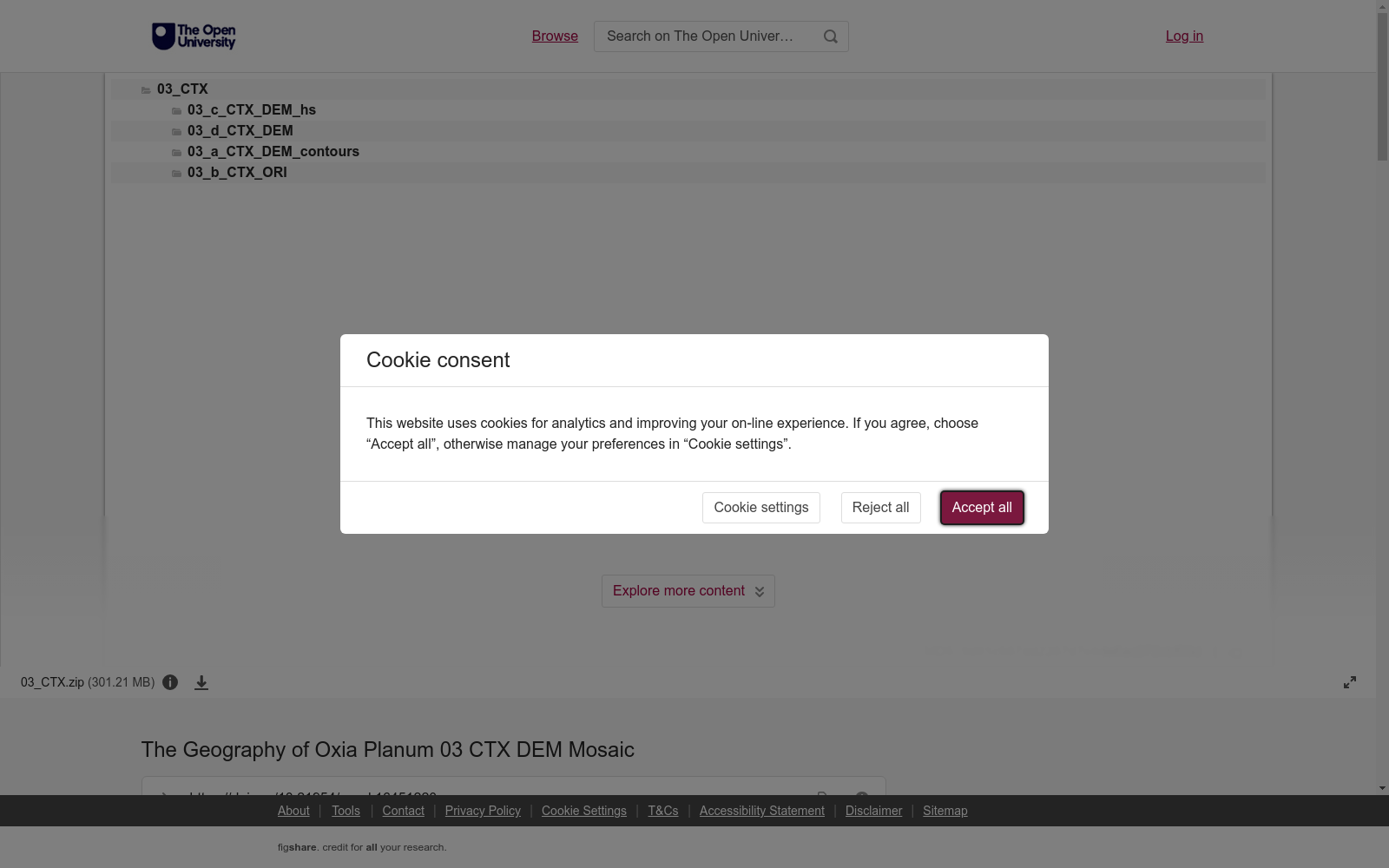
本数据集包含4个目录:
03_a:包含由DEM生成、经平滑处理以适配地图出版需求的100 m与25 m间隔高程等高线集。
03_b:配套DEM的正射校正CTX影像镶嵌图。该数据采用以335.45°E为中心的等经纬度投影。
03_c:CTX DEM镶嵌图的山体阴影模型,用于辅助评估DEM的变化性与质量,同样采用以335.45°E为中心的等经纬度投影。
03_d:CTX DEM镶嵌图,投影中心同样为335.45°E的等经纬度投影。
单个文件命名指南
### 03_a_CTX_DEM_contours
命名规则:CTX_OXIA_DEM = 生成等高线的源数据;_cont = 等高线数据;_m = 等高线垂直间隔(25或100)。
示例文件名及说明:
CTX_OXIA_DEM_cont_100m.cpg:字符编码配置文件
CTX_OXIA_DEM_cont_100m.dbf:属性数据表
CTX_OXIA_DEM_cont_100m.prj:投影信息文件
CTX_OXIA_DEM_cont_100m.sbx:空间索引缓存文件
CTX_OXIA_DEM_cont_100m.shp:矢量要素文件
CTX_OXIA_DEM_cont_100m.shp.xml:地理处理历史记录文件
CTX_OXIA_DEM_cont_100m.shx:空间索引文件
### 03_b_CTX_ORI
命名规则:CTX = 成像仪器,OXIA = 观测区域,ORI = 正射影像,6m = 像素分辨率。
示例文件名及说明:
CTX_OXIA_ORI_6m.tfw:世界文件(坐标映射文件)
CTX_OXIA_ORI_6m.tif:影像数据文件
CTX_OXIA_ORI_6m.tif.aux.xml:辅助符号化统计信息文件
CTX_OXIA_ORI_6m.tif.ovr:影像概视图文件
CTX_OXIA_ORI_6m.xml:地理处理历史记录文件
该数据采用以下投影参数:Equirectangular_Mars_Oxia_Planum,投影类型为等距圆柱投影(Equidistant_Cylindrical),基准面为D_Mars_2000椭球体,中央子午线为335.45°。
### 03_c_CTX_DEM_hs
命名规则:CTX = 成像仪器,OXIA = 观测区域,DEM = 数字高程模型,20m = 像素分辨率,_hs = 山体阴影模型(太阳高度角315°,方位角45°)。
示例文件名及说明:
CTX_OXIA_DEM_20m_hs.tfw:世界文件
CTX_OXIA_DEM_20m_hs.tif:影像数据文件
CTX_OXIA_DEM_20m_hs.tif.aux.xml:辅助符号化统计信息文件
CTX_OXIA_DEM_20m_hs.ovr:影像概视图文件
CTX_OXIA_DEM_20m_hs.tif.xml:地理处理历史记录文件
### 03_d_CTX_DEM
命名规则:CTX = 成像仪器,OXIA = 观测区域,DEM = 数字高程模型,20m = 像素分辨率。
示例文件名及说明:
CTX_OXIA_DEM_20m.tfw:世界文件
CTX_OXIA_DEM_20m.tif:影像数据文件
CTX_OXIA_DEM_20m.tif.aux.xml:辅助符号化统计信息文件
CTX_OXIA_DEM_20m.ovr:影像概视图文件
该数据采用以下投影参数:Equirectangular_Mars_Oxia_Planum,投影类型为等距圆柱投影,基准面为D_Mars_2000椭球体,中央子午线为335.45°。
#### 数字高程模型制作流程
本数据集的数字高程模型(DEM)由美国地质调查局(USGS)成像与光谱仪集成软件(Integrated Software for Imagers and Spectrometers, ISIS)及BAE摄影测量软件SOCET SET,依据Kirk等人(2008)的方法,由CTX立体影像生成。研究团队选取6组CTX立体影像对以最大化覆盖峡谷区域。在每组影像对之间,SOCET SET会自动生成连接点。与以往方法不同的是,本研究对相邻立体影像对进行了光束法平差,并移除错误的连接点,直至剩余点的均方根(RMS)像素匹配误差≤0.6像素。该方法提升了立体影像对之间的配准精度,并减少了立体对边界处的地形伪影。
每个生成的DEM均与火星轨道激光高度计(Mars Orbital Laser Altimeter, MOLA; Zuber et al., 1992)地形数据进行垂直绑定,导出时的水平采样间距为20 m/像素。随后,研究团队从SOCET SET中导出分辨率为6 m/像素的正射校正影像。
正射校正影像(ORI)与DEM随后在ISIS中进行后处理,在Harris Geospatial提供的ENVI(Environment for Visualising Images)软件中进行镶嵌,随后在ArcGIS中进行手动地理配准。最终,使用Avenza Geographic Imager插件在Adobe Photoshop中对配准后的影像镶嵌图进行融合以去除接缝线,该插件可在融合产物中保留地理空间信息。
SocetSet®的输出成果为分辨率18–20 m/像素的DEM,可解析约50–60 m的地形特征,以及6组分辨率6 m/像素的正射校正CTX影像。
#### 预期垂直精度
每组CTX DEM的预期垂直精度可依据观测几何与像素尺度进行估算(Randolph L. Kirk et al., 2003, 2008),计算公式为:EVP = Δp × IFOV / (parallax/height)。
其中:
Δp 为以像素为单位的RMS立体匹配误差,默认取值为0.2像素(Cook et al., 1996),该值已通过多款其他行星影像数据集的匹配软件验证(Howington-Kraus et al., 2002; R. L. Kirk et al., 1999)。像素匹配误差受信噪比、场景对比度及影像间光照差异影响。自动地形提取算法也可能引入图案噪声,尤其在低相关性区域,此类噪声可在山体阴影模型中表现为“三角形”斑块(例如平缓、低对比度的斜坡及阴影区域)。
IFOV 为影像的瞬时视场(即像素尺寸,单位为米)。若成对影像的IFOV不同,则使用均方根值计算,即IFOV = √(像素尺度1² + 像素尺度2²)。
视差/高度比由三维交会几何计算得出,对于发射角为e的影像与天底影像的配对,该比值可简化为tan(e),即parallax/height = tan(e),其中e = |发射角1 − 发射角2|。
#### 地理配准
本数据集以火星快车号高分辨率立体相机(High Resolution Stereo Camera, HRSC; Gwinner et al., 2016)的MC11镶嵌图(Kersten et al., 2018)作为基础控制镶嵌图(瓦片HMC_11W24_co5ps.tif,来源:http://hrscteam.dlr.de/HMC30/)。该数据以火星轨道激光高度计(MOLA; Smith et al., 2001)数据为控制基准,后者是目前精度最高的火星高程数据。
将CTX DEM镶嵌图配准至HRSC镶嵌图时,研究团队在CTX ORI与HRSC镶嵌图之间选取手动连接点,并将这些点应用至DEM镶嵌图。之所以使用手动连接点,是因为自动配准方法未能获得令人满意的结果。CTX镶嵌数据使用样条变换进行校正,该方法可优化局部精度,但无法保证全局精度(Esri, 2020)。该方法对具有不同观测角度的影像适配性良好,可很好地应对地形突变所需的局部调整。
#### 地形等高线制作
地形等高线以25 m间隔从降采样至100 m/像素的CTX DEM生成,并移除长度小于1500 m的等高线,使用PAEK算法以200 m的容差对线条进行平滑处理(USGS & MRCTR GIS Lab, 2018)。
创建时间:
2023-06-28
搜集汇总
数据集介绍
背景与挑战
背景概述
该数据集是一个CTX DEM和正射校正图像的镶嵌图,覆盖ExoMars火星车在Oxia Planum的着陆点,作为地理参考基础图层。数据集包含四个目录,分别提供高程等高线、正射校正图像、hillshade模型和DEM镶嵌图,支持未来高分辨率数据集的配准和分析。
以上内容由遇见数据集搜集并总结生成



