
jnlpba/jnlpba
收藏Hugging Face2024-01-18 更新2024-06-15 收录
下载链接:
https://hf-mirror.com/datasets/jnlpba/jnlpba
下载链接
链接失效反馈官方服务:
资源简介:
---
annotations_creators:
- expert-generated
language_creators:
- expert-generated
language:
- en
license:
- unknown
multilinguality:
- monolingual
size_categories:
- 10K<n<100K
source_datasets:
- extended|other-genia-v3.02
task_categories:
- token-classification
task_ids:
- named-entity-recognition
pretty_name: BioNLP / JNLPBA Shared Task 2004
dataset_info:
features:
- name: id
dtype: string
- name: tokens
sequence: string
- name: ner_tags
sequence:
class_label:
names:
'0': O
'1': B-DNA
'2': I-DNA
'3': B-RNA
'4': I-RNA
'5': B-cell_line
'6': I-cell_line
'7': B-cell_type
'8': I-cell_type
'9': B-protein
'10': I-protein
config_name: jnlpba
splits:
- name: train
num_bytes: 8775707
num_examples: 18546
- name: validation
num_bytes: 1801565
num_examples: 3856
download_size: 3171072
dataset_size: 10577272
---
# Dataset Card for JNLPBA
## Table of Contents
- [Dataset Description](#dataset-description)
- [Dataset Summary](#dataset-summary)
- [Supported Tasks and Leaderboards](#supported-tasks-and-leaderboards)
- [Languages](#languages)
- [Dataset Structure](#dataset-structure)
- [Data Instances](#data-instances)
- [Data Fields](#data-fields)
- [Data Splits](#data-splits)
- [Dataset Creation](#dataset-creation)
- [Curation Rationale](#curation-rationale)
- [Source Data](#source-data)
- [Annotations](#annotations)
- [Personal and Sensitive Information](#personal-and-sensitive-information)
- [Considerations for Using the Data](#considerations-for-using-the-data)
- [Social Impact of Dataset](#social-impact-of-dataset)
- [Discussion of Biases](#discussion-of-biases)
- [Other Known Limitations](#other-known-limitations)
- [Additional Information](#additional-information)
- [Dataset Curators](#dataset-curators)
- [Licensing Information](#licensing-information)
- [Citation Information](#citation-information)
- [Contributions](#contributions)
## Dataset Description
- **Homepage:** http://www.geniaproject.org/shared-tasks/bionlp-jnlpba-shared-task-2004
- **Repository:** [Needs More Information]
- **Paper:** https://www.aclweb.org/anthology/W04-1213.pdf
- **Leaderboard:** https://paperswithcode.com/sota/named-entity-recognition-ner-on-jnlpba?p=biobert-a-pre-trained-biomedical-language
- **Point of Contact:** [Needs More Information]
### Dataset Summary
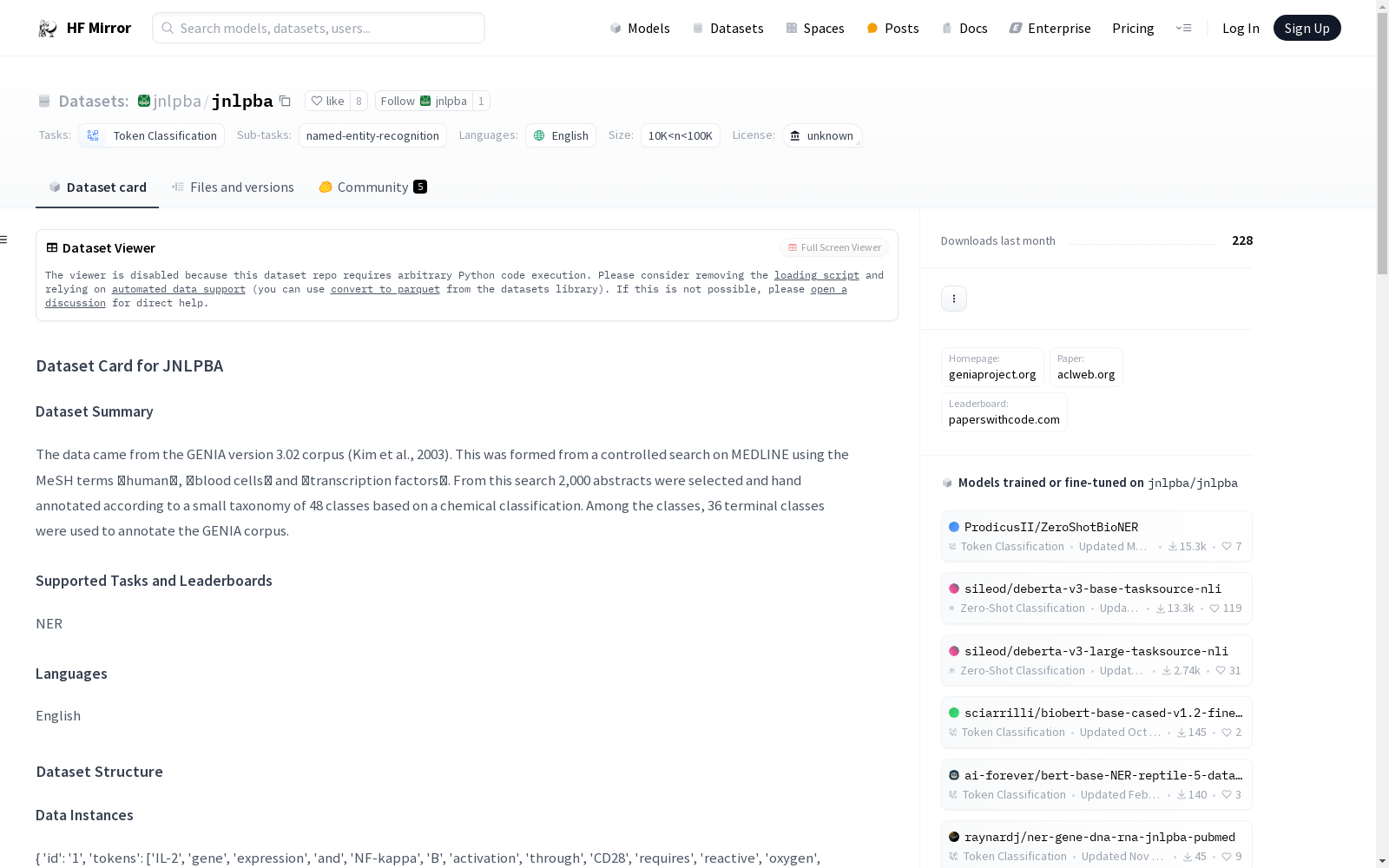
The data came from the GENIA version 3.02 corpus (Kim et al., 2003). This was formed from a controlled search on MEDLINE using the MeSH terms human, blood cells and transcription factors. From this search 2,000 abstracts were selected and hand annotated according to a small taxonomy of 48 classes based on a chemical classification. Among the classes, 36 terminal classes were used to annotate the GENIA corpus.
### Supported Tasks and Leaderboards
NER
### Languages
English
## Dataset Structure
### Data Instances
{
'id': '1',
'tokens': ['IL-2', 'gene', 'expression', 'and', 'NF-kappa', 'B', 'activation', 'through', 'CD28', 'requires', 'reactive', 'oxygen', 'production', 'by', '5-lipoxygenase', '.'],
'ner_tags': [1, 2, 0, 0, 9, 10, 0, 0, 9, 0, 0, 0, 0, 0, 9, 0],
}
### Data Fields
- `id`: Sentence identifier.
- `tokens`: Array of tokens composing a sentence.
- `ner_tags`: Array of tags, where `0` indicates no bio-entity mentioned, `1` signals the first token of a bio-entity and `2` the subsequent bio-entity tokens.
### Data Splits
Train samples: 37094
Validation samples: 7714
## Dataset Creation
### Curation Rationale
[Needs More Information]
### Source Data
#### Initial Data Collection and Normalization
[Needs More Information]
#### Who are the source language producers?
[Needs More Information]
### Annotations
#### Annotation process
[Needs More Information]
#### Who are the annotators?
[Needs More Information]
### Personal and Sensitive Information
[Needs More Information]
## Considerations for Using the Data
### Social Impact of Dataset
[Needs More Information]
### Discussion of Biases
[Needs More Information]
### Other Known Limitations
[Needs More Information]
## Additional Information
### Dataset Curators
[Needs More Information]
### Licensing Information
[Needs More Information]
### Citation Information
@inproceedings{collier-kim-2004-introduction,
title = "Introduction to the Bio-entity Recognition Task at {JNLPBA}",
author = "Collier, Nigel and
Kim, Jin-Dong",
booktitle = "Proceedings of the International Joint Workshop on Natural Language Processing in Biomedicine and its Applications ({NLPBA}/{B}io{NLP})",
month = aug # " 28th and 29th",
year = "2004",
address = "Geneva, Switzerland",
publisher = "COLING",
url = "https://aclanthology.org/W04-1213",
pages = "73--78",
}
### Contributions
Thanks to [@edugp](https://github.com/edugp) for adding this dataset.
annotations_creators:
- 专家生成
language_creators:
- 专家生成
language:
- 英语
license:
- 未知
multilinguality:
- 单语言
size_categories:
- 10K<n<100K
source_datasets:
- 扩展|其他-GENIA v3.02
task_categories:
- Token分类
task_ids:
- 命名实体识别(Named Entity Recognition,NER)
pretty_name: BioNLP / JNLPBA 2004共享任务
dataset_info:
features:
- name: id
dtype: 字符串
- name: tokens
sequence: 字符串序列
- name: ner_tags
sequence:
class_label:
names:
'0': O(非实体标记)
'1': B-DNA(DNA实体起始标记)
'2': I-DNA(DNA实体延续标记)
'3': B-RNA(RNA实体起始标记)
'4': I-RNA(RNA实体延续标记)
'5': B-cell_line(细胞系实体起始标记)
'6': I-cell_line(细胞系实体延续标记)
'7': B-cell_type(细胞类型实体起始标记)
'8': I-cell_type(细胞类型实体延续标记)
'9': B-protein(蛋白质实体起始标记)
'10': I-protein(蛋白质实体延续标记)
config_name: jnlpba
splits:
- name: 训练集(train)
num_bytes: 8775707
num_examples: 18546
- name: 验证集(validation)
num_bytes: 1801565
num_examples: 3856
download_size: 3171072 字节
dataset_size: 10577272 字节
# JNLPBA数据集卡片
## 目录
- [数据集描述](#dataset-description)
- [数据集概述](#dataset-summary)
- [支持任务与排行榜](#supported-tasks-and-leaderboards)
- [语言](#languages)
- [数据集结构](#dataset-structure)
- [数据实例](#data-instances)
- [数据字段](#data-fields)
- [数据划分](#data-splits)
- [数据集构建](#dataset-creation)
- [构建初衷](#curation-rationale)
- [源数据](#source-data)
- [注释标注](#annotations)
- [个人与敏感信息](#personal-and-sensitive-information)
- [数据集使用注意事项](#considerations-for-using-the-data)
- [数据集的社会影响](#social-impact-of-dataset)
- [偏差分析](#discussion-of-biases)
- [其他已知局限](#other-known-limitations)
- [附加信息](#additional-information)
- [数据集维护者](#dataset-curators)
- [授权信息](#licensing-information)
- [引用信息](#citation-information)
- [贡献者](#contributions)
## 数据集描述
- **主页**:http://www.geniaproject.org/shared-tasks/bionlp-jnlpba-shared-task-2004
- **代码仓库**:[需补充更多信息]
- **相关论文**:https://www.aclweb.org/anthology/W04-1213.pdf
- **排行榜**:https://paperswithcode.com/sota/named-entity-recognition-ner-on-jnlpba?p=biobert-a-pre-trained-biomedical-language
- **联系方式**:[需补充更多信息]
### 数据集概述
本数据集源自GENIA 3.02语料库(Kim等人,2003年)。该语料库通过对MEDLINE数据库(MEDLINE)执行受控检索构建,检索关键词为医学主题词表(Medical Subject Headings,MeSH)中的「人类」「血细胞」与「转录因子」。从中筛选出2000篇摘要,并依据基于化学分类的48类小型分类体系进行人工标注。其中36个终端类别被用于GENIA语料库的实体标注。
### 支持任务与排行榜
命名实体识别(NER)
### 语言
英语
## 数据集结构
### 数据实例
json
{
'id': '1',
'tokens': ['IL-2', 'gene', 'expression', 'and', 'NF-kappa', 'B', 'activation', 'through', 'CD28', 'requires', 'reactive', 'oxygen', 'production', 'by', '5-lipoxygenase', '.'],
'ner_tags': [1, 2, 0, 0, 9, 10, 0, 0, 9, 0, 0, 0, 0, 0, 9, 0],
}
### 数据字段
- `id`:句子标识符。
- `tokens`:组成句子的Token序列。
- `ner_tags`:标签序列,其中`0`表示未提及生物实体,`1`表示生物实体的起始Token,`2`表示生物实体的后续Token。
### 数据划分
训练样本:37094
验证样本:7714
## 数据集构建
### 构建初衷
[需补充更多信息]
### 源数据
#### 初始数据收集与标准化
[需补充更多信息]
#### 源语言生产者是谁?
[需补充更多信息]
### 注释标注
#### 标注流程
[需补充更多信息]
#### 标注者是谁?
[需补充更多信息]
### 个人与敏感信息
[需补充更多信息]
## 数据集使用注意事项
### 数据集的社会影响
[需补充更多信息]
### 偏差分析
[需补充更多信息]
### 其他已知局限
[需补充更多信息]
## 附加信息
### 数据集维护者
[需补充更多信息]
### 授权信息
[需补充更多信息]
### 引用信息
bibtex
@inproceedings{collier-kim-2004-introduction,
title = "JNLPBA生物实体识别任务介绍",
author = "Collier, Nigel 与 Kim, Jin-Dong",
booktitle = "生物医学与应用自然语言处理国际联合研讨会(NLPBA/BioNLP)论文集",
month = "8月28日与29日",
year = "2004",
address = "瑞士日内瓦",
publisher = "国际计算语言学委员会(COLING)",
url = "https://aclanthology.org/W04-1213",
pages = "73--78",
}
### 贡献者
感谢[@edugp](https://github.com/edugp) 为本数据集的收录提供支持。
提供机构:
jnlpba
原始信息汇总
数据集概述
数据集描述
- 名称: BioNLP / JNLPBA Shared Task 2004
- 语言: 英语
- 许可证: 未知
- 多语言性: 单语种
- 数据集大小: 10K<n<100K
- 源数据集: 扩展自GENIA v3.02
- 任务类别: 词性标注
- 任务ID: 命名实体识别
数据集结构
特征
- id: 字符串类型,句子标识符。
- tokens: 字符串序列,组成句子的词。
- ner_tags: 序列类型,标签序列,其中:
- 0: O (非生物实体)
- 1: B-DNA (DNA实体开始)
- 2: I-DNA (DNA实体后续)
- 3: B-RNA (RNA实体开始)
- 4: I-RNA (RNA实体后续)
- 5: B-cell_line (细胞系实体开始)
- 6: I-cell_line (细胞系实体后续)
- 7: B-cell_type (细胞类型实体开始)
- 8: I-cell_type (细胞类型实体后续)
- 9: B-protein (蛋白质实体开始)
- 10: I-protein (蛋白质实体后续)
数据分割
- 训练集: 18546个样本,8775707字节
- 验证集: 3856个样本,1801565字节
数据实例
json { id: 1, tokens: [IL-2, gene, expression, and, NF-kappa, B, activation, through, CD28, requires, reactive, oxygen, production, by, 5-lipoxygenase, .], ner_tags: [1, 2, 0, 0, 9, 10, 0, 0, 9, 0, 0, 0, 0, 0, 9, 0] }
数据集创建
数据来源
数据来自GENIA版本3.02语料库,通过MEDLINE使用MeSH术语“human”、“blood cells”和“transcription factors”进行控制搜索,选择了2000个摘要并根据一个小型分类法(48个类)进行手工标注,其中36个终端类用于标注GENIA语料库。
搜集汇总
数据集介绍
构建方式
JNLPBA数据集的构建基于GENIA版本3.02语料库,该语料库通过在MEDLINE数据库中使用MeSH术语'human'、'blood cells'和'transcription factors'进行控制搜索,从中筛选出2000篇摘要。这些摘要经过专家手工标注,形成了一个包含48个类别的分类体系,其中36个终端类别用于标注GENIA语料库中的生物实体。数据集的构建过程严格遵循专家生成的标准,确保了标注的高质量和一致性。
特点
JNLPBA数据集的主要特点在于其专注于生物医学领域的命名实体识别(NER)任务,涵盖了DNA、RNA、细胞系、细胞类型和蛋白质等多种生物实体。数据集的标注精细,每个实体的开始和内部标记清晰,便于模型学习和识别。此外,数据集的规模适中,包含超过18,000个训练样本和近4,000个验证样本,为模型训练提供了充足的数据支持。
使用方法
JNLPBA数据集适用于生物医学领域的命名实体识别任务,研究人员可以通过加载数据集并使用其中的'tokens'和'ner_tags'字段进行模型训练和评估。数据集提供了详细的标注信息,包括实体的开始和内部标记,便于模型理解和识别生物实体。使用时,建议结合生物医学领域的特定背景知识,优化模型参数,以提高识别准确率。
背景与挑战
背景概述
JNLPBA数据集,全称为BioNLP / JNLPBA Shared Task 2004,是由Nigel Collier和Jin-Dong Kim等研究人员于2004年创建的。该数据集源自GENIA版本3.02语料库,通过MEDLINE数据库中使用特定MeSH术语(如‘human’、‘blood cells’和‘transcription factors’)进行检索,最终筛选出2,000篇摘要并进行手工标注。其核心研究问题集中在生物实体识别(Named Entity Recognition, NER),旨在通过标注生物医学文本中的DNA、RNA、细胞类型和蛋白质等实体,推动生物医学自然语言处理领域的发展。JNLPBA数据集的创建不仅为生物医学文本处理提供了丰富的资源,还为相关领域的算法研究和模型训练奠定了基础。
当前挑战
JNLPBA数据集在构建过程中面临多项挑战。首先,生物医学文本的复杂性和专业性使得实体识别任务异常艰巨,需要高度专业化的标注团队。其次,数据集的标注过程依赖于专家生成,这不仅增加了成本,还可能引入主观偏差。此外,数据集的规模虽在10K到100K之间,但对于处理大规模生物医学数据的需求而言,仍显不足。最后,数据集的许可证信息未知,这可能限制其在某些研究或商业应用中的使用。这些挑战不仅影响了数据集的可用性和可靠性,也对后续研究提出了更高的要求。
常用场景
经典使用场景
在生物医学领域,JNLPBA数据集的经典使用场景主要集中在命名实体识别(Named Entity Recognition, NER)任务上。该数据集通过标注生物医学文本中的实体,如蛋白质、DNA、RNA等,为研究人员提供了一个标准化的基准,用于评估和改进NER模型的性能。
衍生相关工作
基于JNLPBA数据集,许多经典工作得以展开,包括开发更高效的NER模型和改进的生物医学语言处理技术。例如,BioBERT等预训练模型利用该数据集进行微调,显著提升了生物医学文本处理的性能,进一步推动了相关领域的研究进展。
数据集最近研究
最新研究方向
在生物医学领域,JNLPBA数据集的最新研究方向主要集中在提升命名实体识别(NER)的精度和效率。随着深度学习技术的进步,研究者们正探索如何利用预训练语言模型(如BioBERT)来增强NER任务的表现。此外,跨领域的知识融合和多模态数据处理也成为研究热点,旨在通过整合生物医学文本与其他类型的数据(如基因组数据)来提高实体识别的准确性。这些研究不仅推动了生物医学信息提取技术的发展,也为精准医学和药物研发提供了强有力的支持。
以上内容由遇见数据集搜集并总结生成



