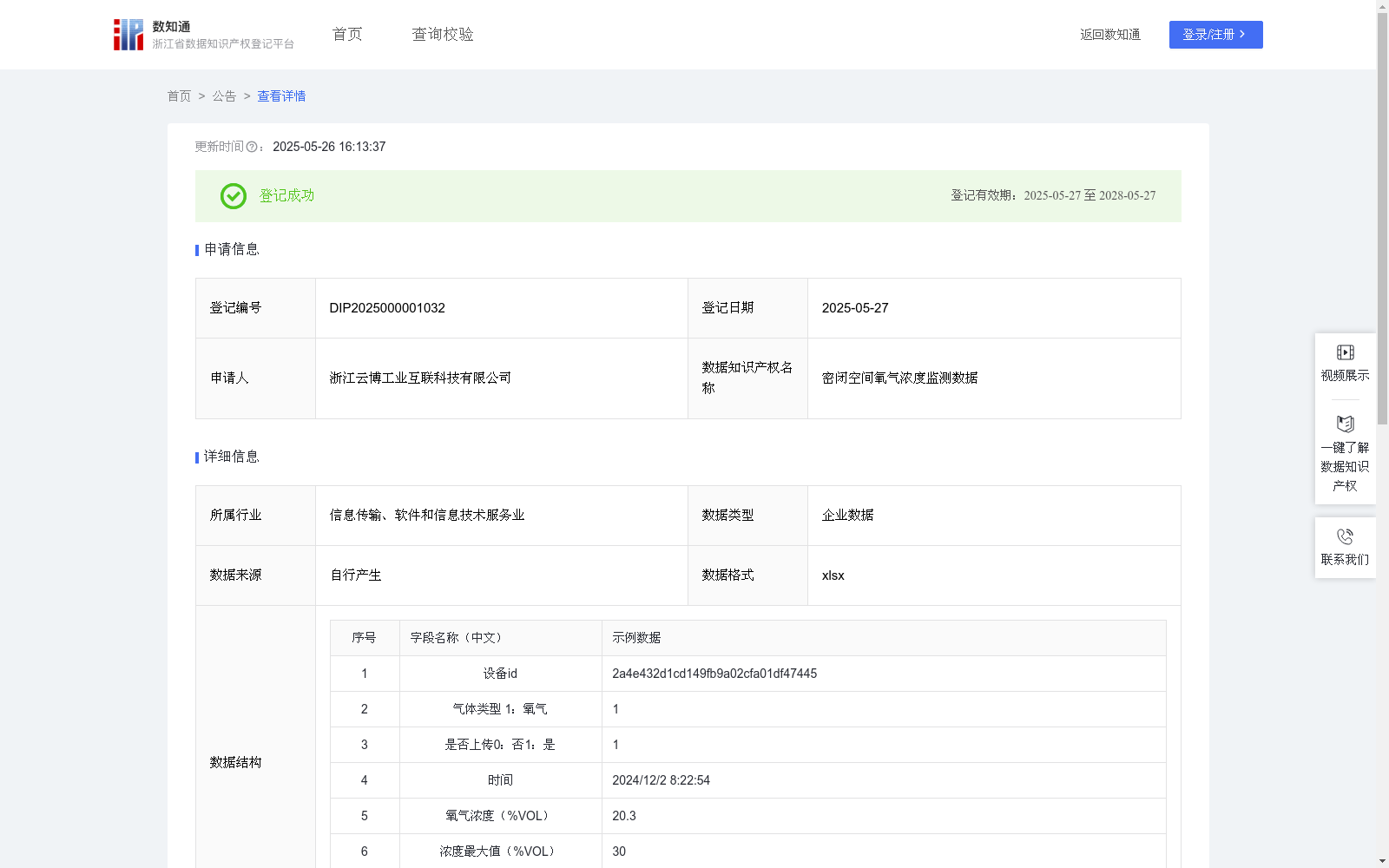
密闭空间氧气浓度监测数据
收藏资源简介:
船舶的货舱、压载舱、燃油舱等区域通常通风不良,容易因货物呼吸作用、化学反应或残留熏剂影响导致氧气浓度降低。在进入这些密闭空间进行作业前,氧气浓度监测系统能够实时检测舱内氧气浓度,确保其在安全范围内(19.5%VOL - 23.5%VOL),通过采集的氧气浓度数据进而来判断空间内是否适合作业,防止人员因缺氧窒息并且浓度过低或者过高时会采用声光报警的形式进行预警。1. 数据采集:通过安装在密闭空间内的高精度氧气传感器,实时采集氧气浓度数据,氧气浓度 ( %VOL )为体积百分比用来表示气体中氧气成分占比,浓度最大值指的是设备最大能测量的气体浓度的最大值即传感器量程。服务器每三秒采集一次气体传感器数据,并将采集到的数据按照时间戳和传感器编号分类存储。采集到的数据通过无线通信模块(lora模块)传输至服务端数据库中,该数据还会同步保存至密闭空间的监控设备中。2. 数据加密:为了确保氧气浓度数据的安全性和完整性,系统会对采集到的气体数据进行 AES非对称加密,加密密钥由服务端统一发送。然后,结合密闭空间的唯一识别码(如设备编号或区域代码)添加crc校验标识并进行加密和压缩处理 ,并将压缩后的数据存储至本地存储模块。加密后的数据通过安全通道上传至岸端存储系统。当本地存储模块达到容量限制时,系统会从岸端检索相应的密钥信息,对上传的数据进行解密与解压并进行crc校验,确保数据在传输和存储过程中不被篡改或损坏。3. 数据分析与报警:在数据上传至服务器后,监控系统按照预设的时间间隔对氧气浓度数据进行分析。系统利用预先设定的阈值(如氧气浓度低于19.5%VOL或高于23.5%VOL)对数据进行实时监测。当检测到氧气浓度超出安全范围时,设备会立即触发声光报警提醒在厂人员,与此同时平台系统自动触发报警机制,通过短信通知或邮件提醒等方式通知相关人员。同时系统会记录报警时间、位置和氧气浓度值以便后续分析。4. 数据应用:系统前端根据氧气浓度的变化趋势和报警记录,提供可视化界面供操作人员实时监控。用户可以通过界面快速定位氧气浓度异常的时间点和位置。通过这一系列操作,系统能够有效提高密闭空间的安全管理水平,确保人员和设备的安全。
Areas such as cargo holds, ballast tanks and fuel tanks on ships are usually poorly ventilated, and their oxygen concentration is prone to decrease due to cargo respiration, chemical reactions or residual fumigants. Before entering these confined spaces for operations, the oxygen concentration monitoring system can detect the oxygen concentration in the tanks in real time, ensuring it stays within the safe range (19.5%VOL - 23.5%VOL). By collecting oxygen concentration data, the system judges whether the space is suitable for operations, preventing personnel from suffering hypoxia-induced asphyxiation. When the concentration is too low or too high, audio and visual alarms will be triggered for early warning. 1. Data Collection: High-precision oxygen sensors installed in confined spaces collect oxygen concentration data in real time. Oxygen concentration (%VOL) refers to the volume percentage used to represent the proportion of oxygen in the gas, and the maximum concentration refers to the maximum measurable gas concentration, i.e., the sensor's measuring range. The server collects gas sensor data every 3 seconds, and stores the collected data in categories according to timestamps and sensor IDs. The collected data is transmitted to the server-side database via a wireless communication module (LoRa module), and is also synchronously saved to the monitoring equipment of the confined space. 2. Data Encryption: To ensure the security and integrity of the oxygen concentration data, the system performs AES asymmetric encryption on the collected gas data, and the encryption keys are uniformly distributed by the server. Then, combined with the unique identification code of the confined space (such as equipment number or area code), a CRC check identifier is added, and the data is encrypted, compressed and processed. The compressed data is stored in the local storage module. The encrypted data is uploaded to the shore-side storage system via a secure channel. When the local storage module reaches its capacity limit, the system retrieves the corresponding key information from the shore side, decrypts and decompresses the uploaded data, and performs CRC verification to ensure that the data is not tampered with or damaged during transmission and storage. 3. Data Analysis and Alarm: After the data is uploaded to the server, the monitoring system analyzes the oxygen concentration data at preset time intervals. The system monitors the data in real time using pre-set thresholds (e.g., oxygen concentration lower than 19.5%VOL or higher than 23.5%VOL). When the oxygen concentration is detected to exceed the safe range, the device will immediately trigger an audio and visual alarm to remind on-site personnel. At the same time, the platform system will automatically trigger an alarm mechanism, notifying relevant personnel via SMS or email alerts. The system will also record the alarm time, location and oxygen concentration value for subsequent analysis. 4. Data Application: The front-end of the system provides a visual interface for operators to monitor in real time based on the oxygen concentration change trend and alarm records. Users can quickly locate the time points and locations where abnormal oxygen concentration occurs through the interface. Through this series of operations, the system can effectively improve the safety management level of confined spaces and ensure the safety of personnel and equipment.