
mahadchangaizkhan/squad
收藏Hugging Face2026-03-28 更新2026-03-29 收录
下载链接:
https://hf-mirror.com/datasets/mahadchangaizkhan/squad
下载链接
链接失效反馈官方服务:
资源简介:
---
annotations_creators:
- crowdsourced
language_creators:
- crowdsourced
- found
language:
- en
license: cc-by-sa-4.0
multilinguality:
- monolingual
size_categories:
- 10K<n<100K
source_datasets:
- extended|wikipedia
task_categories:
- question-answering
task_ids:
- extractive-qa
paperswithcode_id: squad
pretty_name: SQuAD
dataset_info:
config_name: plain_text
features:
- name: id
dtype: string
- name: title
dtype: string
- name: context
dtype: string
- name: question
dtype: string
- name: answers
sequence:
- name: text
dtype: string
- name: answer_start
dtype: int32
splits:
- name: train
num_bytes: 79346108
num_examples: 87599
- name: validation
num_bytes: 10472984
num_examples: 10570
download_size: 16278203
dataset_size: 89819092
configs:
- config_name: plain_text
data_files:
- split: train
path: plain_text/train-*
- split: validation
path: plain_text/validation-*
default: true
train-eval-index:
- config: plain_text
task: question-answering
task_id: extractive_question_answering
splits:
train_split: train
eval_split: validation
col_mapping:
question: question
context: context
answers:
text: text
answer_start: answer_start
metrics:
- type: squad
name: SQuAD
---
# Dataset Card for SQuAD
## Table of Contents
- [Dataset Card for "squad"](#dataset-card-for-squad)
- [Table of Contents](#table-of-contents)
- [Dataset Description](#dataset-description)
- [Dataset Summary](#dataset-summary)
- [Supported Tasks and Leaderboards](#supported-tasks-and-leaderboards)
- [Languages](#languages)
- [Dataset Structure](#dataset-structure)
- [Data Instances](#data-instances)
- [plain_text](#plain_text)
- [Data Fields](#data-fields)
- [plain_text](#plain_text-1)
- [Data Splits](#data-splits)
- [Dataset Creation](#dataset-creation)
- [Curation Rationale](#curation-rationale)
- [Source Data](#source-data)
- [Initial Data Collection and Normalization](#initial-data-collection-and-normalization)
- [Who are the source language producers?](#who-are-the-source-language-producers)
- [Annotations](#annotations)
- [Annotation process](#annotation-process)
- [Who are the annotators?](#who-are-the-annotators)
- [Personal and Sensitive Information](#personal-and-sensitive-information)
- [Considerations for Using the Data](#considerations-for-using-the-data)
- [Social Impact of Dataset](#social-impact-of-dataset)
- [Discussion of Biases](#discussion-of-biases)
- [Other Known Limitations](#other-known-limitations)
- [Additional Information](#additional-information)
- [Dataset Curators](#dataset-curators)
- [Licensing Information](#licensing-information)
- [Citation Information](#citation-information)
- [Contributions](#contributions)
## Dataset Description
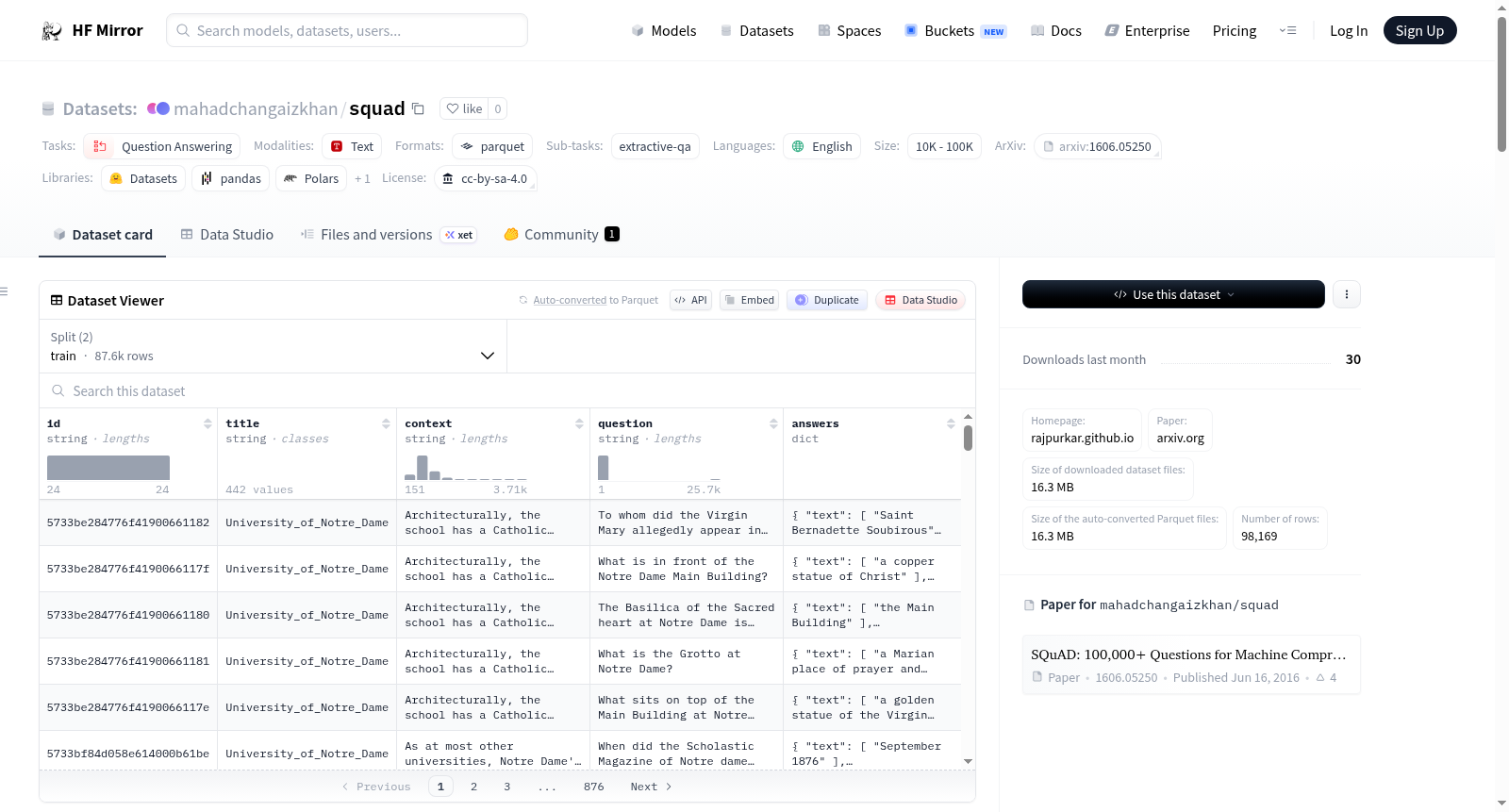
- **Homepage:** https://rajpurkar.github.io/SQuAD-explorer/
- **Repository:** [More Information Needed](https://github.com/huggingface/datasets/blob/master/CONTRIBUTING.md#how-to-contribute-to-the-dataset-cards)
- **Paper:** https://arxiv.org/abs/1606.05250
- **Point of Contact:** [More Information Needed](https://github.com/huggingface/datasets/blob/master/CONTRIBUTING.md#how-to-contribute-to-the-dataset-cards)
### Dataset Summary
Stanford Question Answering Dataset (SQuAD) is a reading comprehension dataset, consisting of questions posed by crowdworkers on a set of Wikipedia articles, where the answer to every question is a segment of text, or span, from the corresponding reading passage, or the question might be unanswerable.
SQuAD 1.1 contains 100,000+ question-answer pairs on 500+ articles.
### Supported Tasks and Leaderboards
Question Answering.
### Languages
English (`en`).
## Dataset Structure
### Data Instances
#### plain_text
- **Size of downloaded dataset files:** 35.14 MB
- **Size of the generated dataset:** 89.92 MB
- **Total amount of disk used:** 125.06 MB
An example of 'train' looks as follows.
```
{
"answers": {
"answer_start": [1],
"text": ["This is a test text"]
},
"context": "This is a test context.",
"id": "1",
"question": "Is this a test?",
"title": "train test"
}
```
### Data Fields
The data fields are the same among all splits.
#### plain_text
- `id`: a `string` feature.
- `title`: a `string` feature.
- `context`: a `string` feature.
- `question`: a `string` feature.
- `answers`: a dictionary feature containing:
- `text`: a `string` feature.
- `answer_start`: a `int32` feature.
### Data Splits
| name |train|validation|
|----------|----:|---------:|
|plain_text|87599| 10570|
## Dataset Creation
### Curation Rationale
[More Information Needed](https://github.com/huggingface/datasets/blob/master/CONTRIBUTING.md#how-to-contribute-to-the-dataset-cards)
### Source Data
#### Initial Data Collection and Normalization
[More Information Needed](https://github.com/huggingface/datasets/blob/master/CONTRIBUTING.md#how-to-contribute-to-the-dataset-cards)
#### Who are the source language producers?
[More Information Needed](https://github.com/huggingface/datasets/blob/master/CONTRIBUTING.md#how-to-contribute-to-the-dataset-cards)
### Annotations
#### Annotation process
[More Information Needed](https://github.com/huggingface/datasets/blob/master/CONTRIBUTING.md#how-to-contribute-to-the-dataset-cards)
#### Who are the annotators?
[More Information Needed](https://github.com/huggingface/datasets/blob/master/CONTRIBUTING.md#how-to-contribute-to-the-dataset-cards)
### Personal and Sensitive Information
[More Information Needed](https://github.com/huggingface/datasets/blob/master/CONTRIBUTING.md#how-to-contribute-to-the-dataset-cards)
## Considerations for Using the Data
### Social Impact of Dataset
[More Information Needed](https://github.com/huggingface/datasets/blob/master/CONTRIBUTING.md#how-to-contribute-to-the-dataset-cards)
### Discussion of Biases
[More Information Needed](https://github.com/huggingface/datasets/blob/master/CONTRIBUTING.md#how-to-contribute-to-the-dataset-cards)
### Other Known Limitations
[More Information Needed](https://github.com/huggingface/datasets/blob/master/CONTRIBUTING.md#how-to-contribute-to-the-dataset-cards)
## Additional Information
### Dataset Curators
[More Information Needed](https://github.com/huggingface/datasets/blob/master/CONTRIBUTING.md#how-to-contribute-to-the-dataset-cards)
### Licensing Information
The dataset is distributed under the CC BY-SA 4.0 license.
### Citation Information
```
@inproceedings{rajpurkar-etal-2016-squad,
title = "{SQ}u{AD}: 100,000+ Questions for Machine Comprehension of Text",
author = "Rajpurkar, Pranav and
Zhang, Jian and
Lopyrev, Konstantin and
Liang, Percy",
editor = "Su, Jian and
Duh, Kevin and
Carreras, Xavier",
booktitle = "Proceedings of the 2016 Conference on Empirical Methods in Natural Language Processing",
month = nov,
year = "2016",
address = "Austin, Texas",
publisher = "Association for Computational Linguistics",
url = "https://aclanthology.org/D16-1264",
doi = "10.18653/v1/D16-1264",
pages = "2383--2392",
eprint={1606.05250},
archivePrefix={arXiv},
primaryClass={cs.CL},
}
```
### Contributions
Thanks to [@lewtun](https://github.com/lewtun), [@albertvillanova](https://github.com/albertvillanova), [@patrickvonplaten](https://github.com/patrickvonplaten), [@thomwolf](https://github.com/thomwolf) for adding this dataset.
提供机构:
mahadchangaizkhan
搜集汇总
数据集介绍
构建方式
在机器阅读理解领域,SQuAD数据集的构建体现了严谨的学术范式。其基础语料源自维基百科的精选文章,确保了文本的规范性与知识广度。通过众包方式,标注者针对每篇文本提出自然语言问题,并精确标注出答案在原文中的起止位置,从而形成了超过十万个高质量的问答对。这种基于真实文本片段进行答案提取的构建方法,为模型提供了学习文本语义关联的可靠基础。
特点
SQuAD数据集的核心特征在于其专注于抽取式问答任务,每个问题的答案均直接对应于给定上下文中的一个连续文本片段。数据集规模适中,包含超过八万七千个训练样本和一万余个验证样本,为模型训练与评估提供了充分的数据支撑。其结构清晰,每个数据实例均包含文章标题、上下文、问题以及带有精确位置信息的答案,这种设计便于模型直接进行端到端的跨度预测研究。
使用方法
该数据集主要用于训练和评估机器阅读理解模型。研究者通常将上下文与问题一同输入模型,目标是从上下文中预测出答案文本的起始与结束位置。数据集的标准划分支持模型在训练集上进行学习,并在验证集上使用精确匹配(Exact Match)和F1分数等指标进行性能评估。其标准化格式也便于集成到主流的深度学习框架中,加速相关算法的迭代与比较。
背景与挑战
背景概述
斯坦福问答数据集(SQuAD)由斯坦福大学的研究团队于2016年发布,旨在推动机器阅读理解领域的发展。该数据集由Pranav Rajpurkar、Jian Zhang、Konstantin Lopyrev和Percy Liang等学者共同构建,核心研究问题聚焦于从给定文本中提取精确答案的抽取式问答任务。SQuAD基于维基百科文章,通过众包方式收集了超过十万个问题-答案对,迅速成为评估自然语言处理模型性能的基准数据集之一,对问答系统、语言理解模型的演进产生了深远影响,促进了预训练语言模型如BERT的突破性进展。
当前挑战
SQuAD数据集致力于解决抽取式问答任务,其核心挑战在于模型需精准定位文本中的答案跨度,并处理语义复杂性及上下文依赖关系。构建过程中,众包标注的一致性保障成为关键难题,确保答案的准确性与边界清晰度要求精细的流程设计。此外,数据源维基百科的多样性虽丰富了内容,但也引入了领域偏差和知识更新滞后等局限,这些因素共同构成了数据集在研究与实际应用中的主要障碍。
常用场景
经典使用场景
在自然语言处理领域,机器阅读理解作为核心任务之一,SQuAD数据集凭借其大规模、高质量的标注特性,成为评估模型性能的经典基准。该数据集通过从维基百科文章中提取段落,并基于这些段落构建问题与答案对,要求模型从给定上下文中精确识别答案片段。这种抽取式问答的设计,使得SQuAD广泛应用于训练和测试各类深度学习模型,尤其是基于Transformer架构的预训练语言模型,如BERT、RoBERTa等,它们在SQuAD上的表现已成为衡量模型理解能力的重要指标。
解决学术问题
SQuAD数据集的推出,有效解决了机器阅读理解研究中缺乏大规模、标准化评估数据的难题。它促进了抽取式问答任务的发展,为研究者提供了统一的评测平台,推动了模型在语义理解、上下文推理和答案定位等方面的进步。该数据集的意义在于,它不仅加速了预训练语言模型的创新,还催生了多项突破性工作,如注意力机制和端到端训练方法的优化,对整个自然语言处理领域的学术研究产生了深远影响,成为该领域不可或缺的基础资源。
衍生相关工作
SQuAD数据集衍生了许多经典研究工作,其中最著名的包括BERT模型,它通过在SQuAD上微调实现了显著的性能提升,开启了预训练语言模型的新纪元。后续的RoBERTa、ALBERT等模型也以SQuAD为基准进行优化,进一步推动了自然语言处理技术的发展。此外,基于SQuAD的挑战赛和排行榜持续激发创新,催生了如BiDAF、QANet等高效架构,这些工作不仅丰富了机器阅读理解的理论体系,还为其他语言任务提供了可借鉴的解决方案。
以上内容由遇见数据集搜集并总结生成



