
The Neural Basis of Conceptualizing the Same Action at Different Levels of Abstraction: spmT Trialwise LOA Parametric Fig3 TabS3
收藏neurovault.org2018-06-30 更新2025-03-26 收录
下载链接:
https://neurovault.org/images/10803
下载链接
链接失效反馈官方服务:
资源简介:
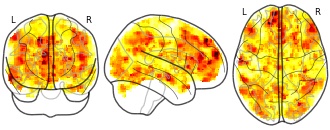
<p>Parametrically Increasing Trialwise Level of Abstraction (LOA)</p>
[](https://neurovault.org/images/10803)
### Collection description
<p>People can conceptualize the same action (e.g., "riding a bike") at different levels of abstraction (LOA), where higher LOAs specify the abstract motives that explain why the action is performed (e.g., "getting exercise"), while lower LOAs specify the concrete steps that indicate how the action is performed (e.g., "gripping handlebars"). Prior neuroimaging studies have shown that why and how questions about actions differentially activate two cortical networks associated with mental-state reasoning and action representation, respectively; however, it remains unknown whether this is due to the differential demands of the questions per se or to the shifts in LOA those questions produce. We conducted functional MRI while participants judged pairs of action phrases that varied in LOA and that could be framed either as a why question (Why ride a bike? Get exercise.) or a how question (How to get exercise? Ride a bike.). Question framing (why vs. how) had no effect on activity in regions of the two networks. Instead, these regions uniquely tracked parametric variation in LOA, both across and within trials. This suggests that the human capacity to understand actions at different levels of abstraction is based in the relative activity of two cortical networks.</p>
###Subject species
homo sapiens
###Modality
fMRI-BOLD
### Cognitive paradigm (task)
why/how task
### Map type
T
<p>参数化提升试验中抽象层次(LOA)</p>
[](https://neurovault.org/images/10803)
### 数据集描述
<p>个体能够以不同的抽象层次(LOA)来概念化同一动作(例如,“骑自行车”),其中较高的LOA规定了说明动作执行原因的抽象动机(例如,“锻炼身体”),而较低的LOA则规定了表示动作执行方式的具象步骤(例如,“握住把手”)。先前神经影像学研究已经表明,关于动作的“为何”和“如何”的问题会分别激活与心智状态推理和动作表征相关的两个皮质网络;然而,尚不清楚这是否源于问题本身的不同需求,或是由于这些问题引发的LOA变化。我们进行了功能性核磁共振成像研究,让参与者判断不同LOA的动作短语的成对出现,这些短语既可以被构造成“为何”问题(为何骑自行车?为了锻炼身体。)或“如何”问题(如何锻炼身体?骑自行车。)。问题的构架(为何对如何)对两个网络区域的活性没有影响。相反,这些区域独特地追踪了LOA的参数化变化,包括跨试验和试验内的变化。这表明,人类理解不同抽象层次动作的能力基于两个皮质网络的相对活性。</p>
### 受试物种
homo sapiens
### 模式
fMRI-BOLD
### 认知范式(任务)
为何/如何任务
### 地图类型
T
提供机构:
NeuroVault


