
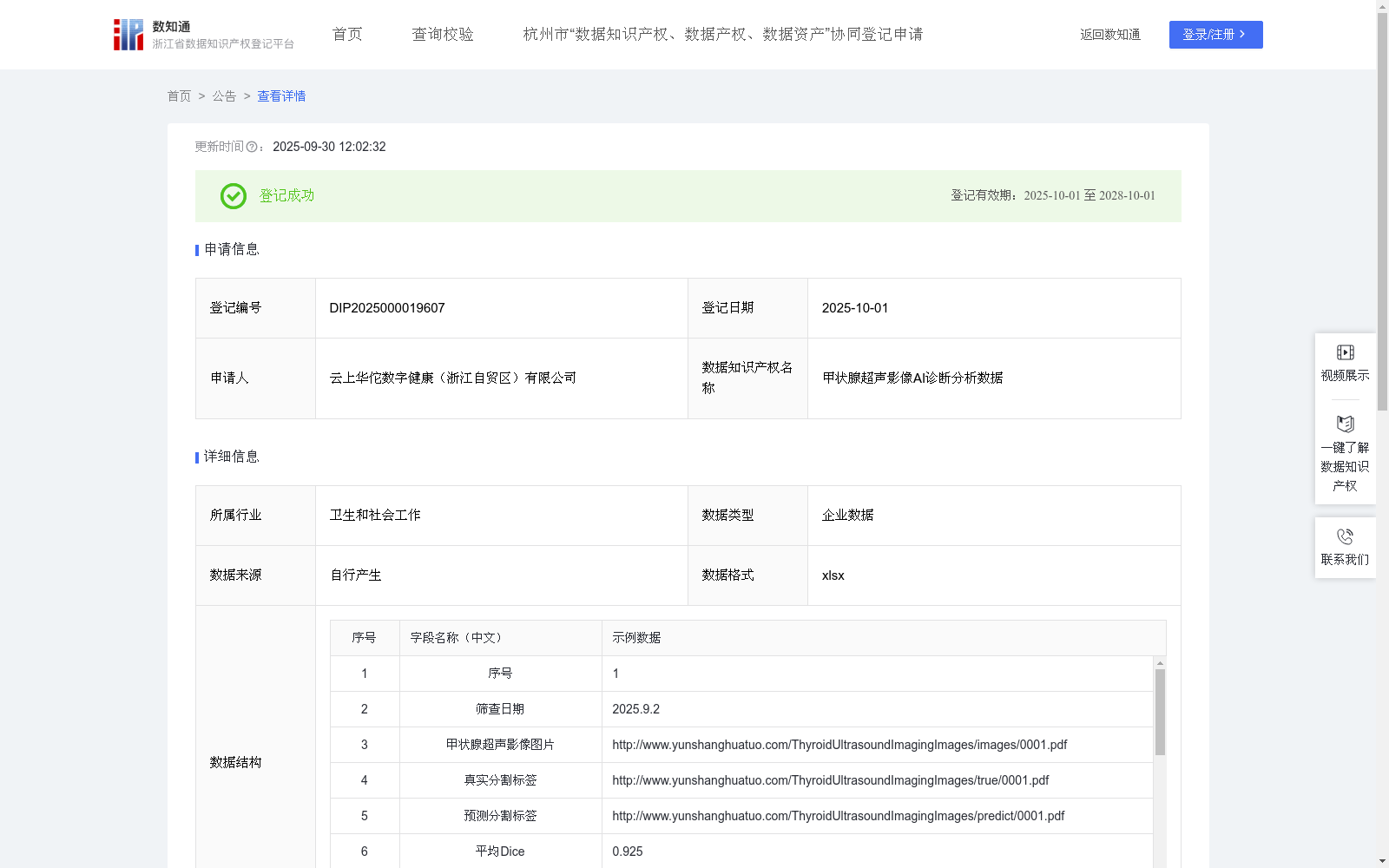
甲状腺超声影像AI诊断分析数据
收藏浙江省数据知识产权登记平台2025-09-30 更新2025-10-04 收录
下载链接:
https://www.zjip.org.cn/home/announce/trends/187949
下载链接
链接失效反馈官方服务:
资源简介:
一、适用条件与对象
适用于接入超声设备的基层医院、医学影像AI公司与设备制造商以及科研院所。主要服务对象包括基层医师、研发工程师和科研人员。
二、解决的问题和痛点
(1)解决基层医院诊断经验不足导致的诊断一致性差、漏误诊率高问题;
(2)突破设备厂商产品智能化水平不足的瓶颈;
(3)缓解科研领域因高质量标注数据匮乏导致的模型研发受阻困境。
三、有益效果
(1)为基层医师提供实时结节识别、特征量化与TI-RADS分级能力,显著提升诊断准确性;
(2)为厂商提供可嵌入的智能诊断模块,增强设备竞争力;
(3)为科研机构提供经质控的标准化数据集,加速算法创新与转化。
四、外部复用价值
(1)核心算法可授权集成至各类超声设备与诊断系统;
(2)脱敏特征数据库可支持多中心研究与模型优化;
(3)标准化诊断流程可推广至基层医疗单位,推动医疗资源均衡化发展。一、数据采集
通过全数字超声诊断仪,采集甲状腺(左叶/右叶)的超声影像图片,收集影像相关的结构化特征信息。
核心字段:
甲状腺超声影像图片:通过URL存储甲状腺超声影像图片(URL链接已脱敏)
真实分割标签:专家标注的真实分割标签(精确标注甲状腺结节区域)
预测分割标签:模型识别的预测分割标签
结节特征数据:结节位置特征(左叶/右叶)、结节形态特征(左叶/右叶)、结节回声特征(左叶/右叶)、结节内部结构、血流信号
诊断数据:结节TI-RADS分级、AI辅助诊断建议
辅助字段:
医生诊断结论用于人工复核。筛查日期用于数据管理。
二、数据处理
对所有甲状腺超声影像图片进行标准化预处理:尺寸归一化(统一超声影像图片分辨率)、图像去噪(减少超声影像斑点噪声)、亮度对比度调整(优化超声影像质量)、特征数据向量化处理
目标:提升后续算法模型的鲁棒性和分割精度
三、核心算法规则 (模型构建与训练)
(1)模型架构:
采用编码器-解码器结构的卷积神经网络(CNN)
模型公式:P=CNNθ(I)
I:预处理后的甲状腺超声影像图片
CNNθ:卷积神经网络模型参数
P:甲状腺结节的预测分割标签图
(2)训练策略:
损失函数:结合Dice损失和二元交叉熵损失
优化器:Adam
性能评估指标:平均Dice系数、平均IoU。在训练和验证阶段,使用平均Dice系数和平均IoU作为核心指标,量化模型预测分割标签结果与真实分割标签之间的重叠精度。
(3)多特征融合:
将影像特征与临床特征(位置、形态、回声等)融合,输出结节TI-RADS分级与AI辅助诊断建议。
四、数据应用
(1)临床诊断辅助:自动生成结节分割结果及量化参数,输出AI辅助诊断建议(基于TI-RADS分级标准);
(2)质量控制:实时监测分割质量(平均Dice≥0.80,平均IoU≥0.70),异常案例自动标记复核;
(3)科研价值:脱敏特征数据库支持模型迭代优化,多中心研究数据标准化支持。
I. Application Conditions and Target Users
Applicable to primary-level hospitals connected to ultrasound equipment, medical imaging AI companies, equipment manufacturers, and research institutions. The main target service groups include primary-level physicians, R&D engineers, and researchers.
II. Solved Problems and Pain Points
(1) Addressing the issues of poor diagnostic consistency and high missed and misdiagnosis rates caused by insufficient diagnostic experience in primary-level hospitals;
(2) Breaking through the bottleneck of insufficient intelligentization level of products from equipment manufacturers;
(3) Alleviating the predicament of stalled model development in the research field due to the shortage of high-quality annotated data.
III. Beneficial Effects
(1) Providing real-time nodule recognition, feature quantification, and TI-RADS classification capabilities for primary-level physicians, significantly improving diagnostic accuracy;
(2) Providing embedable intelligent diagnostic modules for manufacturers to enhance the competitiveness of their equipment;
(3) Providing quality-controlled standardized datasets for research institutions to accelerate algorithm innovation and transformation.
IV. External Reusability Value
(1) The core algorithm can be licensed for integration into various ultrasound equipment and diagnostic systems;
(2) The de-identified feature database can support multi-center research and model optimization;
(3) The standardized diagnostic process can be promoted to primary-level medical institutions, promoting the balanced development of medical resources.
I. Data Collection
Ultrasound images of the thyroid gland (left lobe/right lobe) are collected via full-digital ultrasound diagnostic equipment, and structured feature information related to the images is collected.
Core fields:
- Thyroid ultrasound images: Stored via URLs (the URL links have been de-identified)
- Ground truth segmentation labels: Expert-annotated ground truth segmentation labels (accurately annotating the thyroid nodule regions)
- Predicted segmentation labels: Predicted segmentation labels identified by the model
- Nodule feature data: Nodule location features (left lobe/right lobe), nodule morphology features (left lobe/right lobe), nodule echo features (left lobe/right lobe), nodule internal structure, blood flow signals
- Diagnostic data: Nodule TI-RADS classification, AI-assisted diagnostic recommendations
Auxiliary fields:
- Physician's diagnostic conclusion for manual review; Screening date for data management.
II. Data Processing
Standardized preprocessing is performed on all thyroid ultrasound images: size normalization (unifying the resolution of ultrasound images), image denoising (reducing speckle noise in ultrasound images), brightness and contrast adjustment (optimizing ultrasound image quality), and feature data vectorization processing.
Objective: To improve the robustness and segmentation accuracy of subsequent algorithm models.
III. Core Algorithm Rules (Model Construction and Training)
(1) Model Architecture:
A convolutional neural network (CNN) with an encoder-decoder structure is adopted.
Model formula: $P = CNN_ heta(I)$
Where:
$I$: Preprocessed thyroid ultrasound image
$CNN_ heta$: Convolutional neural network model parameters
$P$: Predicted segmentation label map of thyroid nodules
(2) Training Strategy:
Loss function: Combining Dice loss and binary cross-entropy loss
Optimizer: Adam
Performance evaluation metrics: Average Dice coefficient, average IoU. In the training and validation stages, average Dice coefficient and average IoU are used as core metrics to quantify the overlapping accuracy between the model's predicted segmentation labels and the ground truth segmentation labels.
(3) Multi-feature Fusion:
Fusing image features and clinical features (location, morphology, echo, etc.) to output nodule TI-RADS classification and AI-assisted diagnostic recommendations.
IV. Data Application
(1) Clinical diagnosis assistance: Automatically generate nodule segmentation results and quantitative parameters, and output AI-assisted diagnostic recommendations (based on the TI-RADS classification standard);
(2) Quality control: Real-time monitoring of segmentation quality (average Dice ≥ 0.80, average IoU ≥ 0.70), and automatic marking of abnormal cases for review;
(3) Research value: The de-identified feature database supports model iterative optimization, and provides standardized support for multi-center research data.
提供机构:
云上华佗数字健康(浙江自贸区)有限公司
创建时间:
2025-09-05
搜集汇总
数据集介绍
背景与挑战
背景概述
该数据集是甲状腺超声影像AI诊断分析数据,包含1341条记录,每日更新,涵盖超声影像图片、结节特征和诊断信息,用于AI辅助诊断和科研。其特点包括采用卷积神经网络进行结节分割和TI-RADS分级,支持基层医疗和模型优化,提升诊断准确性和资源均衡化。
以上内容由遇见数据集搜集并总结生成


