
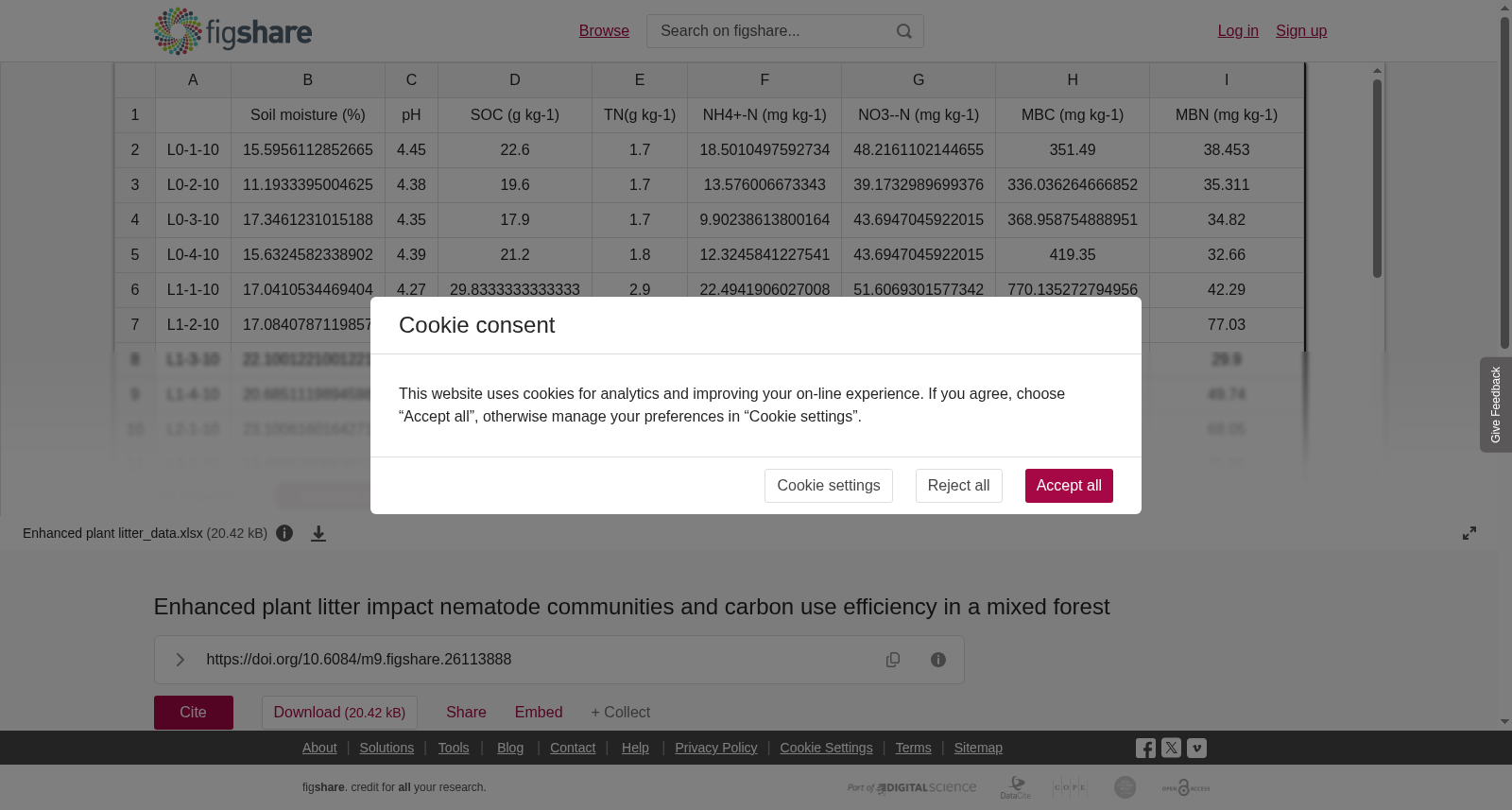
Enhanced plant litter impact nematode communities and carbon use efficiency in a mixed forest
收藏DataCite Commons2024-06-27 更新2024-08-19 收录
下载链接:
https://figshare.com/articles/dataset/Enhanced_plant_litter_impact_nematode_communities_and_carbon_use_efficiency_in_a_mixed_forest/26113888
下载链接
链接失效反馈官方服务:
资源简介:
Rising temperatures and higher atmospheric CO<sub>2</sub> levels can potentially increase plant photosynthesis and boost forest productivity, in turn spurring litter inputs to soils on a global scale. Understanding the feedback loops between increased litter inputs and soil biota activity will allow better prediction of organic matter and carbon (C) cycling in terrestrial ecosystems. Nematodes represent the full spectrum of trophic groups within the soil biota. Accordingly, we studied the link between nematode metabolic activities and plant litter input. For this, different litter input levels were manipulated in a temperate forest, including control zones, natural litter input zones, and zones with double, triple, and quadruple amounts of natural litter input. Soil top layers (0-10 cm) were then collected to study the responses of nematode communities. Increased litter input positively influenced the abundance and diversity of nematodes, except for plant-parasitic species. Higher litter input levels led to an enhancement in the ratio of bacterivores to the total of bacterivores and fungivores. More litter increased the <i>K</i>/<i>r</i> strategist ratio among bacterivores, and the corresponding nematode metabolic footprints. More litter also stimulated nematode production and respiration components and improved the carbon use efficiency of bacterivores. Moreover, the structural equation modeling revealed the crucial role of bacterivores in influencing soil organic C under increased litter input. In conclusion, our study shows that increased plant aboveground litter input modifies the taxonomic and functional communities of soil nematodes, ultimately regulating the carbon cycle in forest soils.
气温升高与大气二氧化碳(CO₂)浓度上升,或可提升植物光合作用效率,增强森林生产力,进而在全球范围内推动土壤枯落物输入量增加。明晰枯落物输入增加与土壤生物群落(soil biota)活动间的反馈机制,有助于更精准地预测陆地生态系统中的有机质与碳(C)循环过程。线虫(nematodes)涵盖了土壤生物群落中全部营养类群的谱系。据此,本研究聚焦线虫代谢活动与植物枯落物输入之间的关联。为此,我们在温带森林中设置了不同梯度的枯落物输入处理组,包括对照组、自然枯落物输入组,以及输入量为自然输入量2倍、3倍、4倍的处理组。随后采集表层0-10厘米的土壤样品,以分析线虫群落的响应特征。枯落物输入增加对线虫的丰度与多样性产生正向促进作用,但植物寄生性线虫除外。更高的枯落物输入水平会提升食细菌线虫(bacterivores)在食细菌线虫与食真菌线虫(fungivores)总丰度中的占比。增加枯落物输入会提升食细菌线虫中K/r对策者(K/r strategist)的比例,以及相应的线虫代谢足迹(metabolic footprints)。更多枯落物输入还可促进线虫的生产与呼吸组分,并提升食细菌线虫的碳利用效率。此外,结构方程模型(structural equation modeling)分析表明,在枯落物输入增加的背景下,食细菌线虫在调控土壤有机碳过程中发挥关键作用。综上,本研究表明,植物地上枯落物输入量的增加会改变土壤线虫的分类学与功能群落结构,最终调控森林土壤的碳循环过程。
提供机构:
figshare
创建时间:
2024-06-27
搜集汇总
数据集介绍
以上内容由遇见数据集搜集并总结生成


