
广东省体检产品消费者分析数据
收藏浙江省数据知识产权登记平台2025-04-11 更新2025-04-12 收录
下载链接:
https://www.zjip.org.cn/home/announce/trends/123266
下载链接
链接失效反馈官方服务:
资源简介:
应用客户价值分层体系能够助力企业精准识别广东省消费群体的差异化需求特征。基于消费潜力与行为偏好的客群画像,企业可构建阶梯式营销方案:面向高净值客群打造专属尊享服务,针对大众消费群体设计普惠型产品组合。依托多维度的消费行为特征分析,企业能深入解析区域市场特征,把握竞品布局动向及消费趋势演变规律,进而优化资源配置策略,提升产品在本地消费生态中的竞争优势。1、数据处理:对采集到的数据进行降噪、清洗、脱敏、聚集、分析。
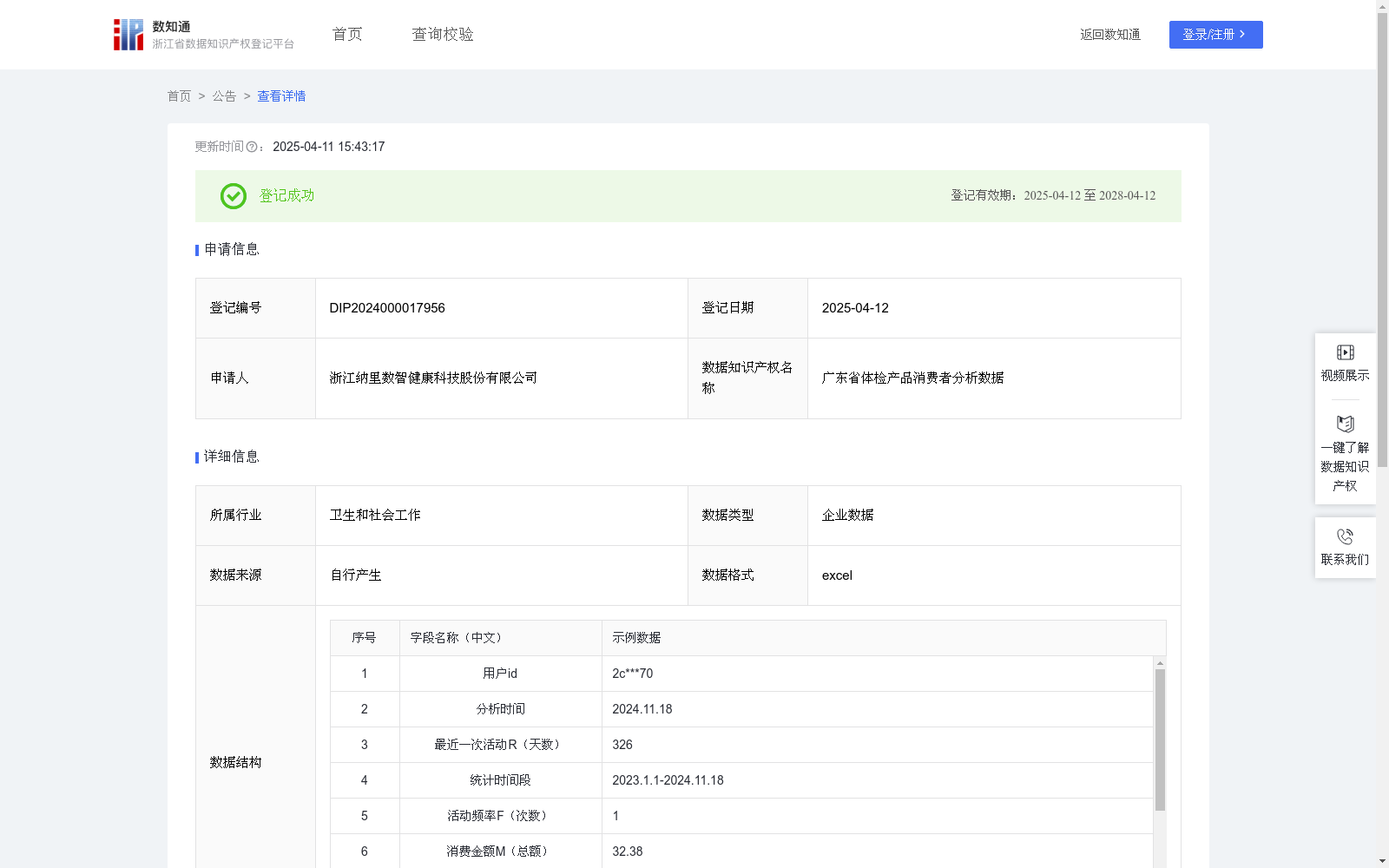
2、数据加工:运用RFM模型 提取出客户最近一次活动R(天数)、活动频率F(次数)、消费金额M(总额),将用户按照最近一次活动(R)进行分类,最近一次活动时间间隔最短的用户排在最上面。按照从1-5评分,前20%的客户获得5分,接下来的20%用户获得4分,再下来20%的客户为3分,再下来20% 的客户为2分,最后20% 的客户为1分。 根据客户活动频率(F)从高到底依次对用户进行分类,前20%的客户在用户活动频率的分数为5,以此类推。 消费金额(M),前20%的客户在消费金额的分数为5,以此类推。消费金额最少的20%客户则分数为1。 RFM得分=(R)得分*0.3+(F)得分*0.3+(M)得分*0.4 评分大于等于4分的为A级客户,大于等于3小于4的为B级客户,大于等于2小于3的为C 级客户,低于2的为D 级客户。
3、 为了精准运营客户,我们根据客户最近一次活动天数、活动频率、消费金额,通过聚类分析将客户分为“A.高粘度客户、B.重要维系客户、C.潜力深耕客户、D.一般客户四类群体。通过调整聚类阀值和维度权重,优化分类合理性,并据此实施差异化服务策略,以提升客户满意度和企业效益。
Applying the customer value stratification system can help enterprises accurately identify the differentiated demand characteristics of consumer groups in Guangdong Province. Based on customer personas constructed from consumption potential and behavioral preferences, enterprises can develop hierarchical marketing programs: create exclusive premium services for high-net-worth customer groups, and design inclusive product portfolios for mass consumer groups. Relying on multi-dimensional analysis of consumer behavior characteristics, enterprises can deeply analyze regional market features, grasp the layout trends of competing products and the evolution laws of consumption trends, thereby optimizing resource allocation strategies and enhancing the competitive advantages of products in the local consumption ecosystem.
1. Data Processing: Noise reduction, cleaning, data desensitization, aggregation and analysis are performed on the collected data.
2. RFM-based Data Processing: The RFM model is adopted to extract three core indicators: Recency (R, days since the last customer activity), Frequency (F, total number of activities), and Monetary value (M, total consumption amount). Users are first classified by Recency (R): users with the shortest interval since their last activity are ranked first. Users are scored on a 1-5 scale, where the top 20% of users receive a score of 5, the next 20% receive 4, the subsequent 20% receive 3, the following 20% receive 2, and the last 20% receive 1. Next, users are classified by Activity Frequency (F) in descending order: the top 20% of users by frequency get a score of 5, and the rest follow the same scoring rule. For Monetary value (M), the top 20% of users receive a score of 5, while the bottom 20% with the lowest consumption amount receive a score of 1. The RFM comprehensive score is calculated as: RFM Score = (R Score) * 0.3 + (F Score) * 0.3 + (M Score) * 0.4. Customers are categorized into four grades: Grade A (score ≥ 4), Grade B (3 ≤ score < 4), Grade C (2 ≤ score < 3), and Grade D (score < 2).
3. Clustering-based Customer Group Classification: To achieve precise customer operation, customers are divided into four groups via cluster analysis based on their days since last activity, activity frequency and consumption amount: "A. High-engagement Customers", "B. Key Retention Customers", "C. Potential In-depth Cultivation Customers", "D. General Customers". The rationality of the classification is optimized by adjusting clustering thresholds and dimensional weights, and differentiated service strategies are implemented accordingly to improve customer satisfaction and corporate benefits.
提供机构:
浙江纳里数智健康科技股份有限公司
创建时间:
2024-12-02
搜集汇总
数据集介绍
背景与挑战
背景概述
该数据集包含1236条广东省体检产品消费者的分析数据,采用RFM模型对客户进行分类和评分,每日更新,适用于客户价值分层和精准营销策略制定。
以上内容由遇见数据集搜集并总结生成


