dataforge-sft-trajectories
收藏资源简介:
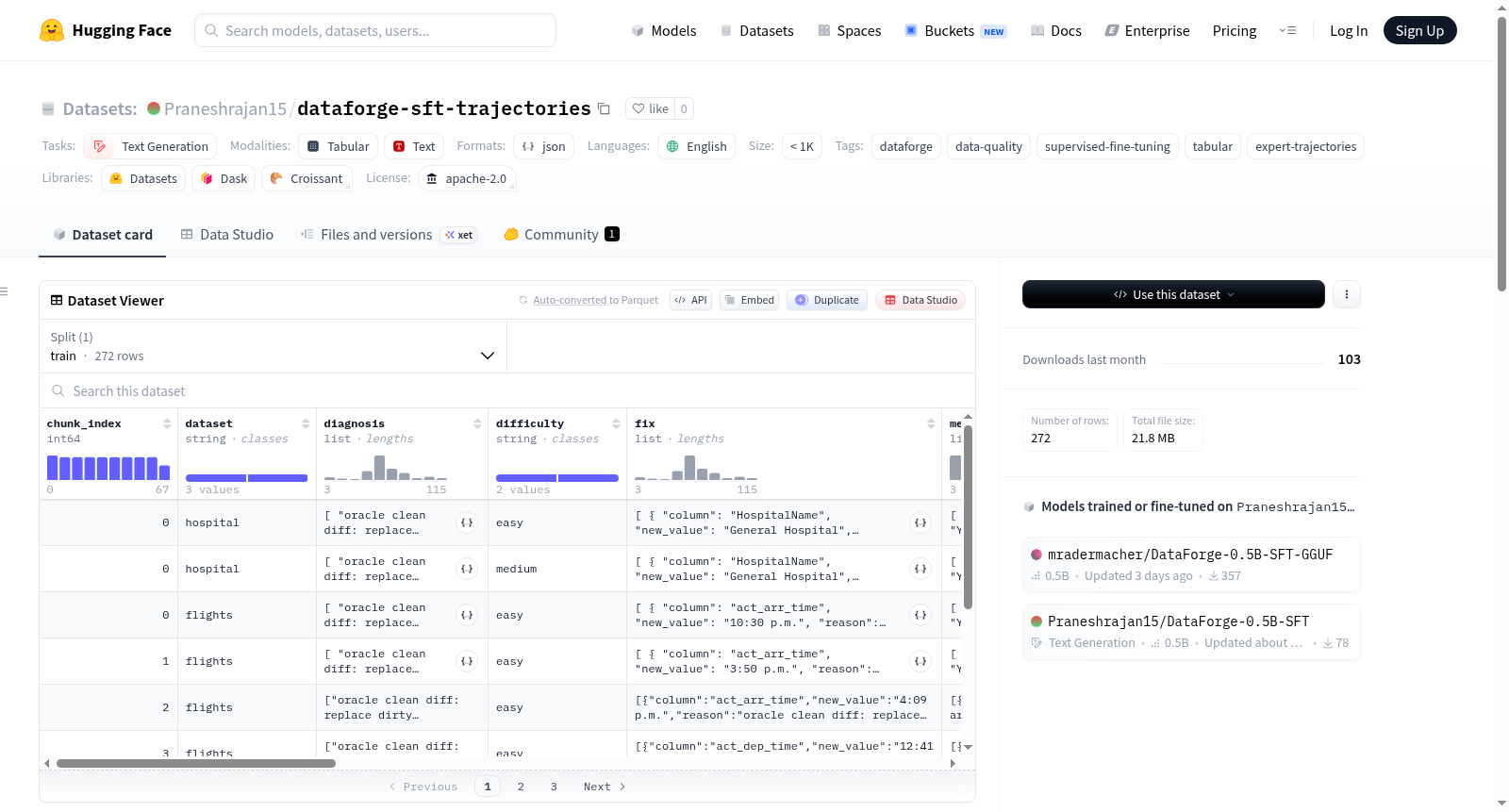
DataForge SFT Trajectories 是一个用于表格数据修复任务的小规模专家监督微调轨迹数据集。该数据集旨在为 DataForge Week 9 热启动模型提供训练数据,主要目的是验证从 Kaggle 到 Hugging Face 的训练流程,而非用于建立模型质量基准。数据集核心文件为 expert_v1.jsonl,其中包含可审计的、聊天风格的修复轨迹记录。每条 JSONL 记录包含丰富的字段信息:模式版本、轨迹ID、任务ID、源数据集名称、任务难度、随机种子、数据块索引、观察到的状态、教师消息、工具调用摘要、建议的修复方案、教师元数据、评估指标以及数据来源。数据来源于 DataForge-Bench-light 框架,覆盖了 Raha 的 Hospital、Flights 和 Beers 基准数据源。当前公开的版本仅包含从 Hospital 数据集的简单任务中收集的记录,这些记录由一个托管在 Groq 上的 llama-3.3-70b-versatile ReAct 教师模型生成,并在保留前经过了基于 F1 分数阈值的过滤。该数据集适用于以下场景:复现 DataForge 0.5B 模型的 SFT 热启动工作流程;审计提交给 Kaggle 笔记本的确切训练数据;在 DataForge 的验证器和事务假设下,训练或调试小型的表格数据修复智能体。需要注意的是,这是一个规模很小的数据集(记录数少于1000条),不应被视为广泛的数据清洗基准。教师模型的输出即使在过滤后也可能包含错误,且该数据集不能替代在独立评估集(如 dataforge-evals)上进行的确切单元格级真值对比。
DataForge SFT Trajectories is a small-scale expert supervised fine-tuning trajectories dataset for table data repair tasks. It is designed to provide training data for the DataForge Week 9 warm-start model, primarily to validate the training pipeline from Kaggle to Hugging Face, rather than to establish a model quality benchmark. The core file of the dataset is expert_v1.jsonl, which contains auditable, chat-style repair trajectory records. Each JSONL record includes rich field information: schema version, trajectory ID, task ID, source dataset name, task difficulty, random seed, data chunk index, observed state, teacher message, tool call summary, proposed fix, teacher metadata, evaluation metrics, and data provenance. The data is sourced from the DataForge-Bench-light framework, covering Rahas Hospital, Flights, and Beers benchmark data sources. The currently released version only includes records collected from simple tasks in the Hospital dataset, generated by a llama-3.3-70b-versatile ReAct teacher model hosted on Groq, and filtered based on an F1 score threshold before retention. The dataset is suitable for the following scenarios: reproducing the SFT warm-start workflow for the DataForge 0.5B model; auditing the exact training data submitted to Kaggle notebooks; training or debugging small table data repair agents under DataForges validator and transaction assumptions. It should be noted that this is a very small dataset (with fewer than 1000 records) and should not be considered a broad data cleaning benchmark. The teacher models output may contain errors even after filtering, and this dataset cannot replace exact cell-level truth comparisons on independent evaluation sets such as dataforge-evals.