Reactions of a Cyclopentadienyl–Amidinate Titanium Benzimidamido Complex
收藏资源简介:
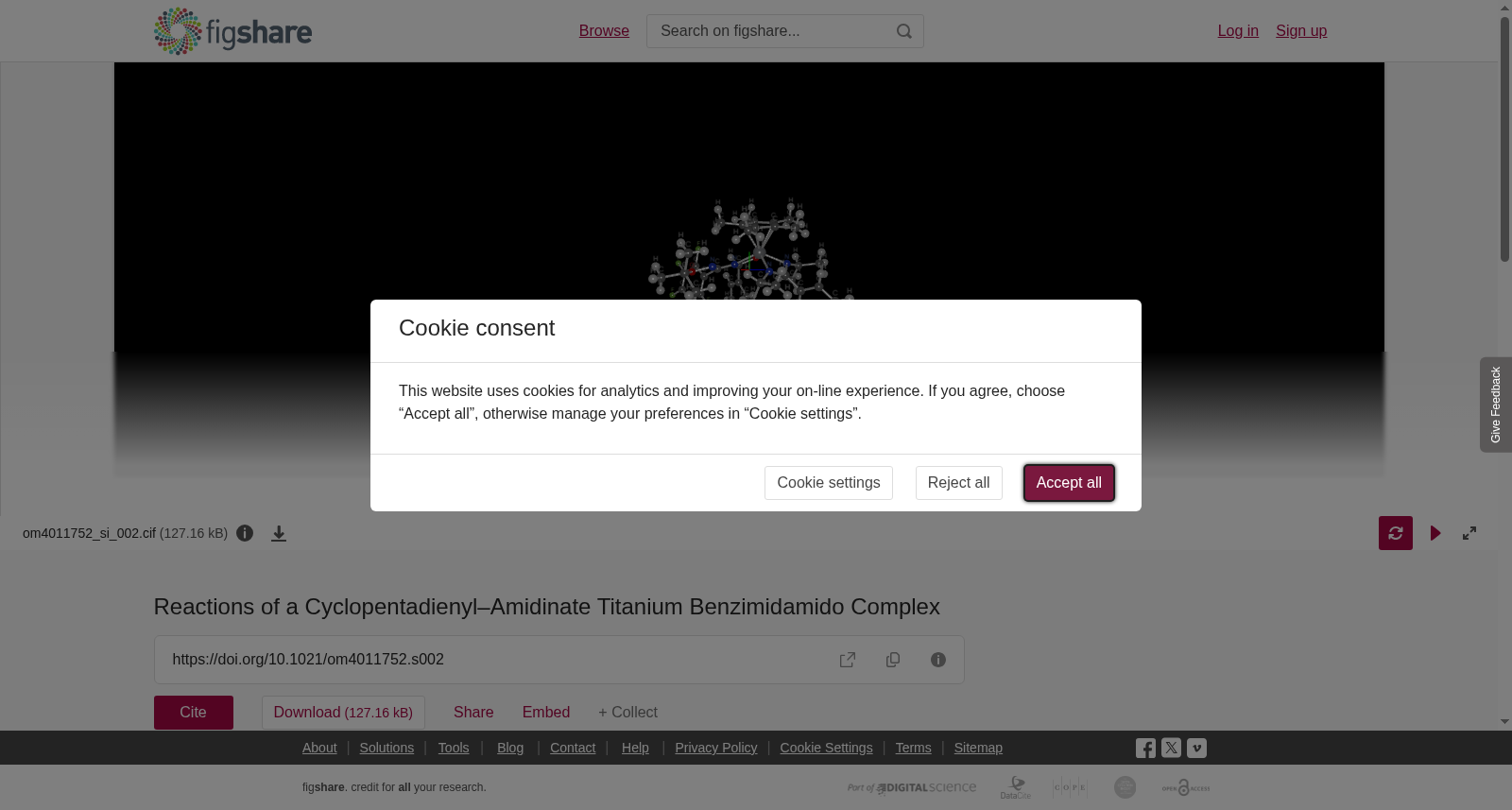
We report the first reactivity study of a transition-metal benzimidamido complex, namely Cp*Ti{PhC(NiPr)2}{NC(ArF5)NOtBu} (5, ArF5 = C6F5). Reaction with CO2 and tBuNCO gave the cycloaddition products Cp*Ti{PhC(NiPr)2}{OC(O)N(C{ArF5}NOtBu)} and Cp*Ti{PhC(NiPr)2}{OC(NtBu)N(C{ArF5}NOtBu)} (10), respectively, whereas with CS2 slow extrusion of ArF5CN from 5 occurred to ultimately form Cp*Ti{PhC(NiPr)2}{SC(S)N(OtBu)}. Reaction of 5 with ArC(O)H (Ar = Ph, 4-C6H4Me, 4-C6H4tBu, 4-C6H4OMe, 4-C6H4NMe2, 4-C6H4CF3) also gave the isolable metallacyclic complexes Cp*Ti{PhC(NiPr)2}{N(C{ArF5}NOtBu)C(Ar)(H)O} (13) via reversible [2 + 2] cycloaddition reactions. In contrast, reaction with HC(O)NMe2 formed Me2N{NC(ArF5)NOtBu}H (16) within 1 h at room temperature. Upon heating, 10 and 13 also underwent retrocyclization, forming the organic products tBuNCNC(ArF5)NOtBu and ArC{NC(ArF5)NOtBu}H (14), respectively. Selected examples of 14 and 16 were studied by DFT and UV–visible spectroscopy. Addition of isonitriles tBuNC and XylNC (Xyl = 2,6-C6H3Me2) to Cp*Ti{PhC(NiPr)2}{NC(Ar)NOtBu} (Ar = ArF5 (5), 2,6-C6H3F2 (ArF2)) afforded the σ adducts Cp*Ti{PhC(NiPr)2}{NC(Ar)NOtBu}(CNR) (Ar = ArF5, R = tBu, Xyl (19); Ar = ArF2, R = Xyl). Subsequently, 19 formed Cp*Ti{PhC(NiPr)2}{NC(NOtBu)C6F4N(Xyl)C}(F) (20) via C–F bond activation. Reaction of 5 with 2 equiv of B(ArF5)3 gave Cp*Ti{PhC(NiPr)2}{ON(B{ArF5}3)C(ArF5)N(H)(B{ArF5}3)} with elimination of 2-methylpropene.
本研究首次报道了过渡金属苯甲脒基配合物的反应性研究,该配合物为五甲基环戊二烯基(Cp*,pentamethylcyclopentadienyl)Ti{Ph(苯基,phenyl)C(NiPr)₂}{NC(ArF5)NOtBu}(记为化合物5,其中ArF5 = C6F5)。该配合物与二氧化碳(CO2)及叔丁基异氰酸酯(tBuNCO)发生环加成反应,分别得到环加成产物Cp*Ti{PhC(NiPr)₂}{OC(O)N(C{ArF5}NOtBu)}与Cp*Ti{PhC(NiPr)₂}{OC(NtBu)N(C{ArF5}NOtBu)}(均记为化合物10);而该配合物与二硫化碳(CS2)反应时,会缓慢脱除五氟苯甲腈(ArF5CN),最终生成Cp*Ti{PhC(NiPr)₂}{SC(S)N(OtBu)}。化合物5与芳醛(ArC(O)H,Ar分别为Ph、4-C6H4Me、4-C6H4tBu、4-C6H4OMe、4-C6H4NMe2、4-C6H4CF3)反应,通过可逆[2+2]环加成反应,可分离得到金属环配合物Cp*Ti{PhC(NiPr)₂}{N(C{ArF5}NOtBu)C(Ar)(H)O}(记为化合物13)。与之相反,化合物5与N,N-二甲基甲酰胺(HC(O)NMe2)在室温下反应1小时内即可生成Me2N{NC(ArF5)NOtBu}H(记为化合物16)。加热条件下,化合物10与13同样会发生逆环化反应,分别生成有机产物tBuNCNC(ArF5)NOtBu与ArC{NC(ArF5)NOtBu}H(记为化合物14)。研究人员选取部分化合物14与16的样品,通过密度泛函理论(DFT,Density Functional Theory)与紫外-可见分光光度法(UV–visible spectroscopy)进行了表征分析。将异腈类化合物(isonitriles)叔丁基异腈(tBuNC)与二甲苯基异腈(XylNC,Xyl=2,6-C6H3Me2)加入到Cp*Ti{PhC(NiPr)₂}{NC(Ar)NOtBu}(Ar分别为ArF5(即化合物5)、2,6-C6H3F2(记为ArF2))的体系中,可得到σ加合物(σ adducts)Cp*Ti{PhC(NiPr)₂}{NC(Ar)NOtBu}(CNR),具体包括Ar=ArF5、R=tBu或Xyl(记为化合物19)以及Ar=ArF2、R=Xyl的产物。随后,化合物19通过碳氟键活化(C–F bond activation)反应,生成Cp*Ti{PhC(NiPr)₂}{NC(NOtBu)C6F4N(Xyl)C}(F)(记为化合物20)。化合物5与2当量的三(五氟苯基)硼(B(ArF5)3)发生反应,消除2-甲基丙烯(2-methylpropene)后,生成Cp*Ti{PhC(NiPr)₂}{ON(B{ArF5}3)C(ArF5)N(H)(B{ArF5}3)}。