
Perceptions_of_Animals_Close_Encounter_Images.csv
收藏DataCite Commons2021-03-01 更新2024-08-18 收录
下载链接:
https://figshare.com/articles/dataset/Perceptions_of_Animals_Close_Encounter_Images_csv/14093303
下载链接
链接失效反馈官方服务:
资源简介:
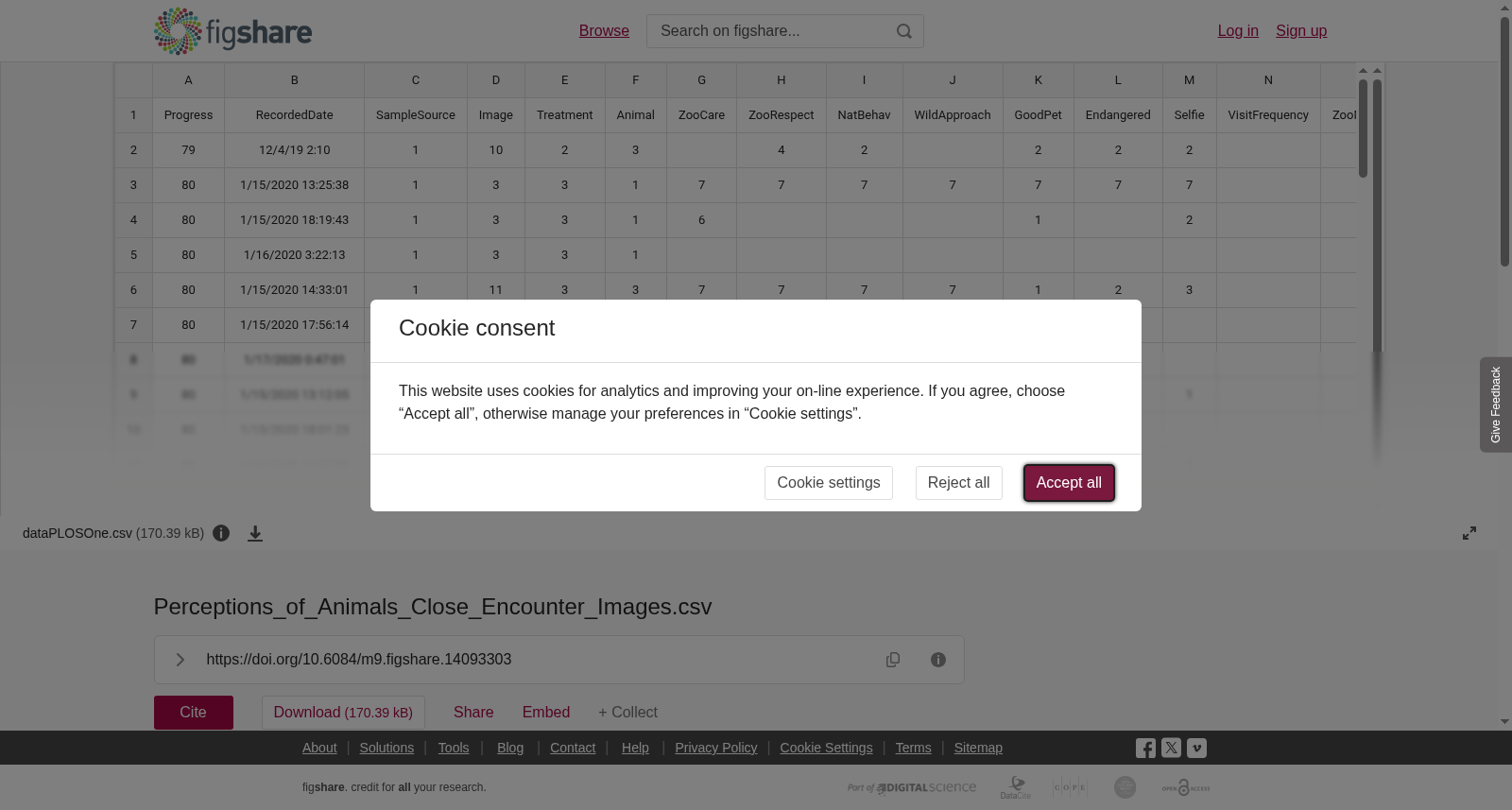
This study measured the effects that viewing such encounter images had on public perceptions of both the zoo and the animal they saw. Via online survey, one of sixteen images was randomly presented to two samples: one consisting of social media users and followers of zoos, and a representative sample of the Australian public. Each image featured one of four animals (Eclectus parrot, Kangaroo Island kangaroo, Monteith’s leaf insect, Centralian carpet python) and one of four Human Positions (human and animal touching, human and animal ~30cm apart, human and animal ~1m apart, animal alone). <br>The survey then asked for respondents' to rate their agreement level to four different statements: 1) The animal is cared for by the zoo2) The animal is displaying a natural behaviour3) The animal would make a good pet4) The animal is endangered in the wildLevel of agreement to these statements was measured through a 7 point Likert-type scale that ranged from 1 = Strongly disagree to 7 = Strongly agree, with the midpoint of 4= Neither agree nor disagree.<br>Respondents also provided demographic data (gender, age, level of education, residential location, zoo membership status, zoo visitation regularity and conservation organisation membership status). <br>All data is non-identifiable, and participants provided consent for their responses to be used for research and publication. Human ethics approval was provided by the University ethics team. Additionally, animal welfare was ensured throughout the photography process by zoo staff and following zoo protocol. <br>Key: Sample Source: 1- Social Media Users, 2- General Australian PopulationImage: 1- Parrot and Touch position, 2- Parrot and Human Close, 3- Parrot and Human Far, 4- Parrot Alone, 5- Kangaroo and Touch Position, 6- Kangaroo and Human Close, 7- Kangaroo and Human Far, 8- Kangaroo Alone, 9- Leaf Insect and Touch Position, 10- Leaf Insect and Human Close, 11- Leaf Insect and Human Far, 12- Leaf Insect Alone, 13- Snake and Touch Position, 14- Snake and Human Close, 15- Snake and Human Far, 16- Snake AloneTreatment: 1- Human Touching Animal, 2- Human and Animal ~30cm apart (Close), 3- Human and Animal ~1m apart (Far), 4- Animal Alone Animal: 1-Parrot, 2- Kangaroo, 3- Leaf Insect, 4- Snake<br>
本研究量化评估了观赏此类人与动物互动影像后,公众对动物园及其所展示动物的认知变化。
本研究通过线上问卷开展实验:向两组受试者随机展示16张影像中的其中一张——第一组为社交媒体用户及动物园粉丝,第二组为具有代表性的澳大利亚普通民众。每张影像均展示四种动物之一(折衷鹦鹉(Eclectus parrot)、袋鼠岛袋鼠(Kangaroo Island kangaroo)、蒙蒂思叶䗛(Monteith’s leaf insect)、中部地毯蟒(Centralian carpet python)),以及四种人与动物互动场景之一:人与动物肢体接触、人与动物间距约30厘米、人与动物间距约1米、仅展示动物。
随后问卷要求受试者对四项陈述的同意程度进行评分:1) 该动物由动物园妥善照料;2) 该动物展现出自然行为;3) 该动物适合作为宠物;4) 该动物在野外处于濒危状态。评分采用7级李克特(Likert)量表,分值1至7分别对应“完全不同意”至“完全同意”,其中分值4代表“既不同意也不反对”。
受试者还需提供人口统计学信息,包括性别、年龄、受教育程度、居住地区、动物园会员身份、参观动物园的频率,以及环保组织会员身份。
所有数据均无法识别受访者身份,受试者已同意将其作答内容用于研究及发表。本研究已获得大学伦理委员会的人类受试者伦理审批。此外,整个影像拍摄过程均由动物园工作人员按照动物园规程开展,确保了动物福利。
标注说明:
样本来源:1- 社交媒体用户,2- 澳大利亚普通民众
影像编号对应:1- 鹦鹉+肢体接触场景,2- 鹦鹉+近距离互动场景,3- 鹦鹉+远距离互动场景,4- 仅鹦鹉场景,5- 袋鼠+肢体接触场景,6- 袋鼠+近距离互动场景,7- 袋鼠+远距离互动场景,8- 仅袋鼠场景,9- 叶䗛+肢体接触场景,10- 叶䗛+近距离互动场景,11- 叶䗛+远距离互动场景,12- 仅叶䗛场景,13- 蛇+肢体接触场景,14- 蛇+近距离互动场景,15- 蛇+远距离互动场景,16- 仅蛇场景
互动处理分组:1- 人与动物肢体接触,2- 人与动物间距约30厘米(近距离),3- 人与动物间距约1米(远距离),4- 仅展示动物
动物类别:1- 鹦鹉,2- 袋鼠,3- 叶䗛,4- 蛇
提供机构:
figshare创建时间:
2021-02-23
搜集汇总
数据集介绍
以上内容由遇见数据集搜集并总结生成


