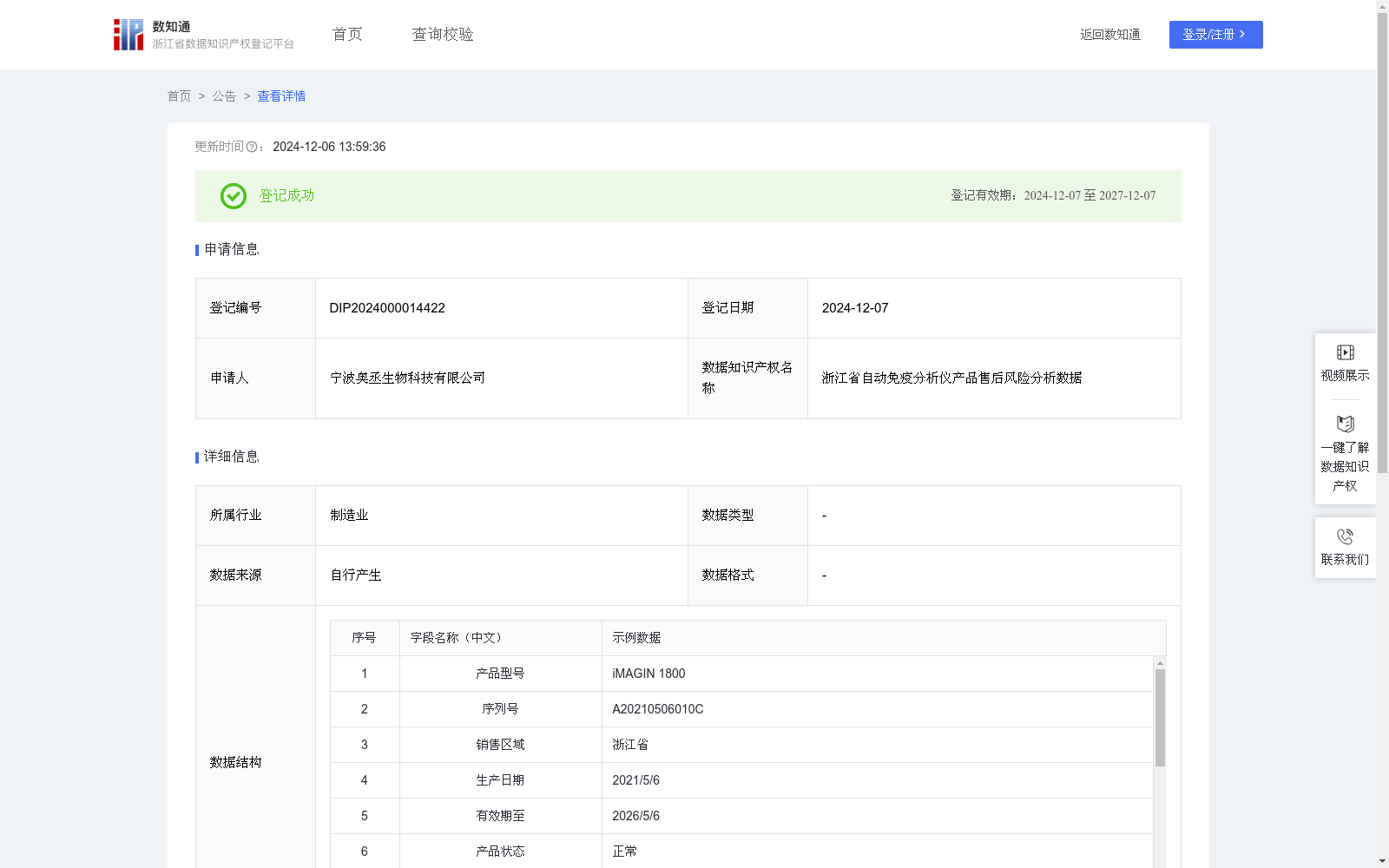
浙江省自动免疫分析仪产品售后风险分析数据
收藏资源简介:
本公司通过识别产品的风险分析数据,可为已售产品提供定制化的售后服务方案,优化服务优先级策略,提高产品可靠性和客户满意度。市场分析机构或产品维修服务商可以基于产品销售区域、产品状态、保修期状态和产品风险数据,进一步统计分析和评估浙江省的自动免疫分析仪产品售后服务市场潜在机会。高风险评分的产品可能更早进入回收流程,本数据可为医疗设备回收企业提供信息支持。1.数据收集和预处理:从公司内部产品数据库中收集已售往浙江省的产品使用数据,包括产品型号、序列号、销售区域、生产日期、有效期至、产品状态、安装日期、保修期至、保修期状态、维修次数。通过数据清洗去除无效或错误记录,确保数据质量。 2.风险因素识别及权重分配:基于产品状态、保修期状态、维修次数等信息,识别影响产品风险的关键因素。按以下规则进行风险权重分配:产品状态:正常:权重1;临期:权重2;过期:权重3。保修期状态:在保:权重1;过期:权重2;维修次数:每增加一次维修,风险评分增加0.5分。 3.风险评分计算:风险评分 = (产品状态权重 + 保修期状态权重 + 维修次数 * 0.5)。 4.逻辑回归模型:使用历史数据训练逻辑回归模型,以风险评分为目标变量,产品状态、保修期状态、维修次数为特征变量。模型训练完成后,使用模型预测每个产品的风险评分。 5.风险评分标准化:将预测的风险评分用Min-Max算法(一种常用的将数据缩放到一个指定的范围内的算法)标准化到1-5的范围内。 6.风险等级划分:低风险:≤2;中风险:2(不含)~4(含);高风险:4(不含)~5(含)。
Our company, by leveraging product risk analysis data, can provide customized after-sales service solutions for sold products, optimize service priority strategies, and enhance product reliability and customer satisfaction. Market analysis institutions or product maintenance service providers can, based on product sales region, product status, warranty status and product risk data, conduct further statistical analysis and evaluate potential opportunities in the after-sales service market for automated immunoassay analyzer products in Zhejiang Province. Products with high risk scores may enter the recycling process earlier, and this dataset can provide information support for medical equipment recycling enterprises. 1. Data Collection and Preprocessing: Collect product usage data of products sold to Zhejiang Province from the company's internal product database, including product model, serial number, sales region, production date, expiration date, product status, installation date, warranty expiration date, warranty status, and number of repairs. Conduct data cleaning to remove invalid or erroneous records to ensure data quality. 2. Risk Factor Identification and Weight Allocation: Identify key factors affecting product risk based on information such as product status, warranty status and number of repairs. Allocate risk weights in accordance with the following rules: Product status: Normal: weight 1; Near expiry: weight 2; Expired: weight 3. Warranty status: Under warranty: weight 1; Expired: weight 2. For the number of repairs: each additional repair increases the risk score by 0.5 points. 3. Risk Score Calculation: Risk score = (Product status weight + Warranty status weight + Number of repairs * 0.5). 4. Logistic Regression Model: Train a logistic regression model using historical data, with risk score as the target variable and product status, warranty status and number of repairs as feature variables. Once the model is trained, use it to predict the risk score for each product. 5. Risk Score Standardization: Standardize the predicted risk scores to the range of 1-5 using the Min-Max algorithm (a commonly used algorithm that scales data to a specified range). 6. Risk Level Classification: Low risk: ≤2; Medium risk: 2 (exclusive) to 4 (inclusive); High risk: 4 (exclusive) to 5 (inclusive).