
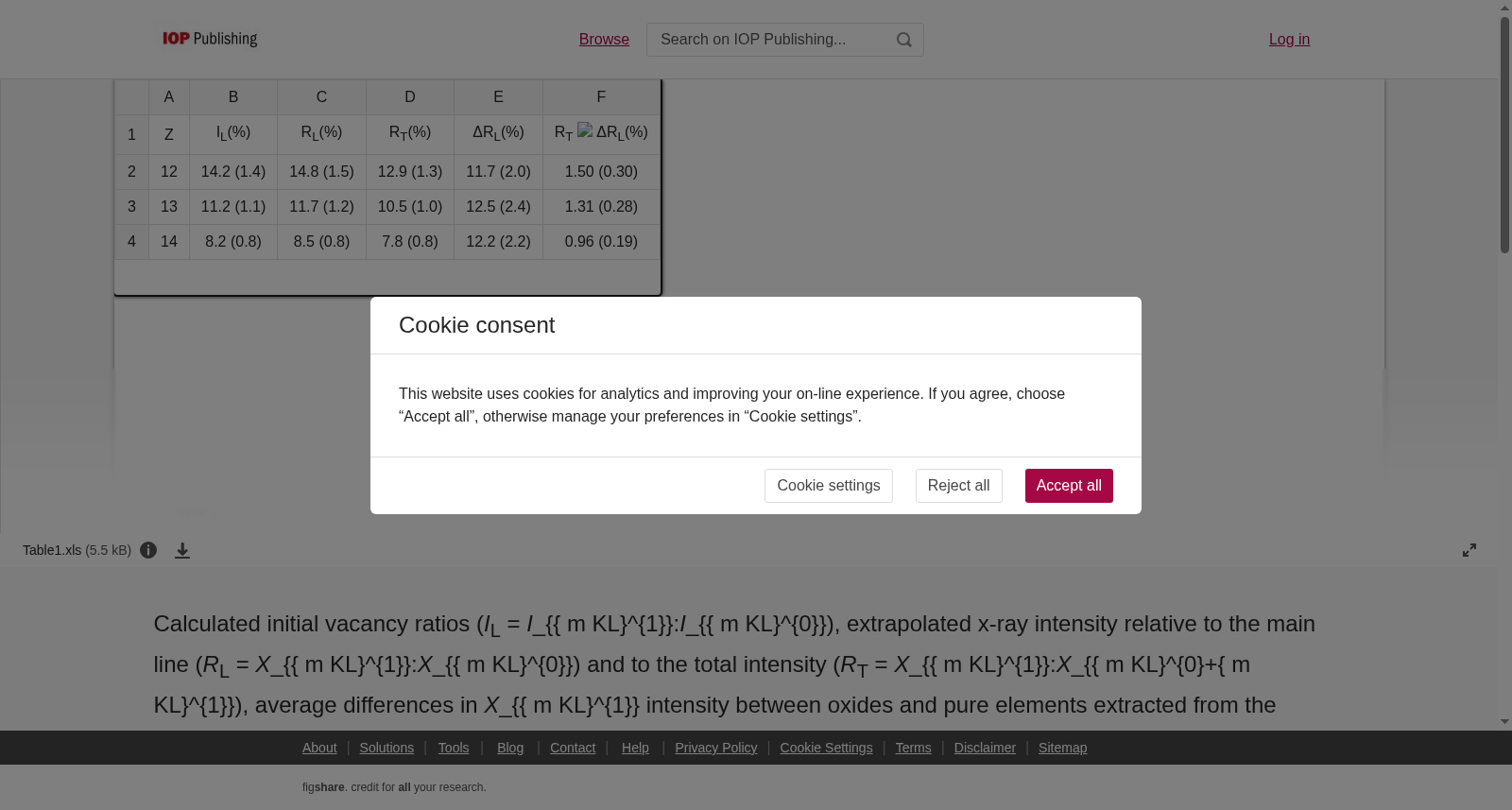
Calculated initial vacancy ratios (IL = I_{{ m KL}^{1}}:I_{{ m KL}^{0}}), extrapolated x-ray intensity relative to the main line (RL = X_{{ m KL}^{1}}:X_{{ m KL}^{0}}) and to the total intensity (RT = X_{{ m KL}^{1}}:X_{{ m KL}^{0}+{ m KL}^{1}}), average differences in X_{{ m KL}^{1}} intensity between oxides and pure elements extracted from the literature (ΔRL), and the product effect on the total x-ray yield
收藏Mendeley Data2024-06-29 更新2024-06-27 收录
下载链接:
https://iop.figshare.com/articles/dataset/_Calculated_initial_vacancy_ratios_em_I_em_sub_L_sub_em_I_em_span_xmlns_xlink_http_www_w3_org_1999_x/1012792/1
下载链接
链接失效反馈官方服务:
资源简介:
Table 1. Calculated initial vacancy ratios (IL = I_{{\rm KL}^{1}}:I_{{\rm KL}^{0}}), extrapolated x-ray intensity relative to the main line (RL = X_{{\rm KL}^{1}}:X_{{\rm KL}^{0}}) and to the total intensity (RT = X_{{\rm KL}^{1}}:X_{{\rm KL}^{0}+{\rm KL}^{1}}), average differences in X_{{\rm KL}^{1}} intensity between oxides and pure elements extracted from the literature (ΔRL), and the product effect on the total x-ray yield. Absolute uncertainties are listed in parentheses. Abstract Proton-induced x-ray emission (PIXE) was used to assess the accuracy of the National Institute of Standards and Technology XCOM and FFAST photo-ionization cross-section databases in the low energy region (1–2 keV) for light elements. Characteristic x-ray yields generated in thick samples of Mg, Al and Si in elemental and oxide form, were compared to fundamental parameters computations of the expected x-ray yields; the database for this computation included XCOM attenuation coefficients. The resultant PIXE instrumental efficiency constant was found to differ by 4–6% between each element and its oxide. This discrepancy was traced to use of the XCOM Hartree–Slater photo-electric cross-sections. Substitution of the FFAST Hartree–Slater cross-sections reduced the effect. This suggests that for 1–2 keV x-rays in light element absorbers, the FFAST predictions of the photo-electric cross-sections are more accurate than the XCOM values.
表1 计算得到的初始空位比(IL = I_{KL^1}:I_{KL^0})、相对于主峰的外推X射线强度比(RL = X_{KL^1}:X_{KL^0})以及相对于总强度的外推X射线强度比(RT = X_{KL^1}:X_{KL^0+KL^1})、从文献中提取的氧化物与单质的X_{KL^1}强度平均差值(ΔRL),以及对总X射线产额的乘积效应。括号内标注绝对不确定度。
摘要 针对轻元素在1~2 keV低能区域的场景,采用质子诱导X射线发射(Proton-induced X-ray emission, PIXE)技术,评估了美国国家标准与技术研究院(National Institute of Standards and Technology, NIST)XCOM与FFAST光电离截面数据库的准确性。对镁、铝、硅单质及氧化物厚样品中产生的特征X射线产额,与基于基本参数计算得到的预期X射线产额开展对比;本次计算所用的数据库包含XCOM衰减系数。研究发现,各元素与其对应氧化物之间的PIXE仪器效率常数存在4%~6%的差异。该偏差可追溯至XCOM哈特里-斯莱特(Hartree–Slater)光电截面的使用。将其替换为FFAST哈特里-斯莱特截面后,该效应得到削弱。这一结果表明,对于轻元素吸收体中1~2 keV的X射线而言,FFAST对光电截面的预测精度优于XCOM。
创建时间:
2023-06-28
搜集汇总
数据集介绍
以上内容由遇见数据集搜集并总结生成


