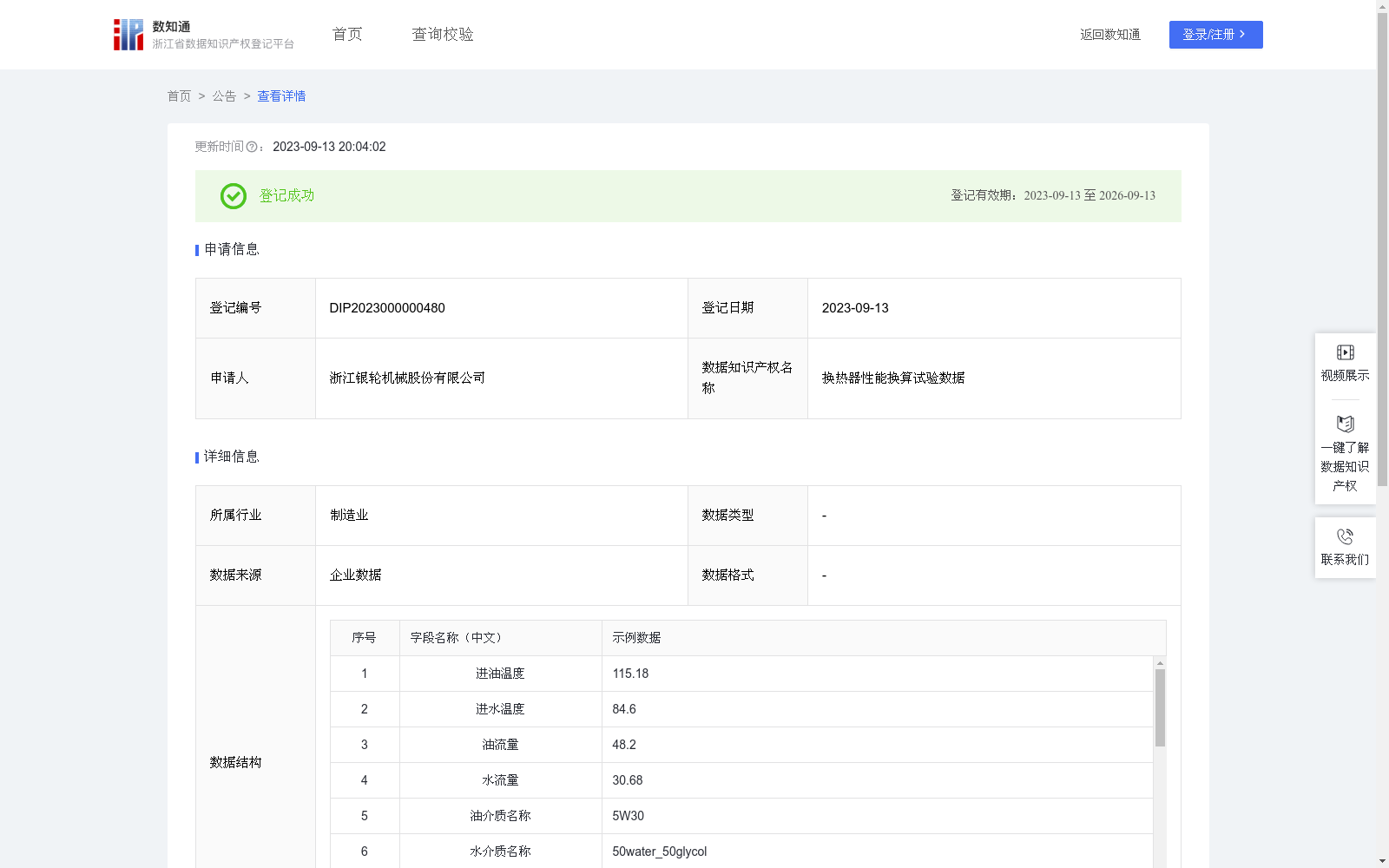
换热器性能换算试验数据
收藏资源简介:
通过采集油冷器产品性能试验数据,采用热阻分离方法来推算油冷器产品其它油品试验介质的试验数据结果,并对试验数据质量进行检查, 用于同一换热器产品不同介质的试验数据换算、同换热单元不同尺寸的性能外推、不同工况的性能外推,显著提高公司换热器产品研发效率。1、采集数据,收集检测数据,保持一定精度。 2、数据质量检查。剔除质量不佳数据。 3、拟合模型。 换热算法模型: 1)、输入模型的尺寸与工况,计算换热面积,物性、Re等 2)、计算实验KA值:KA=NTU*(q*C_P )_min→get KA 3)、采用Nu、NTU方法计算理论KA值: KA=1/(1/(h_oil A_oil )+1/(h_coolant A_coolant ))→get KA 4)、建立误差函数 ∑▒〖〖(KA〗_实验-〖KA〗_理论)〗^2 5)、优化器求解误差函数,输出两侧换热量关联式系数a_1 b_1 a_2 b_2 压降算法模型: 1)、输入模型的参数与工况,计算速度,密度粘度等物性。 2)、采用达西公式,计算理论压降P值: P=a_1*ρ*V_2+b_1*μ*V→get P 3)、建立误差函数: oilOpt:∑▒〖〖(P〗_实验-P_理论)〗^2 4)、优化器求解误差函数,得到两侧压降的关联式系数. 4、预测。选择其它油品及工况,根据上面得到两侧换热量、压降关联式的系数,根据努塞尔数求KA进而计算换热量,根据达西公式,计算油水两侧的压降。
This dataset is developed by collecting performance test data of oil cooler products, leveraging the thermal resistance separation method to infer test data results for other oil-based test media applicable to oil cooler products, and performing data quality validation on the collected test data. It is designed for converting test data of the same heat exchanger product across different media, extrapolating performance of the same heat exchange unit with varying dimensions, and extrapolating performance under different operating conditions, thereby significantly enhancing the R&D efficiency of the company’s heat exchanger products. 1. Data Collection: Collect test and detection data while maintaining a specified level of measurement accuracy. 2. Data Quality Validation: Remove low-quality test data. 3. Model Fitting: Heat Transfer Algorithm Model: 1) Input the dimensions and operating conditions of the model to calculate heat transfer area, physical properties, Reynolds number (Re), etc. 2) Calculate the experimental KA value: $KA=NTU*(q*C_P)_{min}$ → obtain experimental KA 3) Calculate the theoretical KA value using Nusselt number (Nu) and NTU methods: $KA=1/(1/(h_{oil}A_{oil}) + 1/(h_{coolant}A_{coolant}))$ → obtain theoretical KA 4) Establish the error function: $sum (KA_{ ext{experimental}} - KA_{ ext{theoretical}})^2$ 5) Use an optimizer to solve the error function and output the correlation coefficients $a_1, b_1, a_2, b_2$ for the heat transfer rates on both sides. Pressure Drop Algorithm Model: 1) Input the model parameters and operating conditions to calculate physical properties such as velocity, density and viscosity. 2) Use Darcy's formula to calculate the theoretical pressure drop P: $P=a_1* ho*V_2 + b_1*mu*V$ → obtain theoretical pressure drop P 3) Establish the error function: $oilOpt: sum (P_{ ext{experimental}} - P_{ ext{theoretical}})^2$ 4) Use an optimizer to solve the error function and obtain the correlation coefficients for the pressure drops on both sides. 4. Prediction: Select other oil types and operating conditions, then calculate the heat transfer rate by first deriving KA via the Nusselt number using the obtained correlation coefficients for the heat transfer rates and pressure drops on both sides, and compute the pressure drops on both the oil and coolant sides using Darcy's formula.