短周期密集台阵观测数据(2019-2020)
收藏资源简介:
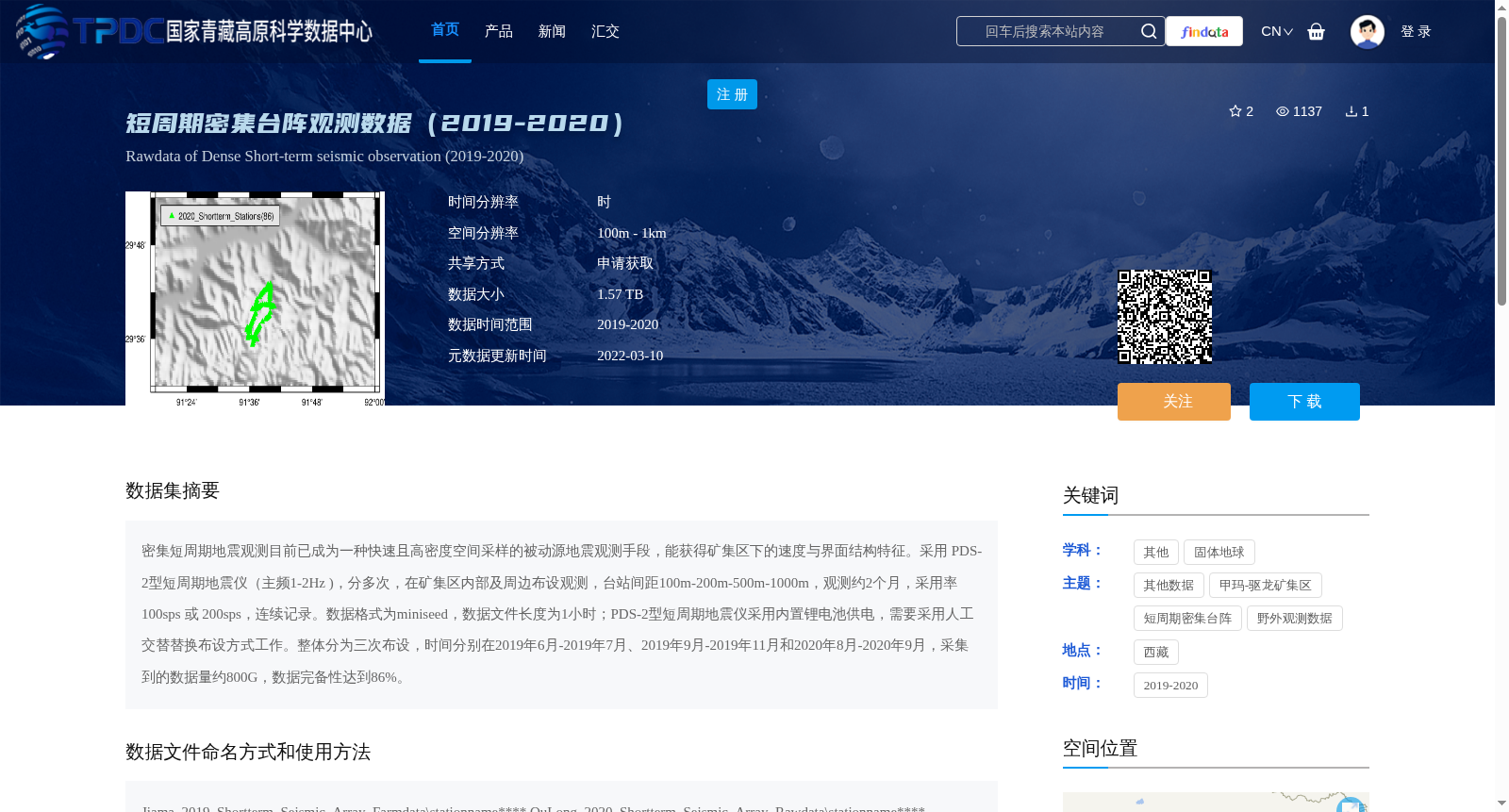
密集短周期地震观测目前已成为一种快速且高密度空间采样的被动源地震观测手段,能获得矿集区下的速度与界面结构特征。采用 PDS-2型短周期地震仪(主频1-2Hz ),分多次,在矿集区内部及周边布设观测,台站间距100m-200m-500m-1000m,观测约2个月,采用率100sps 或 200sps,连续记录。数据格式为miniseed,数据文件长度为1小时;PDS-2型短周期地震仪采用内置锂电池供电,需要采用人工交替替换布设方式工作。整体分为三次布设,时间分别在2019年6月-2019年7月、2019年9月-2019年11月和2020年8月-2020年9月,采集到的数据量约800G,数据完备性达到86%。
Dense short-period seismic observation has emerged as a rapid, high-density spatially sampled passive seismic observation method that can acquire velocity and interface structural characteristics beneath ore concentration areas. The PDS-2 short-period seismometer (dominant frequency 1–2 Hz) was deployed multiple times within and around the target ore concentration area, with station spacings set as 100 m, 200 m, 500 m and 1000 m. Each observation campaign lasted approximately 2 months, with sampling rates of 100 sps or 200 sps and continuous recording. All data are stored in the miniseed format, with each data file having a duration of 1 hour. The PDS-2 seismometer is powered by a built-in lithium battery, requiring manual alternate replacement of deployed instruments to sustain operations. The entire survey was carried out in three phases, spanning June 2019 to July 2019, September 2019 to November 2019, and August 2020 to September 2020 respectively. A total of approximately 800 GB of data was collected, with a data completeness rate of 86%.