RGBP
收藏资源简介:
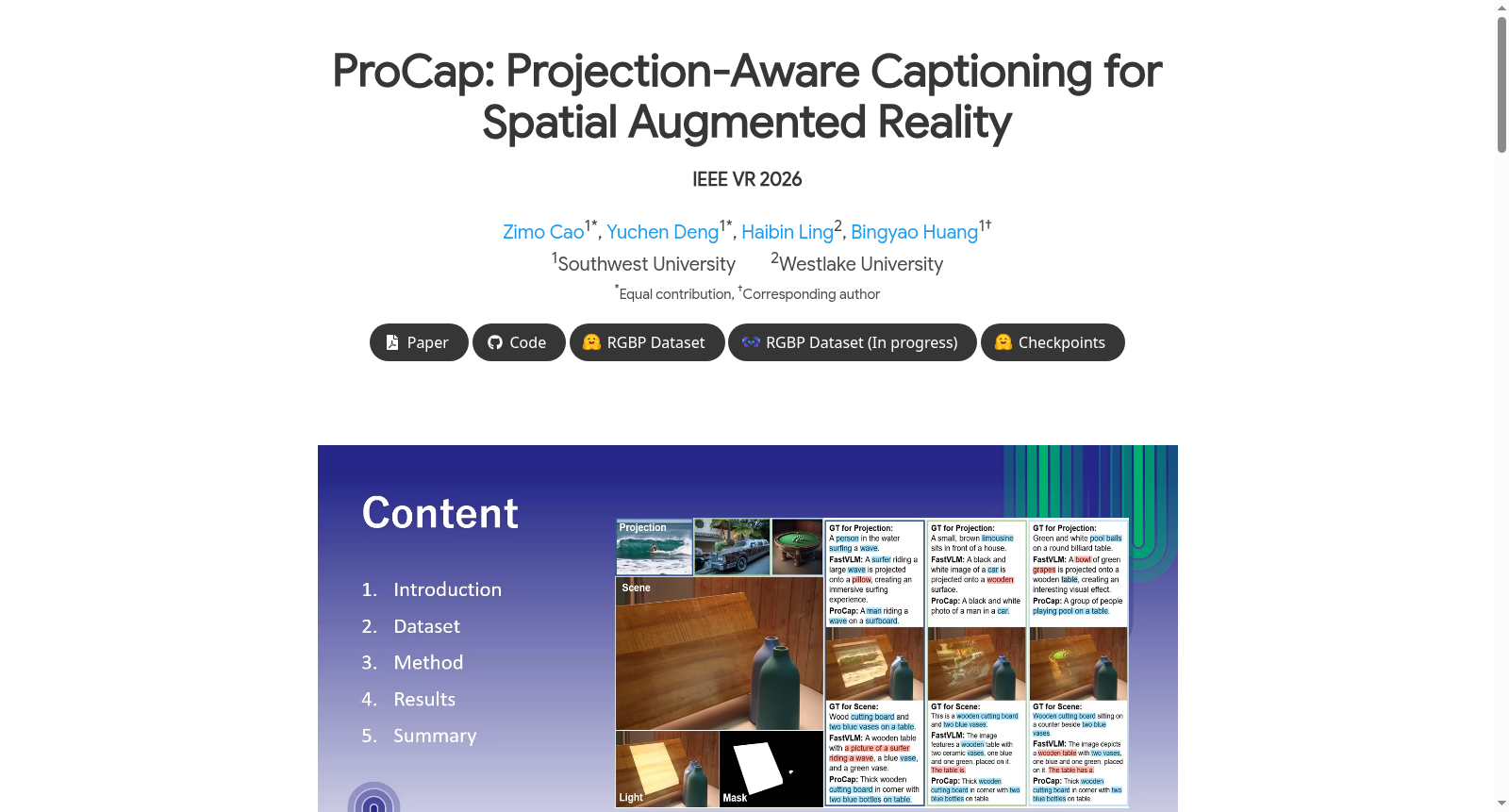
RGBP是由西南大学和西湖大学联合创建的首个大规模空间增强现实语义基准数据集,包含65个多样化物理场景和超过18万条投影数据。该数据集通过投影-相机系统采集,涵盖平面、轻度弯曲和高度弯曲三种表面形态,并提供了物理场景与投影内容的解耦标注(包括分割掩码和独立描述文本)。其数据来源融合了COCO、nocaps等公开数据集,通过语言模型辅助生成高质量标注,旨在解决SAR场景中虚拟-物理内容语义混淆的核心问题,为视觉语言模型在空间增强现实领域的理解与推理提供基础支持。
RGBP is the first large-scale spatial augmented reality semantic benchmark dataset jointly developed by Southwest University and Westlake University. It comprises 65 diverse physical scenarios and over 180,000 projection data entries. Collected via a projection-camera system, this dataset covers three types of surface morphologies: planar, slightly curved, and highly curved. It additionally provides decoupled annotations for physical scenes and their corresponding projection content, including segmentation masks and independent descriptive texts. The dataset incorporates public datasets such as COCO and nocaps as its data sources, and generates high-quality annotations with the assistance of language models. It aims to address the core issue of semantic confusion between virtual and physical content in spatial augmented reality (SAR) scenarios, providing fundamental support for the understanding and reasoning of vision-language models in the spatial augmented reality domain.
ProCap 数据集概述
数据集基本信息
- 数据集名称: RGBP (RGB + Projections)
- 关联研究/框架: ProCap (Projection-Aware Captioning for Spatial Augmented Reality)
- 发布会议: IEEE VR 2026 (2026 IEEE Conference on Virtual Reality and 3D User Interfaces)
- 数据集状态: 部分内容仍在进行中 (RGBP Dataset (In progress))
数据集简介与目的
- RGBP 是首个大规模空间增强现实 (SAR) 语义基准数据集。
- 旨在解决 SAR 场景中,标准视觉语言模型难以区分物理场景与投影内容(虚拟-物理模糊性)的问题。
- 为 ProCap 框架提供支持,该框架通过明确解耦投影内容与物理场景,为 SAR 的智能交互(如场景推理、回答用户查询)奠定语义基础。
数据集内容与规模
- 场景多样性: 包含 65 个不同的物理场景。
- 投影数量: 包含超过 180,000 个投影。
- 标注特点: 提供密集的、解耦的标注(即对物理场景和投影内容分别进行标注)。
- 场景聚焦: 当前数据集专注于基础投影场景,其中内容被限定在矩形边界内,并投射到主要为平面或轻度弯曲的表面上。
数据集应用与评估
- 支持任务: 用于训练和评估能够分别描述物理场景和投影内容的模型。
- 评估协议: 研究建立了一种使用任务特定令牌的双重描述评估协议,以独立评估物理场景和投影描述。
相关资源
- 论文: ProCap: Projection-Aware Captioning for Spatial Augmented Reality
- 代码: 可通过页面提供的“Code”链接获取。
- 数据集: 可通过页面提供的“RGBP Dataset”链接获取。
- 模型检查点: 可通过页面提供的“Checkpoints”链接获取。