
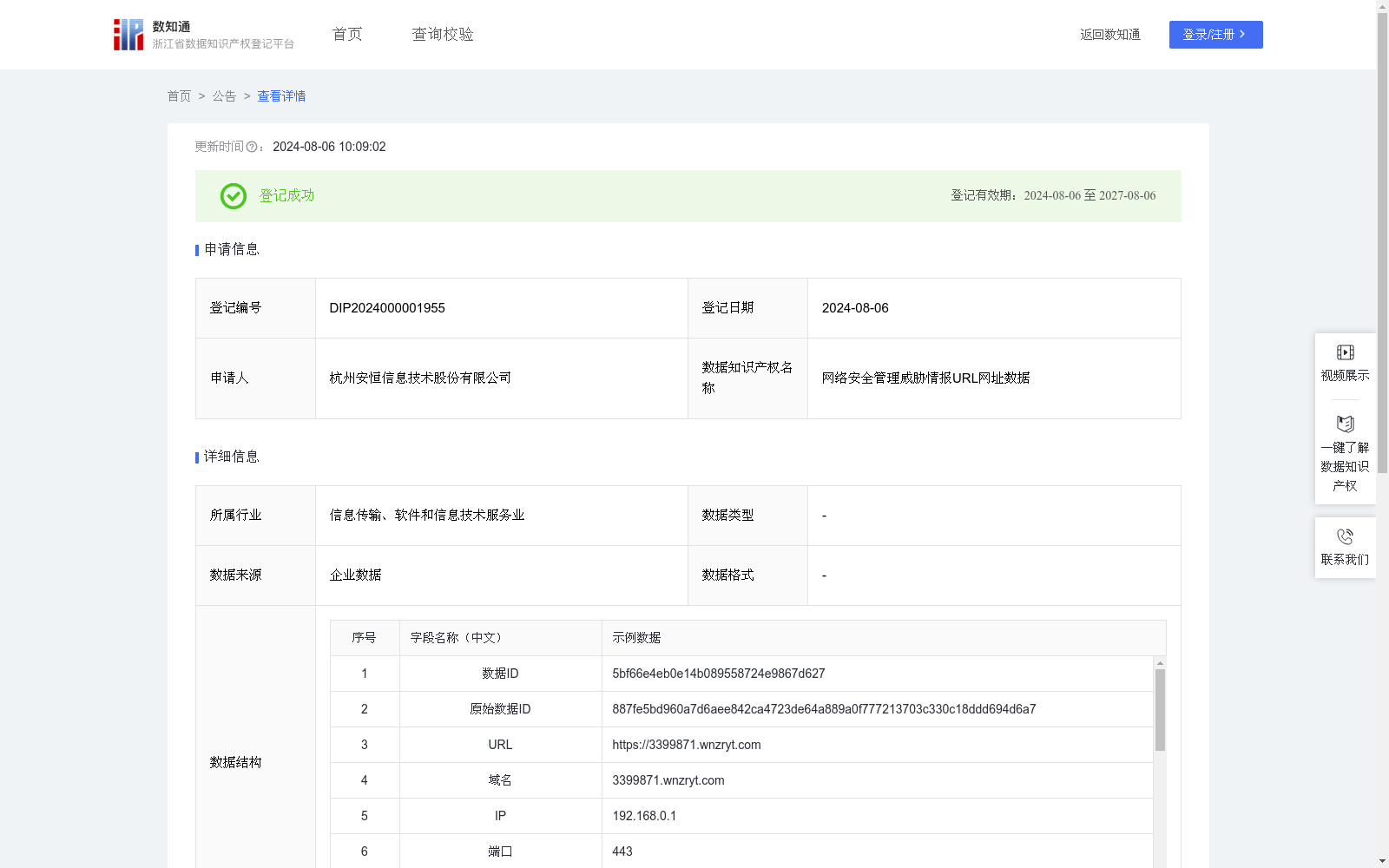
网络安全管理威胁情报URL网址数据
收藏浙江省数据知识产权登记平台2024-08-06 更新2024-08-07 收录
下载链接:
https://www.zjip.org.cn/home/announce/trends/47687
下载链接
链接失效反馈官方服务:
资源简介:
1.安全管理平台/态势感知:
在安全管理平台中,威胁情报URL网址数据能够提供实时的URL分析服务。当网络流量经过平台时,平台会利用威胁情报URL网址数据中的数据,对流量中的URL进行快速识别和比对。一旦发现与已知恶意URL或异常行为模式相匹配的URL,平台会立即触发告警,并采取相应的防护措施。
此外,威胁情报URL网址数据还可以为态势感知系统提供URL相关的威胁情报。通过对威胁情报URL网址数据中的数据进行深度分析,态势感知系统能够发现潜在的威胁趋势和攻击模式,为安全团队提供及时、准确的威胁预警。
2.端点安全-终端安全管理:
在终端安全管理中,威胁情报URL网址数据发挥着重要作用。许多恶意软件或网络钓鱼攻击都会通过URL进行传播。通过集成威胁情报URL网址数据,终端安全管理软件能够实时监控终端上的网络访问行为,对访问的URL进行实时分析和识别。一旦发现用户访问了恶意URL,软件会进行拦截和告警,防止恶意软件对终端造成损害。
3.安全管理-威胁情报(TI):
威胁情报系统利用威胁情报URL网址数据中的数据,能够构建更加全面、准确的威胁情报库。数据采集:通过事件采集系统和恶意文件监控系统,收集网络安全攻击事件与流行恶意文件样本,包括攻击详情、IOC及产品日志。
数据清洗:对采集到的数据进行结构化、标准化清洗,并进行多维信息的聚合。
数据加工:
1. 使用沙箱对恶意文件样本进行动态分析,获取样本攻击行为,包括包含URL的网络请求行为。
2. 利用AI大模型、LSTM+CRF算法等技术进行自然语言处理和安全文章分析,提取URL威胁情报信息。
3. 采用多因子AI威胁评分模型,对恶意URL的威胁程度进行评估。考量因子:1.动态分析结果(沙箱技术发现的恶意行为);2.文本分析信息;3.历史威胁数据(历史威胁等级);4.实时流量(URL的访问频率、模式及来源);5.信誉信息(域名和IP地址的信誉评分)。
通过特征加权求和,将特征按其重要性赋予权重,进行加权求和计算,根据预设的阈值将得分映射为低、中、高三个威胁等级。可信度的计算聚焦评估模型预测的可靠性。我们基于模型预测的不同威胁等级概率,计算出置信区间。
4. 采用MinHashLSH、Xgboost等算法结合海量数据进行恶意URL挖掘
5. 利用威胁定性模型,聚合多源情报及关联数据
1. Security Management Platform / Situational Awareness:
In security management platforms, threat intelligence URL data can provide real-time URL analysis services. When network traffic passes through the platform, the platform will use the data in the threat intelligence URL dataset to quickly identify and compare the URLs contained in the traffic. Once a URL matching a known malicious URL or abnormal behavior pattern is detected, the platform will immediately trigger an alert and take corresponding protective measures.
In addition, threat intelligence URL data can also provide URL-related threat intelligence for situational awareness systems. Through in-depth analysis of the data in the threat intelligence URL dataset, the situational awareness system can identify potential threat trends and attack patterns, providing timely and accurate threat warnings for security teams.
2. Endpoint Security - Endpoint Security Management:
Threat intelligence URL data plays a crucial role in endpoint security management. A large number of malware or phishing attacks spread via URLs. By integrating threat intelligence URL data, endpoint security management software can monitor the network access behavior on endpoints in real time, and conduct real-time analysis and identification of accessed URLs. Once a user is found to be accessing a malicious URL, the software will intercept the access and trigger an alert to prevent malware from causing damage to the endpoint.
3. Security Management - Threat Intelligence (TI):
Threat intelligence systems can leverage threat intelligence URL data to build a more comprehensive and accurate threat intelligence repository.
Data Collection: Collect cybersecurity attack events and prevalent malicious file samples, including attack details, Indicators of Compromise (IOCs) and product logs, via event collection systems and malicious file monitoring systems.
Data Cleaning: Perform structured and standardized cleaning on the collected data, and conduct aggregation of multi-dimensional information.
Data Processing:
1. Conduct dynamic analysis on malicious file samples using sandboxes to obtain the attack behaviors of the samples, including network request behaviors containing URLs.
2. Use technologies such as AI Large Language Models (LLMs) and LSTM+CRF algorithms to perform natural language processing (NLP) and security article analysis, and extract URL threat intelligence information.
3. Adopt a multi-factor AI threat scoring model to evaluate the threat level of malicious URLs. Evaluation factors: 1. Dynamic analysis results (malicious behaviors detected by sandbox technology); 2. Text analysis information; 3. Historical threat data (historical threat levels); 4. Real-time traffic (access frequency, pattern and source of URLs); 5. Reputation information (reputation scores of domain names and IP addresses).
Calculate the weighted summation of features by assigning weights to features based on their importance, and map the scores to three threat levels (low, medium and high) according to preset thresholds. The calculation of credibility focuses on evaluating the reliability of model predictions. We calculate the confidence interval based on the probabilities of different threat levels predicted by the model.
4. Use algorithms such as MinHashLSH and XGBoost combined with massive datasets to mine malicious URLs
5. Utilize threat quantification models to aggregate multi-source intelligence and associated data
提供机构:
杭州安恒信息技术股份有限公司
创建时间:
2024-06-21
搜集汇总
数据集介绍
以上内容由遇见数据集搜集并总结生成


