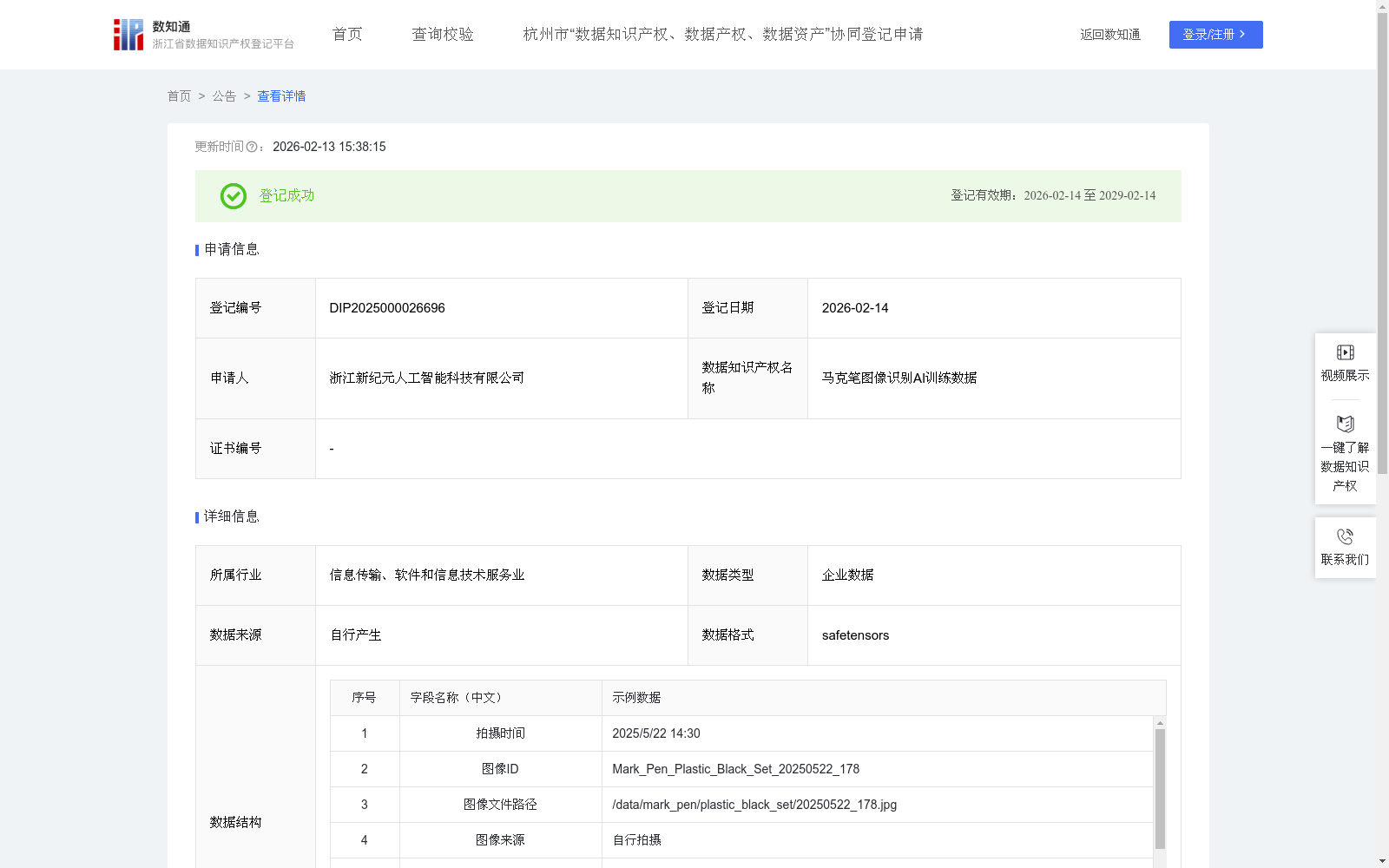
马克笔图像识别AI训练数据
收藏资源简介:
本训练数据是构建精准高效马克笔特征识别 AI 模型的信息基础。通过这些数据的训练,AI 模型能够更加准确地识别和分类不同的马克笔形状,进而可支撑多领域应用:生产端实现部件适配推荐、个性化设计及生产缺陷检测;场景管理端精准调配使用场景适配马克笔;还能监控马克笔破损、判断适配性问题,辅助商业分析区域需求偏好。整体为各领域提供高效自动化识别支撑,推动相关业务决策的精准化与效率提升。一、数据采集和预处理:原始图像数据来源于自行拍摄或算法生成,并记录原始图像的ID、文件路径,根据自身项目需求和模型要求,将马克笔图像数据采用数据集类型,分为训练集和测试集。并对训练集进行标注,形成边界框坐标及对应标签。 二、选择NanoDet预训练模型,初始化模型参数,设置合理的超参数,如学习率、批量大小、迭代次数等,以优化模型的训练过程。 三、模型训练:使用魔盒设计基础大模型(自研)迭代,改变unet学习率,采用AdamW8bit优化器深度进行训练。训练中可视化输出采样图片观察模型的稳定性。模型持续调整权重,观测图片损失(loss)和批次的波动情况,并记录训练时长,得出训练模型并用comfyui进行模型数据测试调优。 四、模型评估:训练完成后,用测试集评估模型,计算不同场景下的精度、召回率、F1 分数以及实时性能评估(准确率)等性能指标,确保模型的准确性和鲁棒性。
This training dataset serves as the foundational information base for building an accurate and efficient AI model for marker feature recognition. Through training with this dataset, the AI model can more accurately identify and classify different marker shapes, thereby supporting applications across multiple fields: on the production side, it enables component adaptation recommendation, customized design, and production defect detection; on the scene management side, it enables accurate allocation of markers adapted to different usage scenarios; it can also monitor marker damage, judge compatibility issues, and assist in analyzing regional demand preferences for commercial analysis. Overall, it provides efficient automated recognition support for various fields, promoting the accuracy and efficiency of relevant business decision-making. 1. Data Collection and Preprocessing: The original image data is sourced from self-captured photos or algorithm-generated content, with the ID and file path of each original image recorded. According to project requirements and model specifications, the marker image dataset is divided into a training set and a test set. The training set is then annotated to generate bounding box coordinates and corresponding labels. 2. Pre-trained Model Selection: A NanoDet pre-trained model is selected, with its model parameters initialized and reasonable hyperparameters (such as learning rate, batch size, number of iterations, etc.) set to optimize the model training process. 3. Model Training: The self-developed foundational large model designed by Magic Box is used for iterative training, with the learning rate of the UNet module adjusted. The AdamW 8-bit optimizer is adopted for in-depth training. During training, sampled images are visualized to observe the stability of the model. The model continuously adjusts its weights, monitors fluctuations in image loss and batches, and records the training duration. The trained model is obtained and subjected to model data testing and tuning via ComfyUI. 4. Model Evaluation: After training is completed, the model is evaluated using the test set. Performance metrics including precision, recall, F1-score, and real-time performance evaluation (accuracy) under different scenarios are calculated to ensure the model's accuracy and robustness.