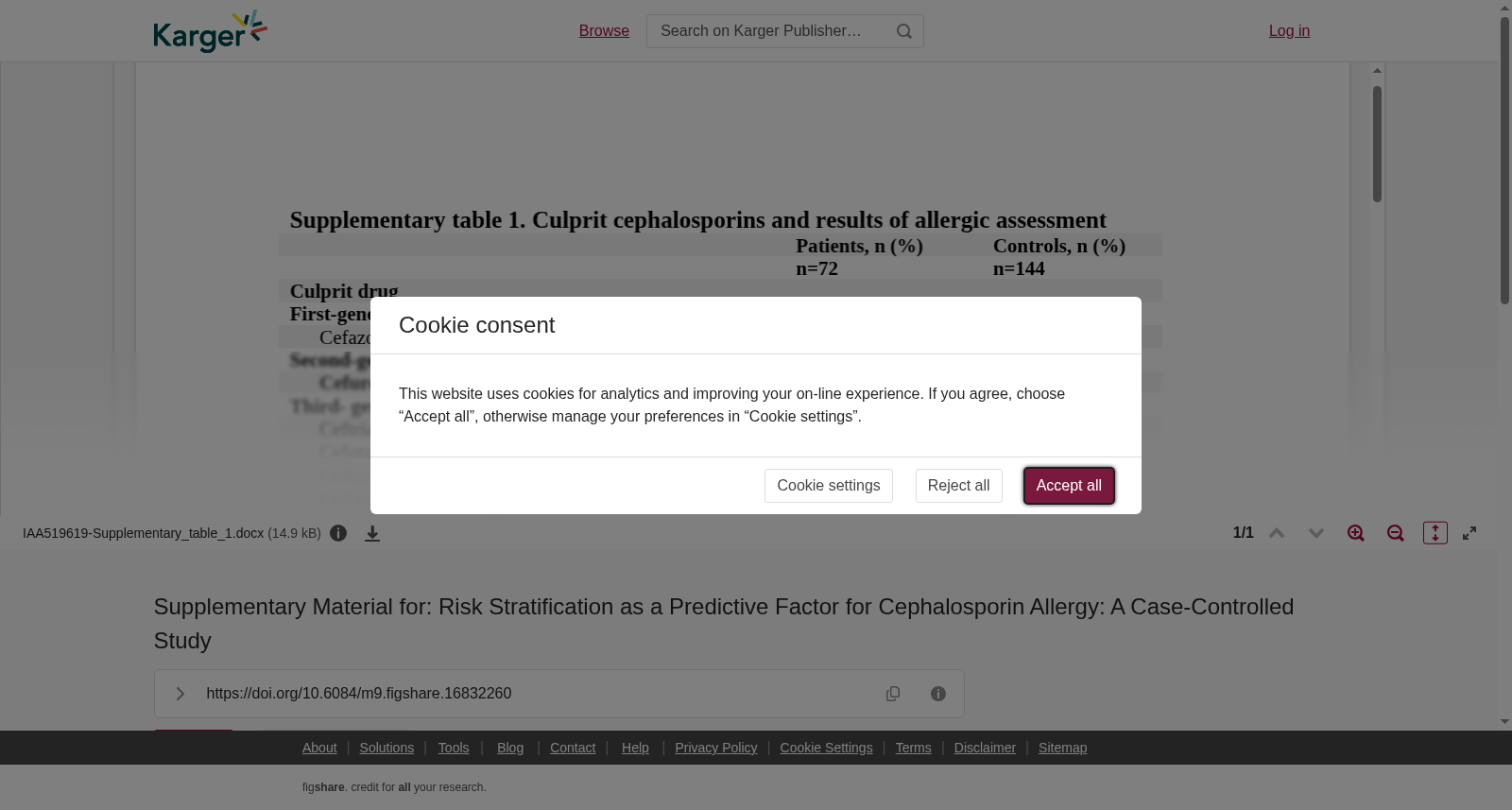
Supplementary Material for: Risk Stratification as a Predictive Factor for Cephalosporin Allergy: A Case-Controlled Study
收藏资源简介:
<b><i>Background:</i></b> Compared to penicillin, cephalosporin allergies are less common in children, and their diagnostic approach is less standardized. A recent European Academy of Allergy and Clinical Immunology position paper provided a risk stratification system for patients with suspected β-lactam hypersensitivity reactions. <b><i>Objective:</i></b> This study aimed to evaluate risk stratification and predicting factors for confirmed cephalosporin hypersensitivity. <b><i>Methods:</i></b> The case-controlled study included patients with confirmed cephalosporin hypersensitivity (skin tests, <i>n</i> = 53; drug provocation, <i>n</i> = 19). For each patient, 2 age- and gender-matched control subjects were included in the study. Data were retrieved from patients’ records and analyzed retrospectively. Risk stratification was performed according to the severity of index reactions, which was initially divided as high and low risk and then further divided as immediate and nonimmediate. <b><i>Results:</i></b> According to risk stratification, the patient and control groups were divided as follows: high-risk immediate (66.7% vs. 13%, respectively), high-risk delayed (1.4% vs. 8.3%, respectively), low-risk immediate (16.7% vs. 16%, respectively), and low-risk delayed (15.3% vs. 62.9%, respectively). Immediate reactions (odds ratio [OR]: 12.1, 95% confidence interval [CI]: 9–24.8, <i>p</i> < 0.001) and high-risk reactions (OR: 7.8, 95% CI: 4.1–14.6, <i>p</i> < 0.001) were associated with confirmed cephalosporin hypersensitivity in univariate analysis. Multivariate regression analysis indicated that immediate reactions (OR: 7.5, 95% CI: 3.3–16.8, <i>p</i> < 0.001) and high-risk reactions (OR: 5.2, 95% CI: 2.1–12.9, <i>p</i> < 0.001) were significant risk factors for the prediction of cephalosporin hypersensitivity. <b><i>Conclusion:</i></b> This model can be applied in children with suspected cephalosporin allergy. Skin testing provides diagnostic information in high-risk patients with immediate reactions and reduces the need for drug provocation testing in these patients. It is highly likely to confirm the diagnosis of low-risk patients directly with provocation tests without skin tests. High-risk and immediate reactions were found to be predictive factors for confirmed cephalosporin allergy.
背景:与青霉素相比,儿童头孢菌素过敏的发生率更低,且其诊断方法尚未完全标准化。近期,欧洲变态反应与临床免疫学会(European Academy of Allergy and Clinical Immunology)发布的立场文件为疑似β-内酰胺(β-lactam)超敏反应患者提供了一套风险分层体系。 目的:本研究旨在评估确诊头孢菌素超敏反应的风险分层方案及预测因素。 方法:本病例对照研究纳入确诊头孢菌素超敏反应患者,其中皮肤试验组53例、药物激发试验组19例。每例患者匹配2名年龄与性别一致的对照受试者。研究数据从患者病历中提取并进行回顾性分析。风险分层依据指征反应的严重程度进行:首先分为高风险与低风险,随后进一步分为速发型与非速发型。 结果:依据风险分层方案,患者组与对照组分为以下四类:高风险速发型(患者组与对照组占比分别为66.7%与13%)、高风险迟发型(1.4%与8.3%)、低风险速发型(16.7%与16%)及低风险迟发型(15.3%与62.9%)。单因素分析结果显示,速发型反应(比值比[odds ratio, OR]=12.1,95%置信区间[confidence interval, CI]=9~24.8,p<0.001)与高风险反应(OR=7.8,95%CI=4.1~14.6,p<0.001)均与确诊头孢菌素超敏反应存在显著关联。多因素回归分析结果表明,速发型反应(OR=7.5,95%CI=3.3~16.8,p<0.001)与高风险反应(OR=5.2,95%CI=2.1~12.9,p<0.001)是预测头孢菌素超敏反应的独立危险因素。 结论:本风险分层模型可应用于疑似头孢菌素过敏的儿童群体。对于存在速发型反应的高风险患者,皮肤试验可为其提供诊断依据,同时可减少此类患者接受药物激发试验的需求。而对于低风险患者,可直接通过激发试验确诊,无需先行皮肤试验。研究证实,高风险反应与速发型反应均为确诊头孢菌素过敏的预测因素。