
uoft-cs/cifar100
收藏Hugging Face2024-01-04 更新2024-06-15 收录
下载链接:
https://hf-mirror.com/datasets/uoft-cs/cifar100
下载链接
链接失效反馈官方服务:
资源简介:
---
annotations_creators:
- crowdsourced
language_creators:
- found
language:
- en
license:
- unknown
multilinguality:
- monolingual
size_categories:
- 10K<n<100K
source_datasets:
- extended|other-80-Million-Tiny-Images
task_categories:
- image-classification
task_ids: []
paperswithcode_id: cifar-100
pretty_name: Cifar100
dataset_info:
config_name: cifar100
features:
- name: img
dtype: image
- name: fine_label
dtype:
class_label:
names:
'0': apple
'1': aquarium_fish
'2': baby
'3': bear
'4': beaver
'5': bed
'6': bee
'7': beetle
'8': bicycle
'9': bottle
'10': bowl
'11': boy
'12': bridge
'13': bus
'14': butterfly
'15': camel
'16': can
'17': castle
'18': caterpillar
'19': cattle
'20': chair
'21': chimpanzee
'22': clock
'23': cloud
'24': cockroach
'25': couch
'26': cra
'27': crocodile
'28': cup
'29': dinosaur
'30': dolphin
'31': elephant
'32': flatfish
'33': forest
'34': fox
'35': girl
'36': hamster
'37': house
'38': kangaroo
'39': keyboard
'40': lamp
'41': lawn_mower
'42': leopard
'43': lion
'44': lizard
'45': lobster
'46': man
'47': maple_tree
'48': motorcycle
'49': mountain
'50': mouse
'51': mushroom
'52': oak_tree
'53': orange
'54': orchid
'55': otter
'56': palm_tree
'57': pear
'58': pickup_truck
'59': pine_tree
'60': plain
'61': plate
'62': poppy
'63': porcupine
'64': possum
'65': rabbit
'66': raccoon
'67': ray
'68': road
'69': rocket
'70': rose
'71': sea
'72': seal
'73': shark
'74': shrew
'75': skunk
'76': skyscraper
'77': snail
'78': snake
'79': spider
'80': squirrel
'81': streetcar
'82': sunflower
'83': sweet_pepper
'84': table
'85': tank
'86': telephone
'87': television
'88': tiger
'89': tractor
'90': train
'91': trout
'92': tulip
'93': turtle
'94': wardrobe
'95': whale
'96': willow_tree
'97': wolf
'98': woman
'99': worm
- name: coarse_label
dtype:
class_label:
names:
'0': aquatic_mammals
'1': fish
'2': flowers
'3': food_containers
'4': fruit_and_vegetables
'5': household_electrical_devices
'6': household_furniture
'7': insects
'8': large_carnivores
'9': large_man-made_outdoor_things
'10': large_natural_outdoor_scenes
'11': large_omnivores_and_herbivores
'12': medium_mammals
'13': non-insect_invertebrates
'14': people
'15': reptiles
'16': small_mammals
'17': trees
'18': vehicles_1
'19': vehicles_2
splits:
- name: train
num_bytes: 112545106.0
num_examples: 50000
- name: test
num_bytes: 22564261.0
num_examples: 10000
download_size: 142291368
dataset_size: 135109367.0
configs:
- config_name: cifar100
data_files:
- split: train
path: cifar100/train-*
- split: test
path: cifar100/test-*
default: true
---
# Dataset Card for CIFAR-100
## Table of Contents
- [Dataset Description](#dataset-description)
- [Dataset Summary](#dataset-summary)
- [Supported Tasks and Leaderboards](#supported-tasks-and-leaderboards)
- [Languages](#languages)
- [Dataset Structure](#dataset-structure)
- [Data Instances](#data-instances)
- [Data Fields](#data-fields)
- [Data Splits](#data-splits)
- [Dataset Creation](#dataset-creation)
- [Curation Rationale](#curation-rationale)
- [Source Data](#source-data)
- [Annotations](#annotations)
- [Personal and Sensitive Information](#personal-and-sensitive-information)
- [Considerations for Using the Data](#considerations-for-using-the-data)
- [Social Impact of Dataset](#social-impact-of-dataset)
- [Discussion of Biases](#discussion-of-biases)
- [Other Known Limitations](#other-known-limitations)
- [Additional Information](#additional-information)
- [Dataset Curators](#dataset-curators)
- [Licensing Information](#licensing-information)
- [Citation Information](#citation-information)
- [Contributions](#contributions)
## Dataset Description
- **Homepage:** [CIFAR Datasets](https://www.cs.toronto.edu/~kriz/cifar.html)
- **Repository:**
- **Paper:** [Paper](https://www.cs.toronto.edu/~kriz/learning-features-2009-TR.pdf)
- **Leaderboard:**
- **Point of Contact:**
### Dataset Summary
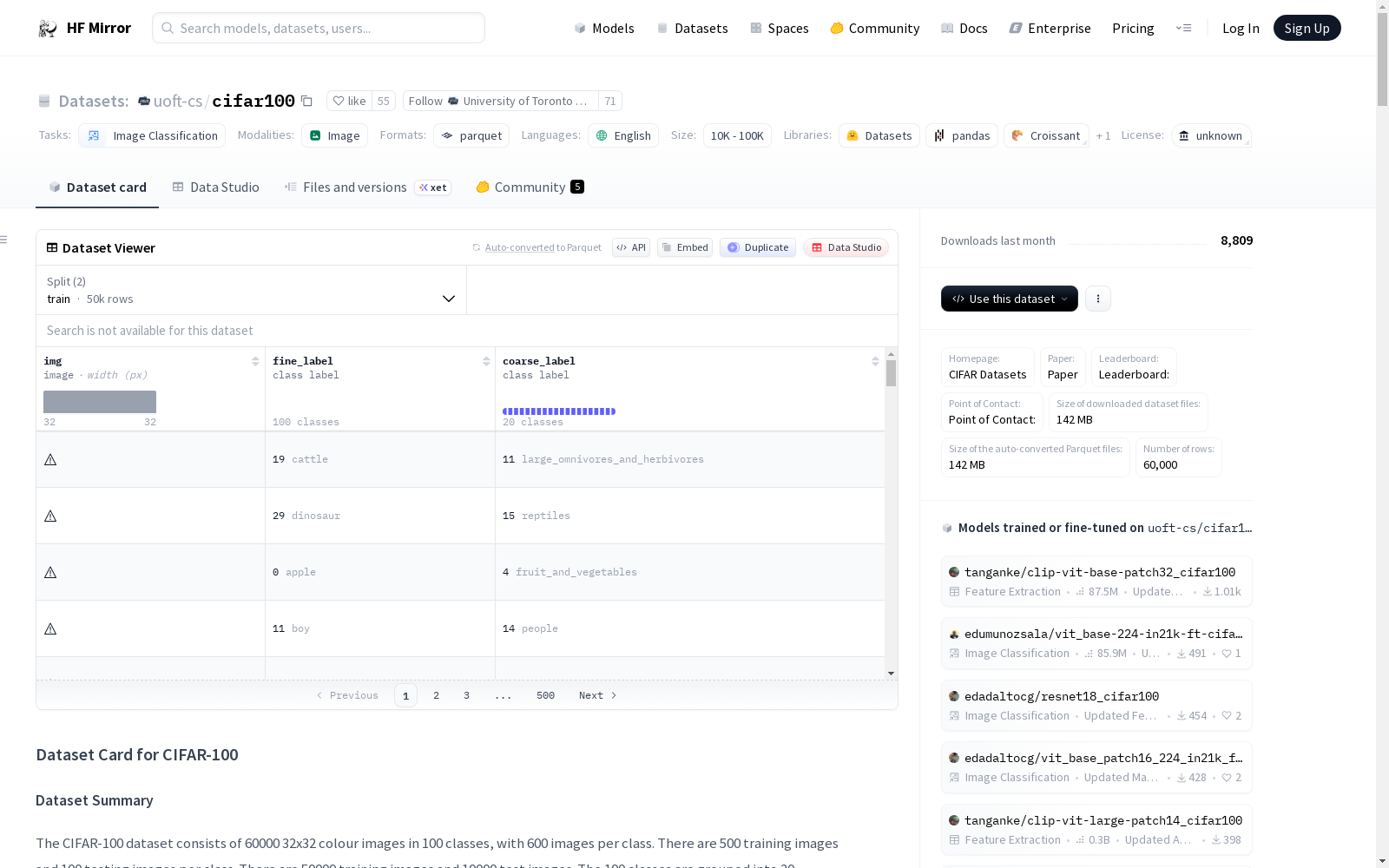
The CIFAR-100 dataset consists of 60000 32x32 colour images in 100 classes, with 600 images
per class. There are 500 training images and 100 testing images per class. There are 50000 training images and 10000 test images. The 100 classes are grouped into 20 superclasses.
There are two labels per image - fine label (actual class) and coarse label (superclass).
### Supported Tasks and Leaderboards
- `image-classification`: The goal of this task is to classify a given image into one of 100 classes. The leaderboard is available [here](https://paperswithcode.com/sota/image-classification-on-cifar-100).
### Languages
English
## Dataset Structure
### Data Instances
A sample from the training set is provided below:
```
{
'img': <PIL.PngImagePlugin.PngImageFile image mode=RGB size=32x32 at 0x2767F58E080>, 'fine_label': 19,
'coarse_label': 11
}
```
### Data Fields
- `img`: A `PIL.Image.Image` object containing the 32x32 image. Note that when accessing the image column: `dataset[0]["image"]` the image file is automatically decoded. Decoding of a large number of image files might take a significant amount of time. Thus it is important to first query the sample index before the `"image"` column, *i.e.* `dataset[0]["image"]` should **always** be preferred over `dataset["image"][0]`
- `fine_label`: an `int` classification label with the following mapping:
`0`: apple
`1`: aquarium_fish
`2`: baby
`3`: bear
`4`: beaver
`5`: bed
`6`: bee
`7`: beetle
`8`: bicycle
`9`: bottle
`10`: bowl
`11`: boy
`12`: bridge
`13`: bus
`14`: butterfly
`15`: camel
`16`: can
`17`: castle
`18`: caterpillar
`19`: cattle
`20`: chair
`21`: chimpanzee
`22`: clock
`23`: cloud
`24`: cockroach
`25`: couch
`26`: cra
`27`: crocodile
`28`: cup
`29`: dinosaur
`30`: dolphin
`31`: elephant
`32`: flatfish
`33`: forest
`34`: fox
`35`: girl
`36`: hamster
`37`: house
`38`: kangaroo
`39`: keyboard
`40`: lamp
`41`: lawn_mower
`42`: leopard
`43`: lion
`44`: lizard
`45`: lobster
`46`: man
`47`: maple_tree
`48`: motorcycle
`49`: mountain
`50`: mouse
`51`: mushroom
`52`: oak_tree
`53`: orange
`54`: orchid
`55`: otter
`56`: palm_tree
`57`: pear
`58`: pickup_truck
`59`: pine_tree
`60`: plain
`61`: plate
`62`: poppy
`63`: porcupine
`64`: possum
`65`: rabbit
`66`: raccoon
`67`: ray
`68`: road
`69`: rocket
`70`: rose
`71`: sea
`72`: seal
`73`: shark
`74`: shrew
`75`: skunk
`76`: skyscraper
`77`: snail
`78`: snake
`79`: spider
`80`: squirrel
`81`: streetcar
`82`: sunflower
`83`: sweet_pepper
`84`: table
`85`: tank
`86`: telephone
`87`: television
`88`: tiger
`89`: tractor
`90`: train
`91`: trout
`92`: tulip
`93`: turtle
`94`: wardrobe
`95`: whale
`96`: willow_tree
`97`: wolf
`98`: woman
`99`: worm
- `coarse_label`: an `int` coarse classification label with following mapping:
`0`: aquatic_mammals
`1`: fish
`2`: flowers
`3`: food_containers
`4`: fruit_and_vegetables
`5`: household_electrical_devices
`6`: household_furniture
`7`: insects
`8`: large_carnivores
`9`: large_man-made_outdoor_things
`10`: large_natural_outdoor_scenes
`11`: large_omnivores_and_herbivores
`12`: medium_mammals
`13`: non-insect_invertebrates
`14`: people
`15`: reptiles
`16`: small_mammals
`17`: trees
`18`: vehicles_1
`19`: vehicles_2
### Data Splits
| name |train|test|
|----------|----:|---------:|
|cifar100|50000| 10000|
## Dataset Creation
### Curation Rationale
[More Information Needed]
### Source Data
#### Initial Data Collection and Normalization
[More Information Needed]
#### Who are the source language producers?
[More Information Needed]
### Annotations
#### Annotation process
[More Information Needed]
#### Who are the annotators?
[More Information Needed]
### Personal and Sensitive Information
[More Information Needed]
## Considerations for Using the Data
### Social Impact of Dataset
[More Information Needed]
### Discussion of Biases
[More Information Needed]
### Other Known Limitations
[More Information Needed]
## Additional Information
### Dataset Curators
[More Information Needed]
### Licensing Information
[More Information Needed]
### Citation Information
```
@TECHREPORT{Krizhevsky09learningmultiple,
author = {Alex Krizhevsky},
title = {Learning multiple layers of features from tiny images},
institution = {},
year = {2009}
}
```
### Contributions
Thanks to [@gchhablani](https://github.com/gchablani) for adding this dataset.
标注创作者:
- 众包
语言创作者:
- 采集所得
语言:
- en
许可证:
- unknown
多语言性:
- 单语言
规模类别:
- 10K<n<100K
源数据集:
- extended|other-80-Million-Tiny-Images
任务类别:
- image-classification
任务ID:
- []
paperswithcode_id: cifar-100
pretty_name: Cifar100
数据集信息:
配置名称: cifar100
特征:
- 名称: img
数据类型: 图像
- 名称: fine_label(细粒度标签)
数据类型:
类别标签:
名称:
'0': 苹果
'1': 观赏鱼
'2': 婴儿
'3': 熊
'4': 海狸
'5': 床
'6': 蜜蜂
'7': 甲虫
'8': 自行车
'9': 瓶子
'10': 碗
'11': 男孩
'12': 桥梁
'13': 公共汽车
'14': 蝴蝶
'15': 骆驼
'16': 金属罐
'17': 城堡
'18': 毛毛虫
'19': 牛
'20': 椅子
'21': 黑猩猩
'22': 时钟
'23': 云
'24': 蟑螂
'25': 长沙发
'26': 螃蟹
'27': 鳄鱼
'28': 杯子
'29': 恐龙
'30': 海豚
'31': 大象
'32': 比目鱼
'33': 森林
'34': 狐狸
'35': 女孩
'36': 仓鼠
'37': 房屋
'38': 袋鼠
'39': 键盘
'40': 灯具
'41': 草坪割草机
'42': 豹
'43': 狮子
'44': 蜥蜴
'45': 龙虾
'46': 成年男性
'47': 枫树
'48': 摩托车
'49': 山脉
'50': 小鼠
'51': 蘑菇
'52': 橡树
'53': 橙子
'54': 兰花
'55': 水獭
'56': 棕榈树
'57': 梨
'58': 皮卡卡车
'59': 松树
'60': 平原
'61': 盘子
'62': 罂粟花
'63': 豪猪
'64': 负鼠
'65': 兔子
'66': 浣熊
'67': 鳐鱼
'68': 道路
'69': 火箭
'70': 玫瑰
'71': 海洋
'72': 海豹
'73': 鲨鱼
'74': 鼩鼱
'75': 臭鼬
'76': 摩天大楼
'77': 蜗牛
'78': 蛇
'79': 蜘蛛
'80': 松鼠
'81': 有轨电车
'82': 向日葵
'83': 甜椒
'84': 桌子
'85': 坦克
'86': 电话机
'87': 电视机
'88': 老虎
'89': 拖拉机
'90': 火车
'91': 鳟鱼
'92': 郁金香
'93': 乌龟
'94': 衣柜
'95': 鲸鱼
'96': 柳树
'97': 狼
'98': 成年女性
'99': 蠕虫
- 名称: coarse_label(粗粒度标签)
数据类型:
类别标签:
名称:
'0': 水生哺乳动物
'1': 鱼类
'2': 花卉
'3': 食品容器
'4': 水果与蔬菜
'5': 家用电气设备
'6': 家用家具
'7': 昆虫
'8': 大型食肉动物
'9': 大型人造户外设施
'10': 大型自然户外场景
'11': 大型杂食与草食动物
'12': 中型哺乳动物
'13': 非昆虫无脊椎动物
'14': 人类
'15': 爬行动物
'16': 小型哺乳动物
'17': 树木
'18': 交通工具1
'19': 交通工具2
划分:
- 名称: train
字节数: 112545106.0
样本数: 50000
- 名称: test
字节数: 22564261.0
样本数: 10000
下载大小: 142291368
数据集总大小: 135109367.0
配置:
- 配置名称: cifar100
数据文件:
- 划分: train
路径: cifar100/train-*
- 划分: test
路径: cifar100/test-*
默认配置: true
# CIFAR-100 数据集卡片
## 目录
- [数据集说明](#dataset-description)
- [数据集摘要](#dataset-summary)
- [支持的任务与排行榜](#supported-tasks-and-leaderboards)
- [语言](#languages)
- [数据集结构](#dataset-structure)
- [数据实例](#data-instances)
- [数据字段](#data-fields)
- [数据划分](#data-splits)
- [数据集构建](#dataset-creation)
- [整理依据](#curation-rationale)
- [源数据](#source-data)
- [标注](#annotations)
- [个人与敏感信息](#personal-and-sensitive-information)
- [数据使用注意事项](#considerations-for-using-the-data)
- [数据集的社会影响](#social-impact-of-dataset)
- [偏差讨论](#discussion-of-biases)
- [其他已知局限性](#other-known-limitations)
- [附加信息](#additional-information)
- [数据集整理者](#dataset-curators)
- [许可证信息](#licensing-information)
- [引用信息](#citation-information)
- [贡献](#contributions)
## 数据集说明
- **主页:** [CIFAR 数据集(CIFAR Datasets)](https://www.cs.toronto.edu/~kriz/cifar.html)
- **代码仓库:**
- **论文:** [论文](https://www.cs.toronto.edu/~kriz/learning-features-2009-TR.pdf)
- **排行榜:**
- **联络人:**
### 数据集摘要
CIFAR-100 数据集包含60000张32×32彩色图像,涵盖100个类别,每个类别包含600张图像。每个类别配有500张训练图像与100张测试图像,整体训练集共50000张图像,测试集共10000张图像。该100个类别被划分为20个超类别。每张图像配有两类标签:细粒度标签(fine_label,对应实际类别)与粗粒度标签(coarse_label,对应超类别)。
### 支持的任务与排行榜
- `image-classification`: 该任务目标为将给定图像分类至100个类别之一。相关排行榜可参见[此处](https://paperswithcode.com/sota/image-classification-on-cifar-100)。
### 语言
英语
## 数据集结构
### 数据实例
训练集的一个样本示例如下:
{
'img': <PIL.PngImagePlugin.PngImageFile image mode=RGB size=32x32 at 0x2767F58E080>, 'fine_label': 19,
'coarse_label': 11
}
### 数据字段
- `img`: `PIL.Image.Image` 类型的图像对象,包含32×32的图像。请注意,当访问图像列时:`dataset[0]["image"]`会自动对图像文件进行解码。解码大量图像文件可能会耗费较长时间,因此建议优先通过样本索引查询再访问图像列,即始终优先使用`dataset[0]["image"]`而非`dataset["image"][0]`。
- `fine_label`: 整数类型的细粒度分类标签,对应映射如下:
`0`: 苹果
`1`: 观赏鱼
`2`: 婴儿
`3`: 熊
`4`: 海狸
`5`: 床
`6`: 蜜蜂
`7`: 甲虫
`8`: 自行车
`9`: 瓶子
`10`: 碗
`11`: 男孩
`12`: 桥梁
`13`: 公共汽车
`14`: 蝴蝶
`15`: 骆驼
`16`: 金属罐
`17`: 城堡
`18`: 毛毛虫
`19`: 牛
`20`: 椅子
`21`: 黑猩猩
`22`: 时钟
`23`: 云
`24`: 蟑螂
`25`: 长沙发
`26`: 螃蟹
`27`: 鳄鱼
`28`: 杯子
`29`: 恐龙
`30`: 海豚
`31`: 大象
`32`: 比目鱼
`33`: 森林
`34`: 狐狸
`35`: 女孩
`36`: 仓鼠
`37`: 房屋
`38`: 袋鼠
`39`: 键盘
`40`: 灯具
`41`: 草坪割草机
`42`: 豹
`43`: 狮子
`44`: 蜥蜴
`45`: 龙虾
`46`: 成年男性
`47`: 枫树
`48`: 摩托车
`49`: 山脉
`50`: 小鼠
`51`: 蘑菇
`52`: 橡树
`53`: 橙子
`54`: 兰花
`55`: 水獭
`56`: 棕榈树
`57`: 梨
`58`: 皮卡卡车
`59`: 松树
`60`: 平原
`61`: 盘子
`62`: 罂粟花
`63`: 豪猪
`64`: 负鼠
`65`: 兔子
`66`: 浣熊
`67`: 鳐鱼
`68`: 道路
`69`: 火箭
`70`: 玫瑰
`71`: 海洋
`72`: 海豹
`73`: 鲨鱼
`74`: 鼩鼱
`75`: 臭鼬
`76`: 摩天大楼
`77`: 蜗牛
`78`: 蛇
`79`: 蜘蛛
`80`: 松鼠
`81`: 有轨电车
`82`: 向日葵
`83`: 甜椒
`84`: 桌子
`85`: 坦克
`86`: 电话机
`87`: 电视机
`88`: 老虎
`89`: 拖拉机
`90`: 火车
`91`: 鳟鱼
`92`: 郁金香
`93`: 乌龟
`94`: 衣柜
`95`: 鲸鱼
`96`: 柳树
`97`: 狼
`98`: 成年女性
`99`: 蠕虫
- `coarse_label`: 整数类型的粗粒度分类标签,对应映射如下:
`0`: 水生哺乳动物
`1`: 鱼类
`2`: 花卉
`3`: 食品容器
`4`: 水果与蔬菜
`5`: 家用电气设备
`6`: 家用家具
`7`: 昆虫
`8`: 大型食肉动物
`9`: 大型人造户外设施
`10`: 大型自然户外场景
`11`: 大型杂食与草食动物
`12`: 中型哺乳动物
`13`: 非昆虫无脊椎动物
`14`: 人类
`15`: 爬行动物
`16`: 小型哺乳动物
`17`: 树木
`18`: 交通工具1
`19`: 交通工具2
### 数据划分
| 名称 | 训练集 | 测试集 |
|----------|-------:|-------:|
| cifar100 | 50000 | 10000 |
## 数据集构建
### 整理依据
[需补充更多信息]
### 源数据
#### 初始数据收集与标准化
[需补充更多信息]
#### 源语言生产者是谁?
[需补充更多信息]
### 标注
#### 标注流程
[需补充更多信息]
#### 标注者是谁?
[需补充更多信息]
### 个人与敏感信息
[需补充更多信息]
## 数据使用注意事项
### 数据集的社会影响
[需补充更多信息]
### 偏差讨论
[需补充更多信息]
### 其他已知局限性
[需补充更多信息]
## 附加信息
### 数据集整理者
[需补充更多信息]
### 许可证信息
[需补充更多信息]
### 引用信息
@TECHREPORT{Krizhevsky09learningmultiple,
author = {Alex Krizhevsky},
title = {Learning multiple layers of features from tiny images},
institution = {},
year = {2009}
}
### 贡献
致谢 [@gchhablani](https://github.com/gchablani) 添加此数据集。
提供机构:
uoft-cs
原始信息汇总
数据集卡片 for CIFAR-100
数据集描述
数据集概述
CIFAR-100数据集包含60000张32x32的彩色图像,分为100个类别,每个类别有600张图像。每个类别有500张训练图像和100张测试图像。总共有50000张训练图像和10000张测试图像。100个类别被分为20个超类。每张图像有两个标签:细标签(实际类别)和粗标签(超类)。
支持的任务和排行榜
image-classification:任务目标是根据给定的图像将其分类为100个类别之一。排行榜可在这里查看。
语言
英语
数据集结构
数据实例
训练集中的一个样本如下:
json { "img": "<PIL.PngImagePlugin.PngImageFile image mode=RGB size=32x32 at 0x2767F58E080>", "fine_label": 19, "coarse_label": 11 }
数据字段
-
img:一个PIL.Image.Image对象,包含32x32的图像。 -
fine_label:一个int分类标签,映射如下:0: apple1: aquarium_fish- ...
99: worm
-
coarse_label:一个int粗分类标签,映射如下:0: aquatic_mammals1: fish- ...
19: vehicles_2
数据分割
| 名称 | 训练 | 测试 |
|---|---|---|
| cifar100 | 50000 | 10000 |
数据集创建
数据集信息
- annotations_creators:
- crowdsourced
- language_creators:
- found
- language:
- en
- license:
- unknown
- multilinguality:
- monolingual
- size_categories:
- 10K<n<100K
- source_datasets:
- extended|other-80-Million-Tiny-Images
- task_categories:
- image-classification
- task_ids: []
- paperswithcode_id: cifar-100
- pretty_name: Cifar100
数据集配置
- config_name: cifar100
- features:
- name: img dtype: image
- name: fine_label dtype: class_label: names: 0: apple 1: aquarium_fish ... 99: worm
- name: coarse_label dtype: class_label: names: 0: aquatic_mammals 1: fish ... 19: vehicles_2
- splits:
- name: train num_bytes: 112545106.0 num_examples: 50000
- name: test num_bytes: 22564261.0 num_examples: 10000
- download_size: 142291368
- dataset_size: 135109367.0
- configs:
- config_name: cifar100
data_files:
- split: train path: cifar100/train-*
- split: test path: cifar100/test-* default: true
- config_name: cifar100
data_files:
搜集汇总
数据集介绍
构建方式
在计算机视觉领域,基准数据集的构建对于推动图像分类算法的进步至关重要。CIFAR-100数据集源于对大规模图像资源的系统化整理,其基础扩展自8000万张微小图像集。通过众包标注的方式,研究者们精心筛选并标注了涵盖日常物品与自然场景的视觉样本,最终形成了包含60000张32x32像素彩色图像的数据集合。这些图像被均衡地划分为100个精细类别,每个类别包含600张图像,并进一步归类至20个粗粒度超类中,从而构建了一个层次化的标注体系。
特点
该数据集在图像分类研究中以其精巧的结构设计而著称。其核心特征在于双层次的标注框架,每张图像不仅拥有一个具体的细粒度标签,还附带一个更高层级的粗粒度超类标签,这为研究层次化分类与特征学习提供了独特视角。数据规模适中,包含50000张训练图像与10000张测试图像,确保了模型训练与评估的可行性。图像内容覆盖了从生物、植物到人造物品的广泛语义范畴,且均为低分辨率的彩色图像,这要求模型具备从有限视觉信息中提取判别性特征的能力。
使用方法
在机器学习实践中,CIFAR-100常作为评估图像分类模型性能的标准基准。使用者可通过Hugging Face数据集库直接加载,数据已预分为训练集与测试集。典型的应用流程包括利用训练集对卷积神经网络等模型进行端到端的训练,随后在测试集上评估其分类准确率。由于图像尺寸统一且已解码为PIL对象,数据预处理流程得以简化。研究者既可专注于100类的细粒度分类任务,也可利用粗粒度标签探索分层分类或迁移学习策略,相关性能排行榜为算法比较提供了公开平台。
背景与挑战
背景概述
在计算机视觉领域,图像分类作为基础任务,其数据集的构建对模型性能评估至关重要。CIFAR-100数据集由多伦多大学的研究团队于2009年创建,核心研究人员Alex Krizhevsky等人旨在通过该数据集探索小尺寸图像的多层次特征学习问题。该数据集扩展自8000万张微小图像库,包含100个精细类别,并划分为20个粗粒度超类,为细粒度视觉识别与层次化分类研究提供了标准基准。其低分辨率图像特性促使研究者设计更高效的模型架构与训练策略,对深度学习在视觉任务上的发展产生了深远影响。
当前挑战
CIFAR-100数据集所应对的核心挑战在于细粒度图像分类,即在高度相似的类别间进行精确区分,这对模型的判别能力提出了严峻考验。构建过程中的挑战主要源于图像的低分辨率特性,32x32像素的尺寸限制了细节信息的提取,增加了类别间混淆的风险。同时,数据集的规模相对有限,每类仅包含600张图像,可能导致模型在复杂视觉模式学习中出现过拟合现象。此外,类别层次结构的设计虽丰富了任务维度,但也引入了跨层次语义一致性的建模难题。
常用场景
经典使用场景
在计算机视觉领域,CIFAR-100数据集作为图像分类任务的基准测试集,其经典使用场景在于评估和比较深度学习模型的性能。该数据集包含100个精细类别,涵盖从自然物体到人造物品的广泛范围,为研究者提供了一个中等复杂度的实验平台。通过训练模型在32x32像素的低分辨率图像上进行分类,学者能够深入探索卷积神经网络的特征提取能力与泛化性能,尤其在有限数据条件下模型的鲁棒性成为研究焦点。
解决学术问题
CIFAR-100数据集有效解决了图像识别中细粒度分类与层次化学习的学术挑战。其独特的双标签结构——精细标签与粗粒度标签——允许研究者探究多尺度特征表示与层级语义理解问题。该数据集推动了小样本学习、模型压缩及迁移学习等领域的发展,为理解神经网络如何从有限数据中学习抽象概念提供了实证基础。其在学术界的广泛采用,显著促进了视觉表征学习理论的深化与算法创新。
衍生相关工作
围绕CIFAR-100数据集,学术界涌现了一系列经典研究工作。残差网络(ResNet)及其变体通过在该数据集上的实验,验证了深度神经网络中跳跃连接的有效性;注意力机制模型如SENet探索了通道间依赖关系的增强方法。此外,知识蒸馏技术利用CIFAR-100验证了教师-学生网络架构的性能传递效率。这些工作不仅提升了数据集上的分类精度,更为计算机视觉领域的架构创新奠定了理论基础。
以上内容由遇见数据集搜集并总结生成



