food-penguin-v1
收藏资源简介:
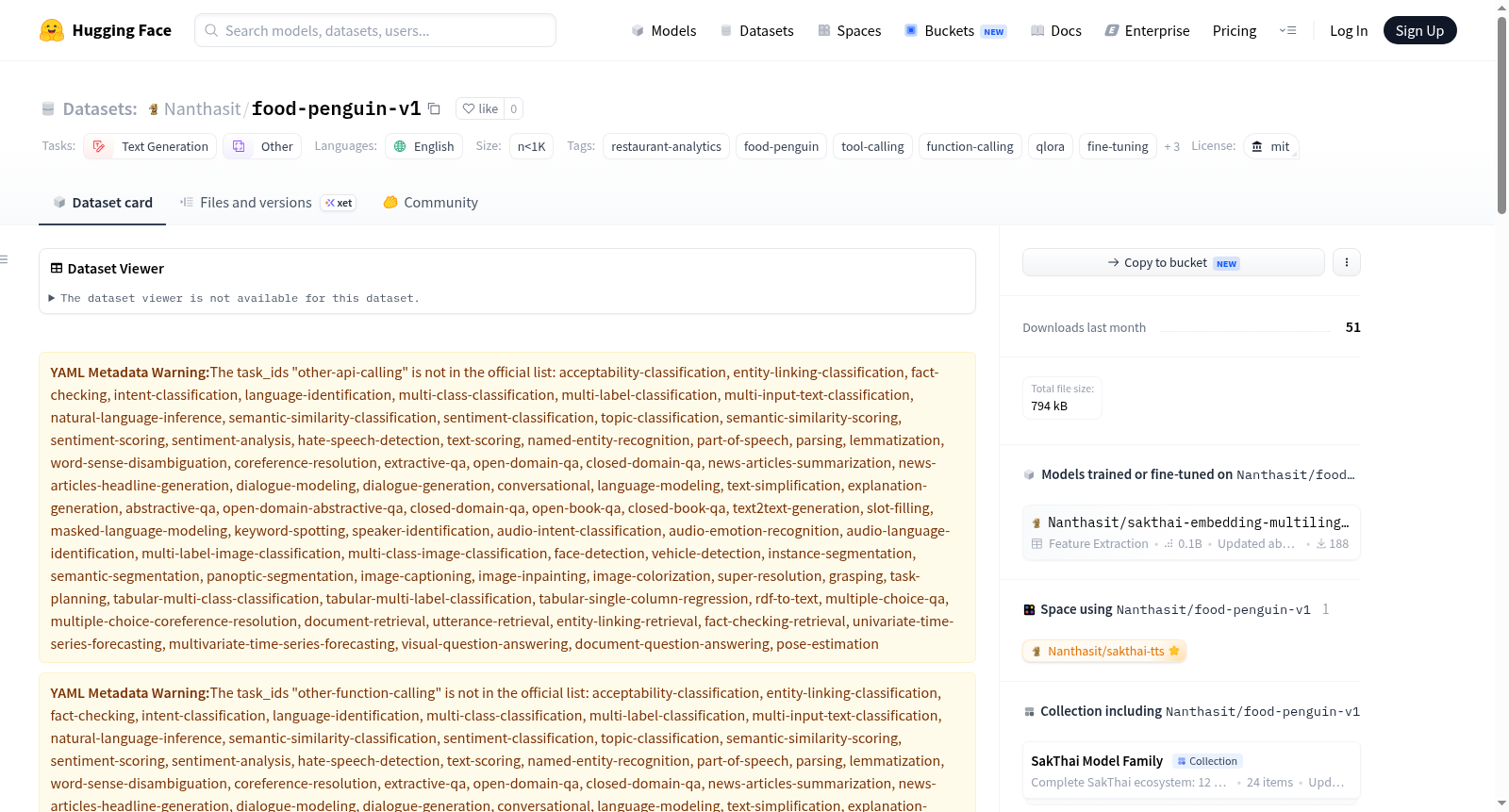
Food-Penguin v1 是一个专门用于餐厅分析场景的工具调用(function-calling)微调数据集。该数据集包含648个训练样本,采用与OpenAI聊天补全API兼容的JSONL格式。每个样本包含一个messages序列(包含system、user、assistant、tool等角色对话)和一个tools序列(定义可调用的函数)。数据集的核心理念是教导语言模型调用7个特定的餐厅业务分析功能,包括:销售预测、浪费分析、生产优化、库存优化、KPI总结、订单洞察和行动建议。这些功能被应用于25个手工设计的业务场景中。数据的一个重要特点是模拟了真实的管理工作流,其中61.4%的样本涉及两个或更多工具的链式调用(最常见的是“预测销售”后接“推荐行动”),38.6%为单工具调用。数据集还特意涵盖了边缘情况,如数据缺失、模糊或冲突的查询、超范围值以及多意图请求,以增强模型的鲁棒性。该数据集适用于对语言模型进行工具调用/函数调用能力的微调,特别是在垂直领域(如餐饮业商业分析)的应用开发。
Food-Penguin v1 is a fine-tuning dataset specifically designed for tool-calling (function-calling) in restaurant analytics scenarios. It contains 648 training samples in JSONL format compatible with the OpenAI Chat Completion API. Each sample includes a messages sequence (containing dialogues with roles such as system, user, assistant, and tool) and a tools sequence (defining callable functions). The core concept is to teach language models to invoke seven specific restaurant business analysis functions: sales forecasting, waste analysis, production optimization, inventory optimization, KPI summary, order insights, and action recommendations. These functions are applied to 25 manually designed business scenarios. A key feature is the simulation of real management workflows, where 61.4% of samples involve chained calls of two or more tools (most commonly predict sales followed by recommend actions), and 38.6% are single-tool calls. The dataset also deliberately covers edge cases such as missing data, ambiguous or conflicting queries, out-of-range values, and multi-intent requests to enhance model robustness. This dataset is suitable for fine-tuning language models tool-calling/function-calling capabilities, particularly in vertical domain applications such as restaurant business analytics.
数据集概述:Food-Penguin v1
Food-Penguin v1 (代号 🐧🍣) 是一个面向餐厅分析领域的工具调用(Tool-Calling)数据集,旨在训练模型根据餐厅管理场景自动调用相关分析函数。
基本信息
| 属性 | 值 |
|---|---|
| 数据集名称 | Food-Penguin v1 — Restaurant Analytics Tool-Calling Dataset |
| 语言 | 英语(单语) |
| 许可证 | MIT |
| 数据集大小 | 648 个样本(训练集) |
| 下载大小 | 781,339 字节 |
| 任务类别 | 文本生成 / 工具调用 / 函数调用 |
| 数据格式 | JSONL(OpenAI messages 格式) |
数据内容与结构
- 样本构成:每个样本包含
messages(多轮对话消息序列)和tools(可用工具定义)两个字段。 - 角色类型:
system、user、assistant、tool,模拟完整的工具调用对话流程。 - 场景覆盖:基于 25 个精心设计的餐厅管理场景。
- 工具链比例:
- 单工具调用:38.6%
- 多工具链式调用:61.4%(主要为 2 个工具),模拟真实管理工作流。
- 最常见的工具链:
predict_sales→recommend_actions
- 边界情况:涵盖缺失数据、歧义/冲突查询、超出范围值、多意图请求等。
工具(共 7 个)
| 函数名称 | 功能描述 | 样本占比 |
|---|---|---|
predict_sales |
根据趋势预测下一期销售额 | 56.5% |
analyze_waste |
发现浪费模式与减废机会 | 56.5% |
optimize_production |
根据需求调整生产计划 | 30.9% |
get_kpi_summary |
获取健康评分/收入/成本快照 | 30.9% |
recommend_actions |
基于分析结果提供可操作建议 | 30.9% |
optimize_inventory |
根据销售速度优化原料订购 | 25.6% |
get_order_insights |
分析订单模式与菜单项表现 | 23.1% |
其他信息
- 训练方案:使用 QLoRA(4-bit)在 Kaggle T4 上训练约 5 个 epoch,基座模型为
sakthai-context-0.5b-merged。 - 关联资源:
- 通用工具调用数据:sakthai-combined-v6
- 项目仓库:Food-Penguin-Limited
- 完整模型/数据集集合:SakThai 模型家族(12 模型、5 数据集、3 空间)