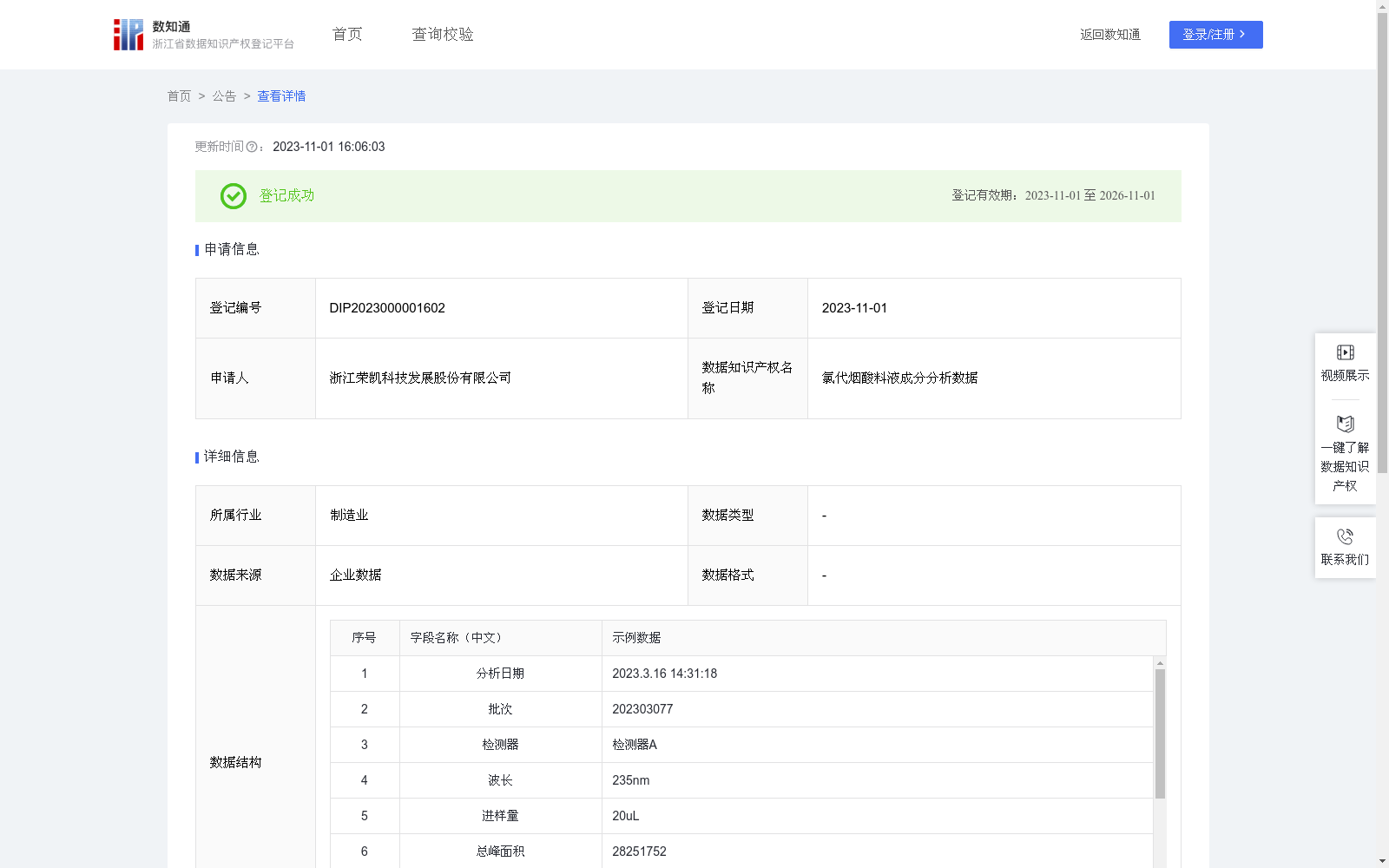
氯代烟酸料液成分分析数据
收藏资源简介:
氯代烟酸生产过程中,氯代步骤是工艺的最关键步骤,通过对氯代步骤反应料液取样后,采用高效液相色谱仪进行检测,采用面积归一法进行成分分析,来确定氯代反应进行的程度和各氯代烟酸的生成效率,鉴别异常工艺批次,为各氯代烟酸产物分离提纯提供关键的成分分布参数。采用液相色谱面积归一法,样品中的化合物在液相色谱柱上进行分离出来形成峰,每个峰的面积与化合物的浓度成正比,因此各物质含量=各峰面积占总峰面积的百分率。1、取样及保存:从氯代反应料液中取得液体样品,封装于50mL玻璃瓶中,送样分析。2、样品预处理:准确称取20mg样品放入50mL容量瓶中,加入流动相溶解定容,作为供试品溶液。3、检测方法:打开高效液相色谱仪色谱工作站,设置检测参数:色谱柱C18 250mm×4.6mm,5um;流速:1.0mL/min;波长235nm;流动相配比磷酸:乙腈:水=1:333:666;运行时间30min;进样量20uL;自动进样。4、数据采集:通过色谱工作站进行数据采集形成色谱峰图。5、数据处理:将色谱图中所有的出峰进行出峰时间、出峰高度、峰面积进行标注和微积分,把所有出峰的峰面积进行加和为总峰面积。将5-氯烟酸、6-氯烟酸和2氯烟酸对应的出峰进行峰面积的积分,计算各物质含量:5-氯烟酸的含量=5-氯烟酸出峰的峰面积/总峰面积×100%;6-氯烟酸的含量=6-氯烟酸出峰的峰面积/总峰面积×100%;2-氯烟酸的含量=2-氯烟酸出峰的峰面积/总峰面积×100%。
During the production of chloronicotinic acids, the chlorination step is the most critical process stage. By sampling the reaction feed liquid from the chlorination step, conducting detection with high-performance liquid chromatography (HPLC) and performing compositional analysis via the area normalization method, we can determine the progress of the chlorination reaction and the formation efficiency of each chloronicotinic acid product, identify abnormal process batches, and provide key compositional distribution parameters for the separation and purification of each chloronicotinic acid product. The principle of liquid chromatography area normalization method is as follows: Compounds in the sample are separated on the liquid chromatography column to form peaks, and the area of each peak is proportional to the concentration of the corresponding compound. Therefore, the content of each substance is equal to the percentage of its peak area in the total peak area. 1. Sampling and storage: Collect liquid samples from the chlorination reaction feed liquid, seal them in 50 mL glass bottles, and send them for analysis. 2. Sample pretreatment: Accurately weigh 20 mg of the sample into a 50 mL volumetric flask, add the mobile phase to dissolve and dilute to the mark to obtain the test solution. 3. Detection method: Turn on the HPLC workstation, set the detection parameters as follows: Chromatographic column: C18, 250 mm × 4.6 mm, 5 μm; Flow rate: 1.0 mL/min; Detection wavelength: 235 nm; Mobile phase ratio: phosphoric acid:acetonitrile:water = 1:333:666; Running time: 30 min; Injection volume: 20 μL; Automatic sampling. 4. Data acquisition: Collect data through the chromatography workstation to generate a chromatogram. 5. Data processing: Label and integrate the retention time, peak height and peak area of all peaks in the chromatogram, sum the peak areas of all peaks to obtain the total peak area. Integrate the peak areas corresponding to 5-chloronicotinic acid, 6-chloronicotinic acid and 2-chloronicotinic acid, and calculate the content of each substance: Content of 5-chloronicotinic acid = (Peak area of 5-chloronicotinic acid / Total peak area) × 100%; Content of 6-chloronicotinic acid = (Peak area of 6-chloronicotinic acid / Total peak area) × 100%; Content of 2-chloronicotinic acid = (Peak area of 2-chloronicotinic acid / Total peak area) × 100%;