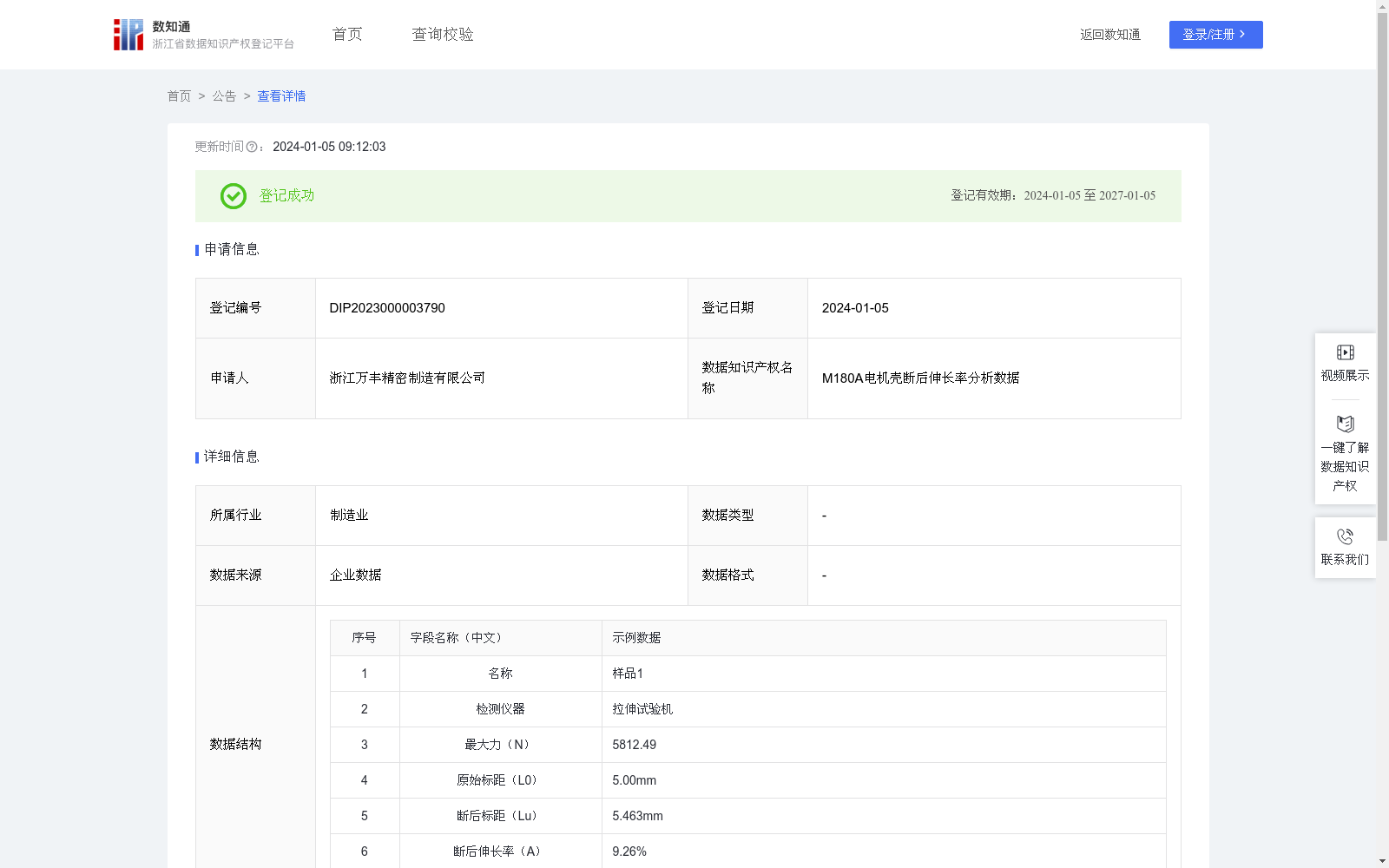
M180A电机壳断后伸长率分析数据
收藏资源简介:
断后伸长率是一个材料力学性能的重要指标,是评估材料可靠性的重要依据之一,用来评估材料在受力后的延展性能,是衡量材料韧性的重要参数之一。M180A电机壳广泛应用于汽车电机,在汽车行驶状态下,它承受着电机带来多变的载荷,断后伸长率能够反映产品在冲击负荷下的断裂性能,从而有效预防汽车在受到冲击或振动载荷时更好地防止突发故障。断后伸长率是指材料在拉伸过程中,在断裂破裂前的延展变形量与原始标距之比。采用M180A电机壳材料制备尺寸为5士0.05mm,长度为227.5mm,试验夹持部位直径为中8士0.2mm,的试样进行拉伸试验测试。1、数据采集:测定试样的原始标距(L0),采用拉伸试验机通过持续施加拉伸力,找到破断点最大力,测量破断点的标距,记录测量结果最大力(N)和断后标距(Lu)。2、数据计算:采用公式计算断后伸长率(A),断后伸长率(A)=(断后标距(Lu)-原始标距(L0))/原始标距(L0)×100%。3、数据结论:测试的断后伸长率(A)符合客户定制要求区间为8%~12%。
Elongation after fracture is a vital index of material mechanical properties, serving as one of the important bases for evaluating material reliability. It is used to assess the plastic deformation capacity of materials after being subjected to external forces, and is also a key parameter for measuring material toughness. M180A motor housings are widely applied in automotive motor systems. When a vehicle is in motion, these housings endure fluctuating loads generated by the motors. Elongation after fracture can reflect the fracture behavior of the product under impact loads, thus effectively helping to prevent sudden malfunctions of automobiles when subjected to impact or vibration loads. Elongation after fracture refers to the ratio of the plastic deformation amount of a material before fracture during the tensile process to its original gauge length. Tensile tests were conducted on specimens prepared from the M180A motor housing material, with the following dimensional specifications: gauge diameter 5 ± 0.05 mm, total length 227.5 mm, and clamping section diameter φ8 ± 0.2 mm. 1. Data Collection: Measure the original gauge length (L0) of the specimen. Use a tensile testing machine to continuously apply tensile force until the specimen fractures, record the maximum tensile force at the fracture point (unit: N) and measure the post-fracture gauge length (Lu). 2. Data Calculation: Calculate the elongation after fracture (A) using the following formula: A = [(Lu - L0) / L0] × 100%, where Lu denotes the post-fracture gauge length and L0 denotes the original gauge length. 3. Data Conclusion: The measured elongation after fracture (A) meets the customer-specified requirement range of 8% to 12%.