laion-voice-profiles-dpo
收藏资源简介:
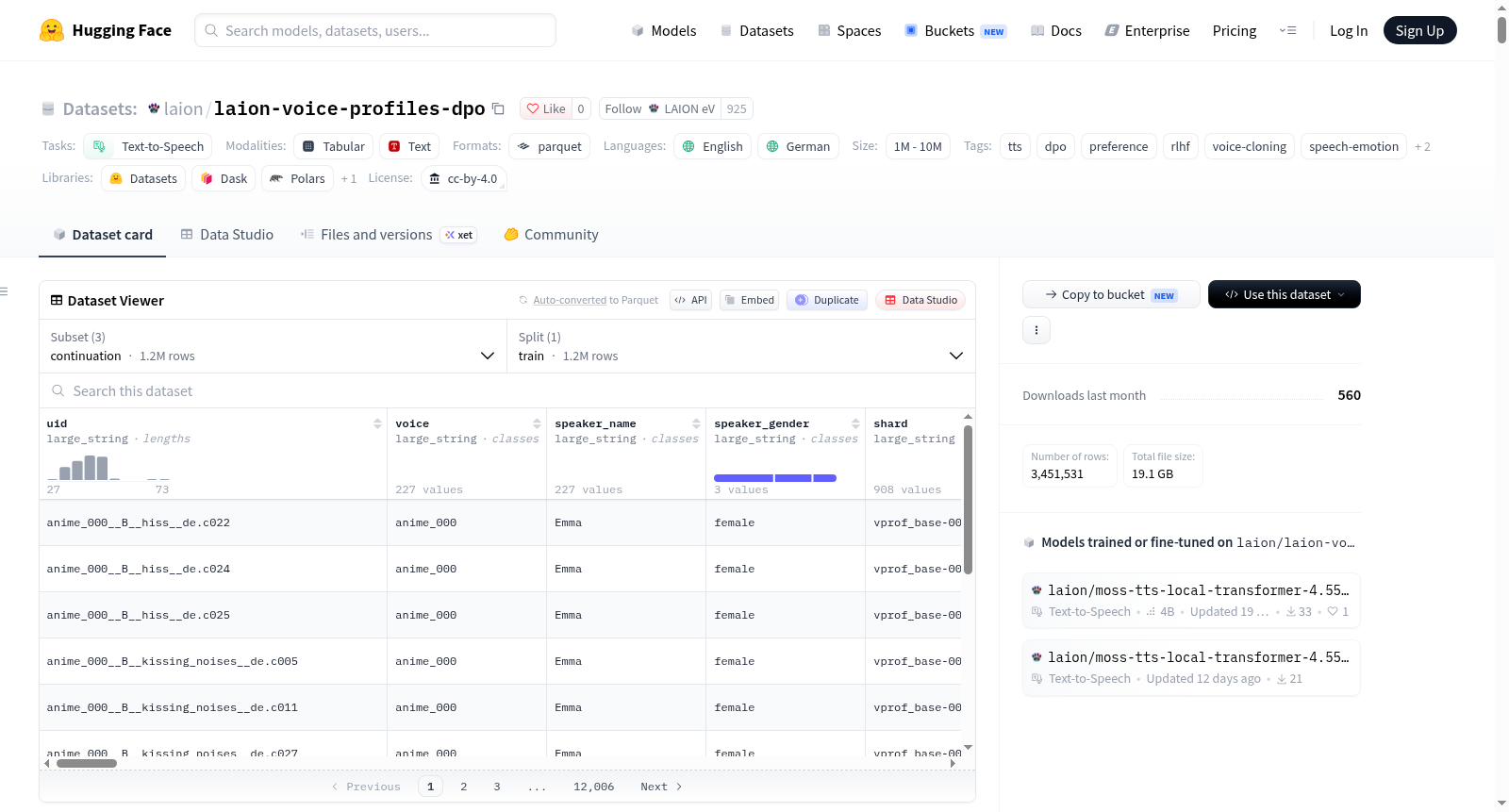
该数据集名为LAION Voice Profiles — TTS DPO pairs,由Christoph Schuhmann和LAION创建,用于文本到语音(TTS)的直接偏好优化(DPO)训练。数据集包含3,451,531个偏好对,每个对共享一个提示(prompt),但chosen和rejected样本在构建方式上不同。数据集基于500个合成语音配置文件,每个配置文件通过固定矩阵的表演条件(如情感和VoiceNet维度)生成大量候选语音,从中选取chosen和rejected。数据集分为三个配置: - emotion:包含1,064,594个对,旨在教导模型为特定语句选择正确的情感语气。rejected样本是同一语音和同一语句,但以错误的情感剂量或维度级别生成。 - truncation:包含1,186,406个对,旨在教导模型不要过早停止。rejected样本是chosen样本在句边界处截断的版本,基于词级强制对齐。 - continuation:包含1,200,531个对,旨在教导模型不要产生幻觉延续。rejected样本是chosen样本后附加同一语音的短失败生成片段。 每个记录都包含两种条件模式(prompt_reference和prompt_name),以及SFT数据集的所有元数据。数据字段包括MOSS代码(12个码本,12.5帧/秒)、强制对齐词边界、情感/维度注释、生成器评分等。数据集还提供了具体的代码示例用于materializing rejected样本,以及在训练中使用两种条件模式的方法。注意:emotion配置的rejected样本直接以字节形式提供,而truncation和continuation的rejected样本需要根据规则从chosen样本生成。
This dataset is called LAION Voice Profiles — TTS DPO pairs, created by Christoph Schuhmann and LAION, used for direct preference optimization (DPO) training of text-to-speech (TTS). It contains 3,451,531 preference pairs, each sharing a prompt, but the chosen and rejected samples differ in construction. The dataset is based on 500 synthetic voice profiles, each generating a large number of candidate voices through a fixed matrix of performance conditions (such as emotion and VoiceNet dimensions), from which chosen and rejected samples are selected. The dataset is divided into three configurations: emotion (1,064,594 pairs, aimed at teaching the model to select the correct emotional tone for a specific utterance), truncation (1,186,406 pairs, aimed at teaching the model not to stop too early), and continuation (1,200,531 pairs, aimed at teaching the model not to produce hallucinated continuations). Each record contains two conditioning modes (prompt_reference and prompt_name), along with all metadata from the SFT dataset. Data fields include MOSS codes (12 codebooks, 12.5 frames per second), forced alignment word boundaries, emotion/dimension annotations, and generator scores. The dataset also provides specific code examples for materializing rejected samples and methods for using the two conditioning modes in training. Note: The rejected samples for the emotion configuration are provided directly in byte form, while those for truncation and continuation need to be generated from the chosen samples according to rules.