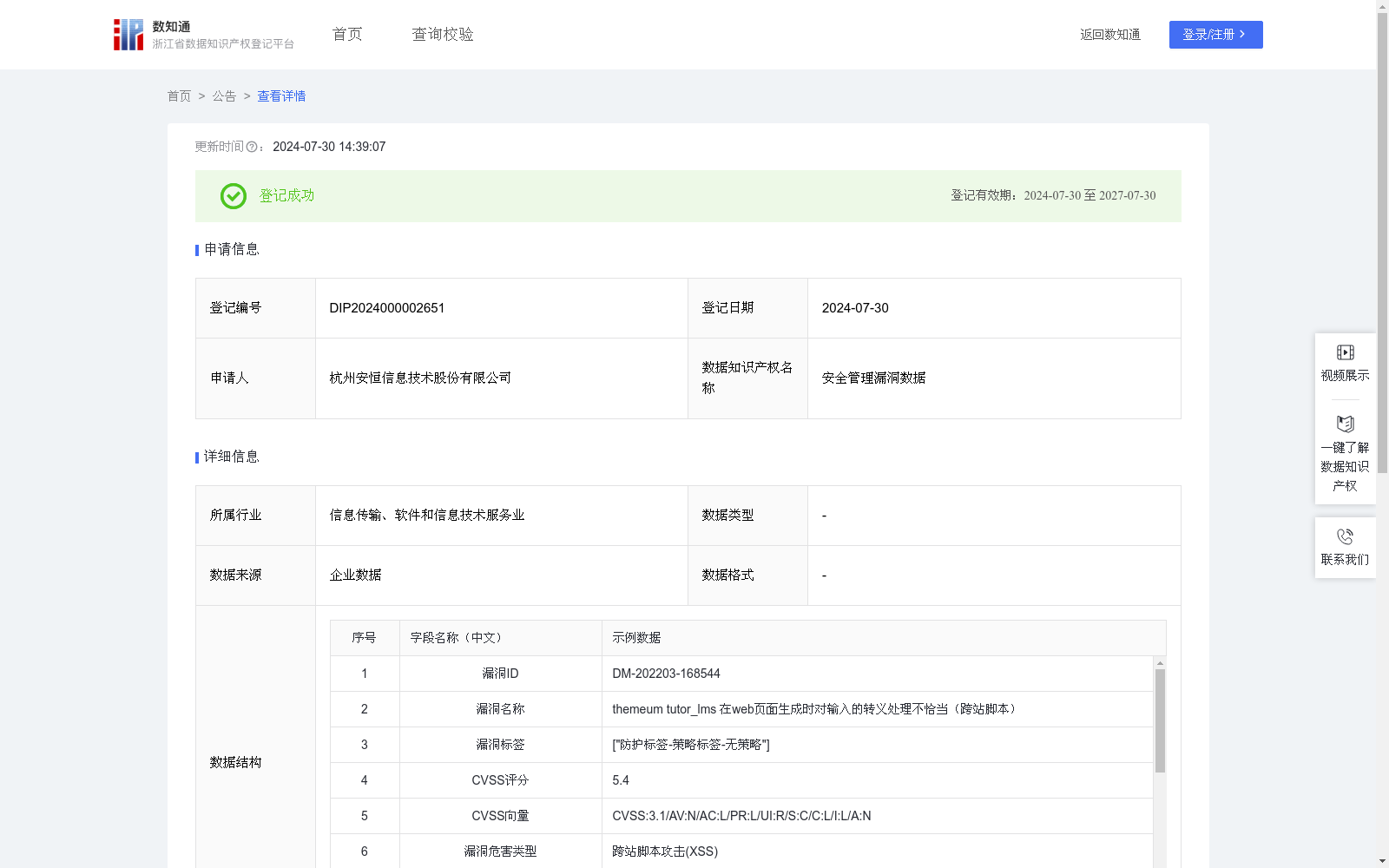
安全管理漏洞数据
收藏资源简介:
漏洞数据主要来源于互联网的漏洞信息、技术人员反馈的漏洞信息、研究人员定向研究的漏洞信息,通过采集、分析、研判、治理等大数据技术手段形成了丰富的漏洞库。 漏洞数据应用价值:漏洞数据的应用价值极为广泛,它不仅对安全风险评估至关重要,帮助组织识别和预防潜在的安全威胁,还支持漏洞管理和修复工作,确保系统和软件的及时更新。此外,漏洞数据对于遵守安全标准和法规、制定安全策略、进行安全教育和培训、应急响应和事件处理、安全研究和开发、威胁情报共享以及业务连续性规划等方面都发挥着关键作用。它还能为投资者提供评估技术风险和业务前景的重要信息,从而做出更明智的投资决策。总体而言,漏洞数据是维护网络安全、保护组织资产、增强用户信任和支持业务决策的宝贵资源。不仅可以提升资产的漏洞发现与预警能力,而且可以增强安全产品的漏洞风险分析能力。 漏洞数据应用场景:1.安全管理-漏洞扫描与漏洞管理 2.端点安全-终端防病毒 3.端点安全-终端安全管理 4.安全解决方案-安全运营/MDR/MSS 4.工控安全-工控安全管理平台 5.工控安全-工控安全审计 6.安全管理 -安全管理平台/态势感知等。数据加工过程:收集外部公开漏洞平台和内部漏洞数据等多源数据,通过判断该数据的公开漏洞编号是否与已掌握漏洞库匹配,若匹配则进行关联融合维度信息;另外针对字段中空缺的值,使用大模型基于漏洞详细信息进行推理补充。详细规则:根据漏洞发现年份月份自增序号生成漏洞ID,利用行业公开的通用漏洞评分系统标准CVSS3.0进行漏洞评分计算,计算公式: 基础分数(Base Score)的计算依据攻击向量(AV)、攻击复杂度(AC)、身份认证(PR)、用户交互(UI)、机密性影响(C)、完整性影响(I)、可用性影响(A);计算公式: ISCbase(影响力基础评分): ISCBase = 1 - [(1−C) × (1−I) × (1−A)] ESC(可利用性评分): ESC = 8.22 × AV × AC × PR × UI 漏洞数据应用:漏洞预警是网络安全领域中一项关键的活动,通过及时的漏洞公告和警报,帮助各类组织快速响应和修复软件和系统中的安全漏洞。这些预警不仅针对已知漏洞,还包括新发现的安全威胁,如零日漏洞,帮助提高系统的安全性和稳定性。
The vulnerability data is primarily sourced from publicly available Internet vulnerability information, vulnerability reports submitted by technical personnel, and vulnerabilities identified through targeted research by researchers. A comprehensive vulnerability database has been established via big data technologies including collection, analysis, assessment, and governance. Application Value of Vulnerability Data: The application value of vulnerability data is extremely broad. It is not only critical for security risk assessment, enabling organizations to identify and prevent potential security threats, but also supports vulnerability management and remediation efforts to ensure timely updates of systems and software. Furthermore, vulnerability data plays a pivotal role in complying with security standards and regulations, formulating security policies, conducting security education and training, emergency response and incident handling, security research and development, threat intelligence sharing, and business continuity planning. It also provides investors with essential information for evaluating technical risks and business prospects to facilitate more informed investment decisions. Overall, vulnerability data is a valuable resource for maintaining cybersecurity, protecting organizational assets, enhancing user trust, and supporting business decision-making. It can not only improve the vulnerability discovery and early warning capabilities for assets but also enhance the vulnerability risk analysis capabilities of security products. Application Scenarios of Vulnerability Data: 1. Security Management - Vulnerability Scanning and Vulnerability Management 2. Endpoint Security - Endpoint Antivirus 3. Endpoint Security - Endpoint Security Management 4. Security Solutions - Security Operations/MDR/MSS 4. Industrial Control Security - Industrial Control Security Management Platform 5. Industrial Control Security - Industrial Control Security Audit 6. Security Management - Security Management Platform/Situation Awareness, etc. Data Processing Workflow: Multi-source data including external publicly available vulnerability platforms and internal vulnerability data are collected. First, verify whether the public vulnerability identifier of the collected data matches the entries in the existing vulnerability database; if a match is found, associate and integrate relevant dimensional information. Additionally, for fields with missing values, a Large Language Model (LLM) is used to perform inference and supplementation based on the detailed vulnerability information. Detailed Rules: Generate a unique vulnerability ID by auto-incrementing the serial number based on the year and month when the vulnerability was discovered. Calculate the vulnerability score using the industry-standard Common Vulnerability Scoring System 3.0 (CVSS3.0). The calculation formula is as follows: The Base Score is calculated based on Attack Vector (AV), Attack Complexity (AC), Privileges Required (PR), User Interaction (UI), Confidentiality Impact (C), Integrity Impact (I), and Availability Impact (A). The specific formulas are: ISCbase (Impact Base Score): ISCBase = 1 - [(1−C) × (1−I) × (1−A)] ESC (Exploitability Score): ESC = 8.22 × AV × AC × PR × UI Vulnerability Data Application: Vulnerability early warning is a critical activity in the cybersecurity domain. Through timely vulnerability announcements and alerts, it helps various organizations rapidly respond to and remediate security vulnerabilities in software and systems. These warnings cover not only known vulnerabilities but also newly discovered security threats such as zero-day vulnerabilities, helping to improve the security and stability of systems.