rtx-5090-benchmarks
收藏资源简介:
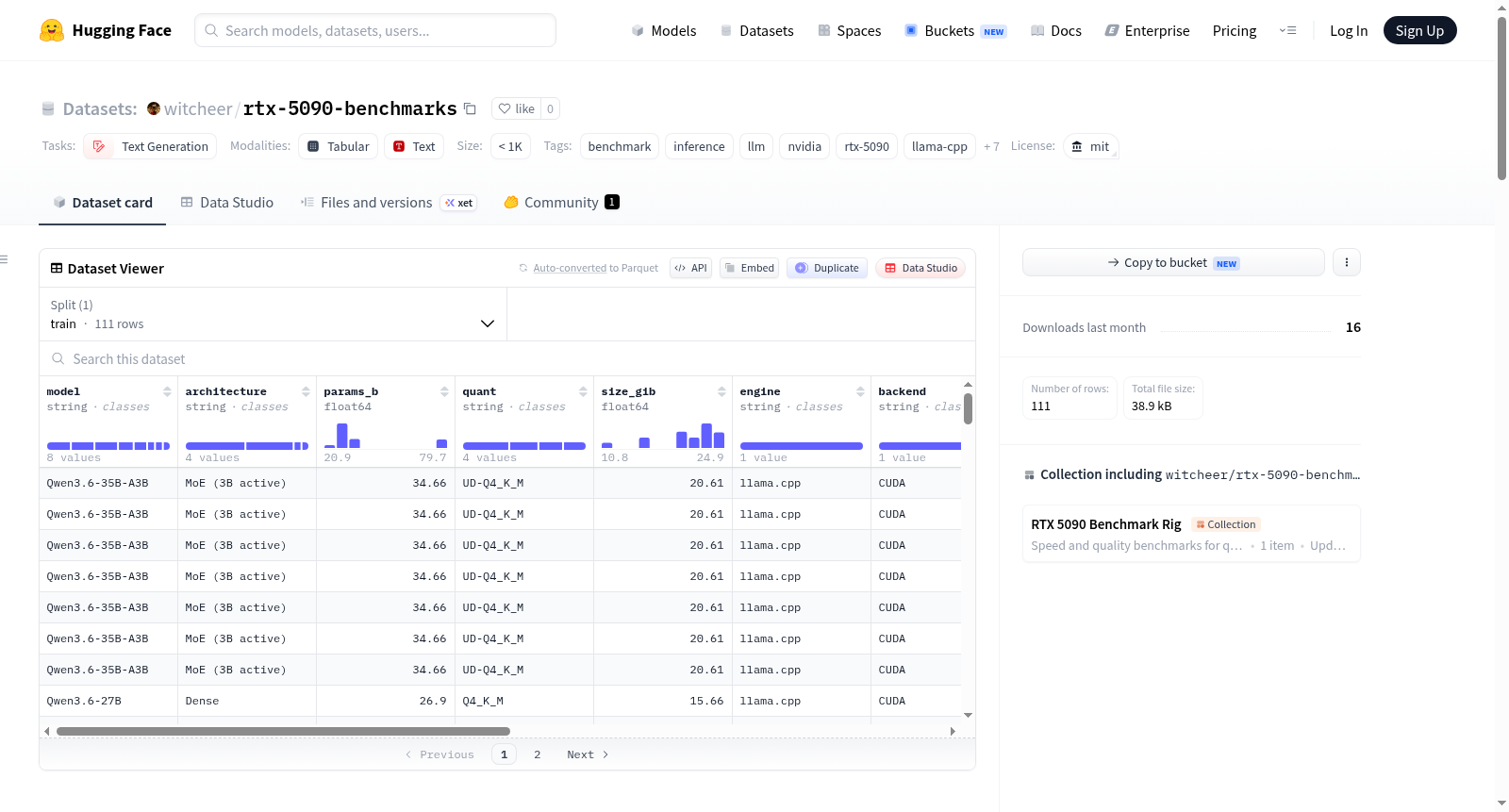
RTX 5090 LLM Benchmarks是一个在NVIDIA RTX 5090 32GB GPU上对量化大型语言模型(LLMs)进行综合基准测试的数据集,使用llm-bench-rig工具生成。该数据集包含质量和速度两方面的评估结果:质量基准测试覆盖了多个标准自然语言处理和代码生成任务,包括MMLU(常识推理)、ARC-Challenge(科学推理)、HellaSwag(常识推理)、GSM8K(数学问题解决)和HumanEval(代码生成),提供了Gemma 4、Qwen3.6、Nemotron-Cascade等多个模型在不同量化配置(如Q6_K、Q4_K_M)下的性能得分;速度基准测试测量了模型在多种上下文长度(128至16384)下的提示处理吞吐量和文本生成吞吐量,并记录了详细的硬件和软件配置信息。数据集采用结构化表格格式,包含模型参数、架构类型(密集或MoE)、量化方法、文件大小、推理引擎、GPU型号、VRAM容量、测试类型、吞吐量及标准差等字段。该数据集适用于比较不同量化LLM在特定硬件上的性能表现,为模型选择、部署优化和硬件评估提供参考。
RTX 5090 LLM Benchmarks is a comprehensive benchmarking dataset for quantized large language models (LLMs) on the NVIDIA RTX 5090 32GB GPU, generated using the llm-bench-rig tool. The dataset includes evaluations in both quality and speed aspects: quality benchmarks cover multiple standard natural language processing and code generation tasks, including MMLU (commonsense reasoning), ARC-Challenge (scientific reasoning), HellaSwag (commonsense reasoning), GSM8K (mathematical problem-solving), and HumanEval (code generation), providing performance scores for models such as Gemma 4, Qwen3.6, and Nemotron-Cascade under various quantization configurations (e.g., Q6_K, Q4_K_M); speed benchmarks measure the prompt processing throughput and text generation throughput of models across various context lengths (128 to 16384), with detailed hardware and software configuration information recorded. The dataset is in a structured table format, containing fields such as model parameters, architecture type (dense or MoE), quantization method, file size, inference engine, GPU model, VRAM capacity, test type, throughput, and standard deviation. This dataset is suitable for comparing the performance of different quantized LLMs on specific hardware, providing reference for model selection, deployment optimization, and hardware evaluation.
数据集概述:RTX 5090 LLM Benchmarks
该数据集提供了在 NVIDIA RTX 5090 32GB 显卡上运行量化大语言模型的速度与质量基准测试结果。所有基准测试均通过 llm-bench-rig 工具完成。
1. 质量基准
该部分使用 llama-server 的聊天补全功能进行生成式评估,覆盖多项标准 NLP 基准测试。
- 评估模型与结果:包含 Gemma 4 31B-it、Qwen3.6-27B、Qwen3.6-35B-A3B、Qwen3-Coder-Next、Nemotron-Cascade-2、gpt-oss-20b 等模型,并记录了其在不同量化级别下的 MMLU、ARC-C、HellaSwag、GSM8K、HumanEval 分数。
- 评估方法:
- 所有基准测试在
temperature=0,max_tokens=2048的条件下运行。 - 多项选择题使用生成式字母提取(Generative letter extraction)进行评分,而非对数似然(log-likelihood)评分,分数差异可能在 5-15% 之间。
- 详细的基准配置:MMLU 使用 5-shot,ARC-Challenge 使用 25-shot,HellaSwag 使用 10-shot,GSM8K 使用 5-shot CoT,HumanEval 使用 0-shot pass@1(代码执行)。
- 所有基准测试在
2. 速度基准
该部分测量了模型的提示处理(PP)和文本生成(TG)吞吐量。
- 测量内容:
- Prompt processing (pp):在上下文长度 128、512、2048、4096、8192、16384 下的并行批量 token 吞吐量。
- Text generation (tg):在 128 tokens 下的顺序自回归 token 吞吐量。
- 所有模型均完全卸载到 GPU。
- 数据模式:数据包含
model、architecture(Dense 或 MoE)、params_b、quant、size_gib、engine(llama.cpp 或 vLLM)、backend、gpu、vram_gb、test(如 pp128、tg128)、tokens_per_sec、stddev、date等字段。 - 关键发现:在 Qwen3.6 系列模型上,MoE 架构(30亿活跃参数)相比 Dense 架构(270亿参数)在提示处理上快 2.4 倍,文本生成上快 3.5 倍。
3. 硬件与工具
- 硬件配置:NVIDIA GeForce RTX 5090 32GB GPU、AMD Ryzen 5 9600 CPU、64GB DDR5-5600 RAM、Ubuntu 26.04 LTS 操作系统、CUDA 12.8。
- 基准工具:llm-bench-rig 开源工具,用于 GGUF 和 safetensors 模型的速度与质量基准测试。