
区块链网络节点管理系统性能瓶颈识别数据
收藏浙江省数据知识产权登记平台2025-04-23 更新2025-04-24 收录
下载链接:
https://www.zjip.org.cn/home/announce/trends/125707
下载链接
链接失效反馈官方服务:
资源简介:
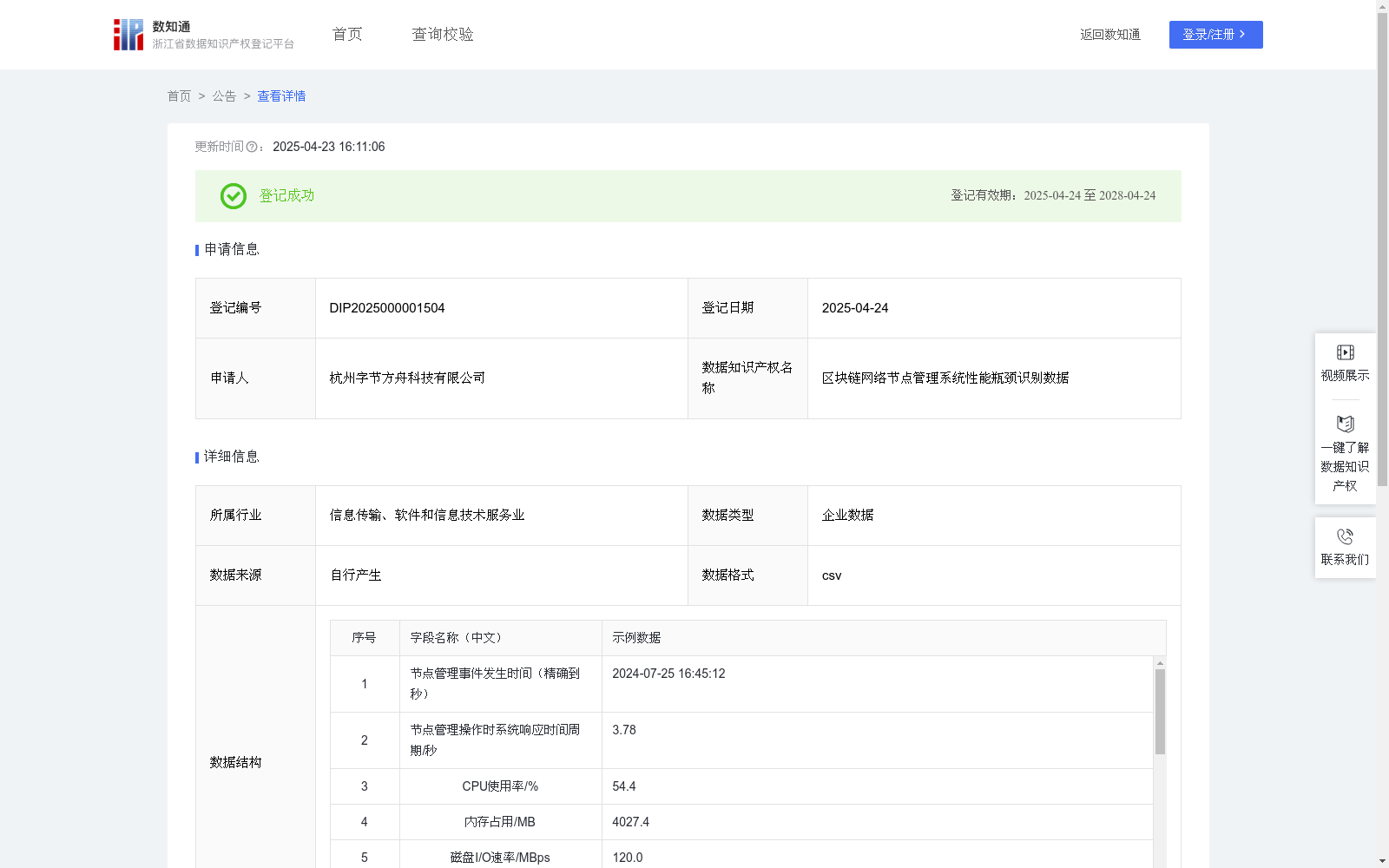
本数据为区块链网络节点管理系统及其相关方提供了多方面的价值,不仅帮助系统开发者优化资源配置、提升节点管理效率,还为其他技术开发者、云计算服务商、硬件供应商等提供了重要的技术参考与改进方向,有助于推动区块链网络性能优化、技术创新和产业升级。对公司(作为系统开发商)而言,根据识别出的性能瓶颈(如网络带宽占用过高),可以优化资源配置,如增加网络带宽、优化节点通信协议、改进数据压缩算法等,以提升节点管理效率。本数据还能为其他技术开发者在优化类似区块链网络节点管理系统设计过程中提供宝贵参考;为云计算服务商优化云服务资源的分配策略提供依据;为网络设备、存储设备等硬件供应商提供改进产品的方向,开发更高性能的硬件以满足区块链网络节点管理的需求。1.数据采集和预处理:(1)数据采集:从公司区块链网络节点管理系统日志中采集反映系统实时性能的数据字段,包括节点管理事件发生时间(精确到秒)、节点管理操作时系统响应时间周期/秒、资源占用情况(分别为CPU使用率/%、内存占用/MB、磁盘I/O速率/MBps、网络带宽占用/Mbps)。(2)数据预处理:对数据进行清洗,去除异常值;将数据按动态的1小时窗口(即从当前时间点向前推1小时)进行聚合,形成结构化数据集X。
2.瓶颈识别:(1)预设回归模型:基于CPU使用率、内存占用、磁盘I/O速率、网络带宽占用4种资源占用情形,预设多元线性回归模型(预设为:节点管理操作时系统响应时间周期=a×CPU使用率+b×内存占用+c×磁盘I/O速率+d×网络带宽占用;其中a,b,c,d为回归系数);(2)模型拟合:基于数据集X,使用最小二乘法(OLS)拟合模型,计算回归系数a,b,c,d;(3)根据回归系数的绝对值大小,确定对节点管理操作时系统响应时间周期影响最大的资源,即为影响最大的性能瓶颈。
This dataset provides multi-faceted value for blockchain network node management systems and their stakeholders. It not only helps system developers optimize resource allocation and improve node management efficiency, but also offers critical technical references and improvement directions for other technology developers, cloud computing service providers, hardware suppliers and other parties, contributing to the optimization of blockchain network performance, technological innovation and industrial upgrading. For the company (as the system developer), based on identified performance bottlenecks (such as excessive network bandwidth occupation), it can optimize resource allocation, e.g., increasing network bandwidth, optimizing node communication protocols, improving data compression algorithms, etc., to enhance node management efficiency. This dataset also provides valuable references for other technology developers when optimizing the design of similar blockchain network node management systems; offers a basis for cloud computing service providers to optimize cloud service resource allocation strategies; and provides improvement directions for hardware suppliers such as network equipment and storage equipment developers to produce higher-performance hardware that meets the requirements of blockchain network node management.
1. Data Collection and Preprocessing
(1) Data Collection: Collect data fields reflecting the real-time performance of the system from the logs of the company's blockchain network node management system, including the occurrence time of node management events (accurate to the second), the system response time cycle/second during node management operations, and resource occupation status (specifically CPU usage/%, memory occupancy/MB, disk I/O rate/MBps, network bandwidth occupation/Mbps).
(2) Data Preprocessing: Clean the data to remove outliers; aggregate the data using a dynamic 1-hour window (i.e., 1 hour forward from the current time point) to form the structured dataset X.
2. Bottleneck Identification
(1) Preset Regression Model: Based on the four resource occupation scenarios of CPU usage, memory occupancy, disk I/O rate and network bandwidth occupation, preset a multiple linear regression model (preset as: system response time cycle during node management operations = a × CPU usage + b × memory occupancy + c × disk I/O rate + d × network bandwidth occupation; where a, b, c, d are regression coefficients).
(2) Model Fitting: Use the ordinary least squares (OLS) method to fit the model based on dataset X, and calculate the regression coefficients a, b, c, d.
(3) Determine the resource that has the greatest impact on the system response time cycle during node management operations based on the absolute values of the regression coefficients, which is the most significant performance bottleneck.
提供机构:
杭州字节方舟科技有限公司
创建时间:
2025-03-22
搜集汇总
数据集介绍
背景与挑战
背景概述
该数据集为区块链网络节点管理系统性能瓶颈识别数据,包含665条记录,涵盖系统响应时间、资源占用情况等17个字段,通过多元线性回归模型识别性能瓶颈,用于优化资源配置和提升系统效率。
以上内容由遇见数据集搜集并总结生成


