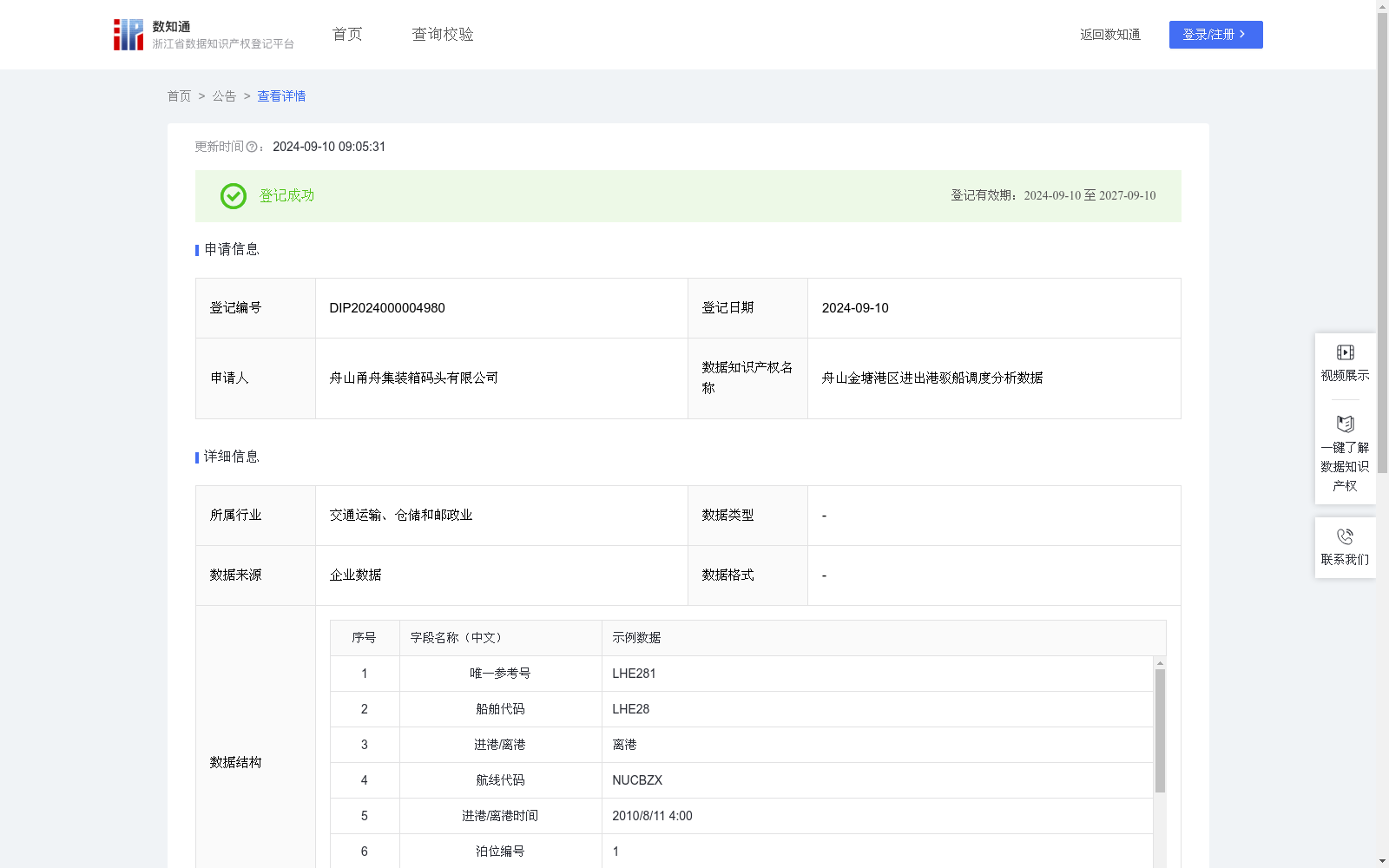
舟山金塘港区进出港驳船调度分析数据
收藏资源简介:
通过对舟山金塘港区进出港驳船调度分析数据分析具体的进港/离港时间、是否使用驳船等等数据,港口管理者能够高效精确调度驳船资源,安排驳船班组工作次序、就位等待时间,确保货船能够迅速且准确地被接驳,安排船舶的靠泊和离港,有效减少船舶等待时间,从而提升码头的使用率,可以进一步增强港口的物流处理能力。不仅提高了港口作业的流畅性,还为港口运营商提供了数据支持,实现更加精细化和智能化的运营管理。1.数据采集处理:通过港口管理系统对船舶代码、进港/离港、航线代码、进港/离港时间、泊位编号、是否使用驳船等数据进行采集、整理、汇总。 2.数据计算:首先判断是否使用驳船,如货船进港离港不使用驳船则后续无驳船工作次序安排;如货船进港离港使用驳船,根据驳船编号安排上一次出勤工作的驳船的下一编号的待命驳船处理本次工作,以保证工作量均衡,同时交替工作便于留出检修维护时间,根据进港/离港时间,依照提前30分钟要求驳船就位等待接驳时间,即就位等待接驳时间=进港/离港时间-30分钟,预测本次接驳预计完成时间=进港/离港时间+2小时;如出现在新的接驳工作安排的等待接驳时间,全部驳船均处于接驳预计完成时间内时,本次接驳工作则标记为延后,驳船就位等待接驳时间以上一次工作接驳预计完成时间为准,顺延15分钟;根据本日的工作安排以及驳船编号,根据时间汇总统计每艘驳船的每个接驳工作的本日工作次序。 3.数据应用:港口管理者能够高效精确调度驳船资源,安排驳船班组工作次序、就位等待时间,确保货船能够迅速且准确地被接驳,安排船舶的靠泊和离港。
By analyzing data including arrival/departure times, whether barges are used, and other relevant data for barge scheduling in Zhoushan Jintang Port Area, port managers can achieve efficient and accurate scheduling of barge resources, arrange the work sequence and berthing waiting time of barge crews, ensure cargo ships can be quickly and accurately connected, and arrange vessel berthing and departure operations. This effectively reduces vessel waiting time, improves terminal utilization rate, further enhances port logistics handling capacity, optimizes the smoothness of port operations, provides data support for port operators, and enables more refined and intelligent operation management. 1. Data Collection and Processing: Relevant data including vessel code, arrival/departure status, route code, arrival/departure time, berth number, and whether to use barges are collected, sorted and aggregated via the port management system. 2. Data Calculation: First, determine whether barges are required for the task. If a cargo ship does not need barges for arrival or departure, no subsequent barge scheduling arrangements will be made. If barges are needed, assign the standby barge with the next serial number of the barge that completed the last shift to handle the current task, so as to balance the workload and allow alternating work schedules for maintenance downtime. Based on the arrival/departure time, the required berthing waiting time for barges is set as 30 minutes in advance, calculated as: Berthing Waiting Time = Arrival/Departure Time - 30 minutes; the predicted completion time of the current connection is calculated as: Predicted Connection Completion Time = Arrival/Departure Time + 2 hours. If the waiting time of a new connection task overlaps with the predicted completion times of all active barges, the current task will be marked as delayed, and its berthing waiting time will be set as the previous task's predicted connection completion time plus 15 minutes. Based on the daily work schedule and barge serial numbers, summarize and count the daily work sequence of each connection task for each barge according to time. 3. Data Application: Port managers can efficiently and accurately schedule barge resources, arrange the work sequence and berthing waiting time of barge crews, ensure cargo ships can be quickly and accurately connected, and arrange vessel berthing and departure operations.