
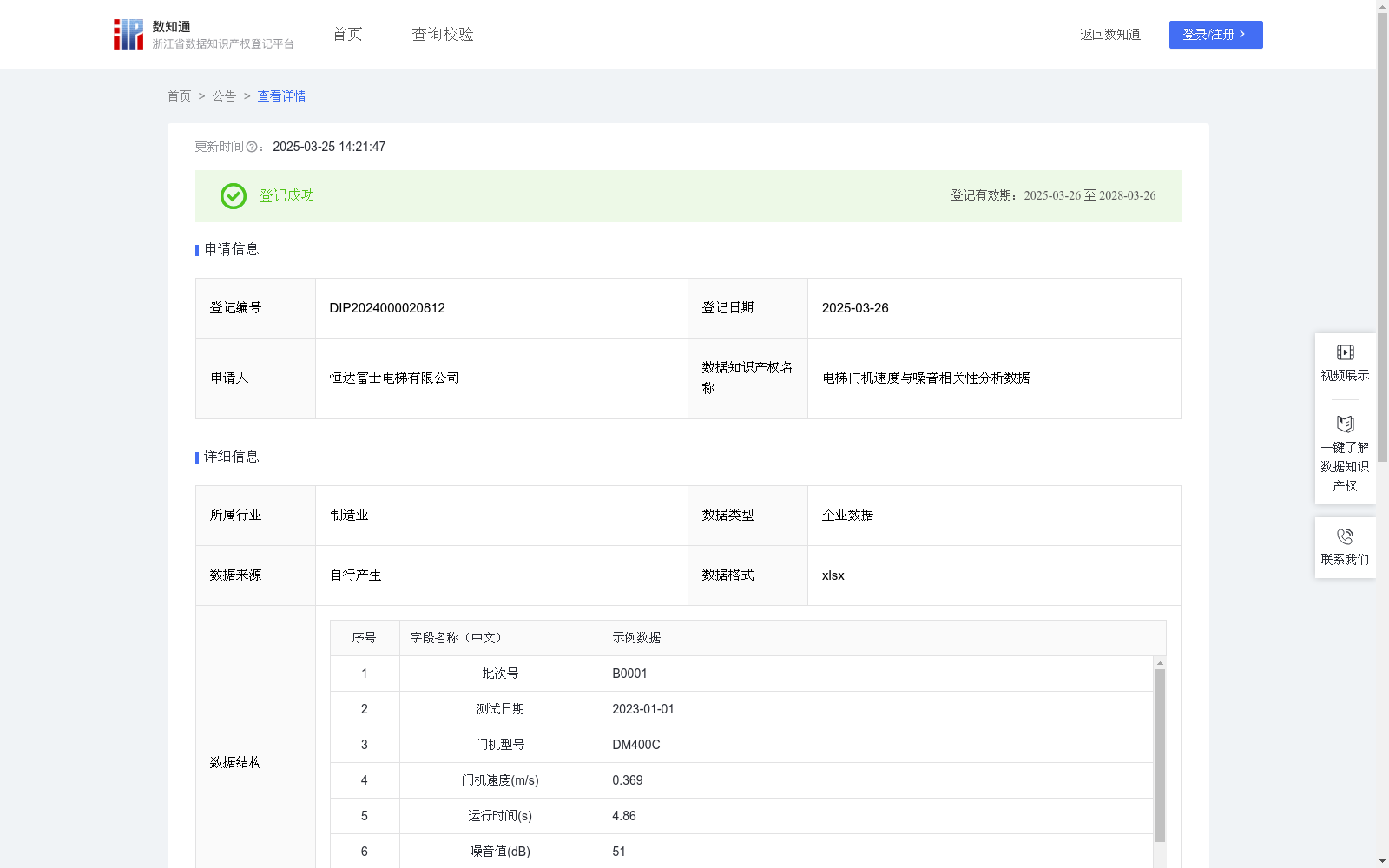
电梯门机速度与噪音相关性分析数据
收藏浙江省数据知识产权登记平台2025-03-25 更新2025-03-26 收录
下载链接:
https://www.zjip.org.cn/home/announce/trends/119709
下载链接
链接失效反馈官方服务:
资源简介:
电梯门机速度与噪音的相关性分析具有重要的工程意义。相关系数是衡量门机运行速度与噪音值之间线性关系强度的关键指标,而斜率和截距作为线性方程的核心参数,共同决定了回归直线的位置和倾斜程度,对于优化门机运行参数和预测噪音表现具有重要实践价值。通过持续积累和长期跟踪测试数据,相关系数、斜率和截距的计算结果将更加准确地反映门机速度与噪音之间的内在联系。这些分析成果为制造、安装、检验、维保和管理等领域的技术人员提供了科学依据,帮助优化门机系统设计、建立噪音评估标准、制定降噪维护策略,并实现噪音的全过程监控。数据驱动的分析方法不仅能有效评估门机运行的静音性,还能监控噪音变化趋势、优化速度控制参数、提升用户体验并延长门机寿命。通过持续的数据积累和科学分析,我们将更深入地理解门机速度对噪音的影响规律,为优化控制和降噪提升提供可靠的数据支持,最终实现门机运行的精确控制和性能提升,满足用户对舒适性和静音性的严格要求。1、数据采集和预处理:
(1)数据采集:采集电梯门机运行性能测试的结果数据,包括:测试日期、批次号、门机型号、门机速度(m/s)、运行时间(s)、噪音值(dB)。
(2)数据预处理:对采集的数据进行清洗;剔除门机速度超出0.2-0.65m/s范围的异常值;剔除噪音异常值(小于45dB或大于65dB);剔除重复、错误或无关的信息,确保数据的准确性和完整性。
2、数据加工和分析:
(1)计算相关系数:
①将历史采集的门机速度和噪音数据以及本次测试的数据汇总,形成X(门机速度)、Y(噪音)两个变量集合。
②利用numpy的corrcoef函数计算变量集合X、Y之间的相关系数,具体公式为:相关系数 = Cov(X,Y)/sX*sY,其中,Cov(X,Y)为X和Y协方差,sX、sY分别为门机速度和噪音的标准差。
(2)计算斜率和截距:
①利用numpy的polyfit函数,对变量集合X(门机速度)、Y(噪音)进行线性回归分析,建立两者之间的数学关系。
②通过回归分析得到线性方程:Y = mX + b,其中:Y为噪音值(dB);X为门机速度(m/s);m为斜率,表示门机速度每增加1m/s时,噪音的变化量(dB/(m/s));b为截距,表示静止时(速度为0)的基础噪音值(dB)。通过此方程可更精准地分析电梯门机速度与噪音的相关性,为门机调试和维护提供依据。
Correlation analysis between elevator door operator speed and noise holds significant engineering importance. The correlation coefficient is a key metric for measuring the strength of the linear relationship between door operator operating speed and noise levels. As core parameters of the linear equation, the slope and intercept jointly determine the position and inclination of the regression line, holding important practical value for optimizing door operator operating parameters and predicting noise performance. By continuously accumulating test data and conducting long-term tracking tests, the calculated results of correlation coefficients, slopes and intercepts will more accurately reflect the intrinsic connection between door operator speed and noise. These analytical results provide scientific basis for technical personnel in fields such as manufacturing, installation, inspection, maintenance and management, helping optimize door operator system design, establish noise assessment standards, formulate noise reduction maintenance strategies, and realize whole-process noise monitoring. Data-driven analysis methods can not only effectively evaluate the acoustic quietness of door operator operation, but also monitor noise change trends, optimize speed control parameters, improve user experience and extend the service life of door operators. Through continuous data accumulation and scientific analysis, we will gain a deeper understanding of the influence laws of door operator speed on noise, provide reliable data support for optimized control and noise reduction improvement, and ultimately achieve precise control of door operator operation and performance improvement, meeting users' strict requirements for comfort and quietness.
1. Data Collection and Preprocessing:
(1) Data Collection: Collect test result data of elevator door operator operating performance, including: test date, batch number, door operator model, door operator speed (m/s), operating time (s), noise level (dB).
(2) Data Preprocessing: Clean the collected data; eliminate outliers where the door operator speed exceeds the range of 0.2-0.65 m/s; eliminate noise outliers (less than 45 dB or greater than 65 dB); remove duplicate, incorrect or irrelevant information to ensure the accuracy and integrity of the data.
2. Data Processing and Analysis:
(1) Calculate Correlation Coefficient:
① Aggregate the historically collected door operator speed and noise data as well as the data from this test to form two variable sets: X (door operator speed) and Y (noise level).
② Use the corrcoef function in NumPy to calculate the correlation coefficient between variable sets X and Y. The specific formula is: Correlation Coefficient = Cov(X,Y)/(sX * sY), where Cov(X,Y) is the covariance of X and Y, and sX and sY are the standard deviations of door operator speed and noise, respectively.
(2) Calculate Slope and Intercept:
① Use the polyfit function in NumPy to perform linear regression analysis on variable sets X (door operator speed) and Y (noise level) to establish the mathematical relationship between the two.
② Obtain the linear equation through regression analysis: Y = mX + b, where: Y is the noise level (dB); X is the door operator speed (m/s); m is the slope, representing the change in noise (dB/(m/s)) when the door operator speed increases by 1 m/s; b is the intercept, representing the basic noise level when stationary (speed is 0). This equation can more accurately analyze the correlation between elevator door operator speed and noise, providing a basis for door operator commissioning and maintenance.
提供机构:
恒达富士电梯有限公司
创建时间:
2024-12-04
搜集汇总
数据集介绍
背景与挑战
背景概述
该数据集包含651条电梯门机速度与噪音相关性的测试数据,用于分析门机速度与噪音的线性关系,优化门机系统设计和降噪策略。
以上内容由遇见数据集搜集并总结生成



