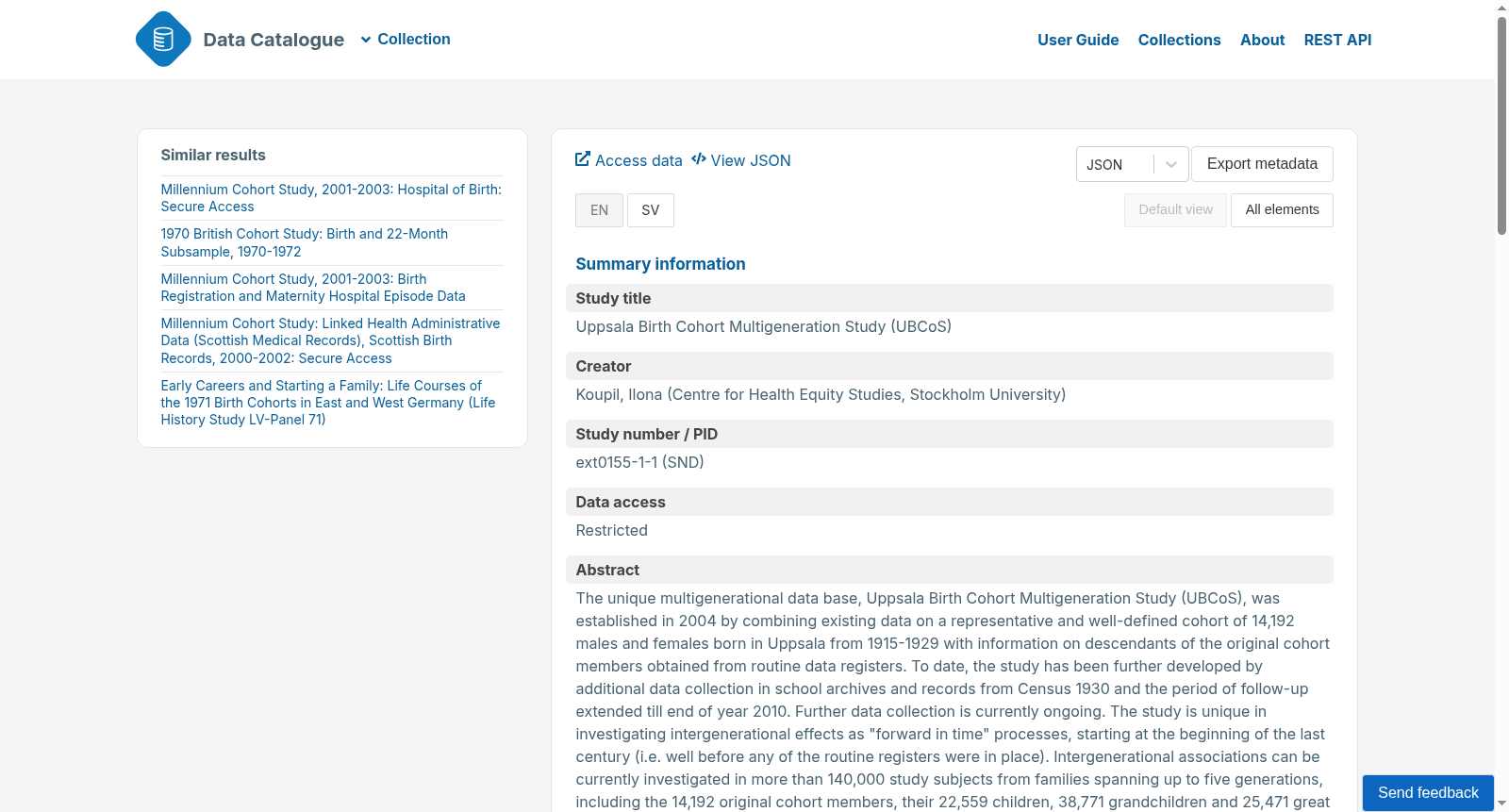
Uppsala Birth Cohort Multigeneration Study (UBCoS)
收藏资源简介:
The unique multigenerational data base, Uppsala Birth Cohort Multigeneration Study (UBCoS), was established in 2004 by combining existing data on a representative and well-defined cohort of 14,192 males and females born in Uppsala from 1915-1929 with information on descendants of the original cohort members obtained from routine data registers. To date, the study has been further developed by additional data collection in school archives and records from Census 1930 and the period of follow-up extended till end of year 2010. Further data collection is currently ongoing. The study is unique in investigating intergenerational effects as "forward in time" processes, starting at the beginning of the last century (i.e. well before any of the routine registers were in place). Intergenerational associations can be currently investigated in more than 140,000 study subjects from families spanning up to five generations, including the 14,192 original cohort members, their 22,559 children, 38,771 grandchildren and 25,471 great grandchildren. The main research objectives are to: (i) Address questions of the extent to which and the mechanisms whereby social advantage and disadvantage are transmitted from one generation to the next, giving rise to continuity in social disadvantage both over the life cycle and across generations. (ii) Explore how early social and biological factors are transmitted from the parent generation to offspring generation(s). (iii) Integrate the understanding of broader social mechanisms with the understanding of disease specific aetiology to answer the question of how, and to what extent, health inequalities are reproduced into each new generation. Purpose: The aim of the study is to investigate life course and intergenerational determinants of social inequalities in health. Number of participants: 14,192 original cohort together with >140,000 family members.
这款独特的多代数据库——乌普萨拉出生队列多代研究(Uppsala Birth Cohort Multigeneration Study, UBCoS)——于2004年建成,它整合了1915年至1929年间在乌普萨拉出生的14192名特征明确的代表性队列成员(男女均有)的现有数据,以及从常规数据登记系统获取的该队列原始成员的后代相关信息。 截至目前,本研究通过补充采集学校档案及1930年人口普查记录中的数据得到进一步完善,随访周期也延长至2010年末,当前仍在推进额外的数据采集工作。 本研究的独特之处在于,以「时间向前推演」的范式开展代际效应研究,其起始节点设于20世纪初(即早于所有常规登记系统建立的时期)。目前,本研究可对来自最多跨越五代的家庭的14万余名研究对象进行代际关联分析,研究对象涵盖14192名原始队列成员、其22559名子女、38771名孙辈以及25471名曾孙辈。 本研究的主要目标包括: (一)探究社会优势与劣势在代际间传递的程度与作用机制,阐明社会劣势在个体生命周期内及跨代际间的延续性成因; (二)探索亲代早期社会与生物学因素向子代传递的具体路径; (三)将对广义社会机制的认知与特定疾病病因学的研究相结合,解答健康不平等如何、且在多大程度上在每一代新群体中重现的问题。 研究宗旨: 本研究旨在探究健康社会不平等的生命历程与代际决定因素。 研究对象规模:包含14192名原始队列成员及其14万余名家族成员。