DeepSWE1.1-trajectories-Qwen3.8-27B
收藏资源简介:
数据集“DeepSWE 1.1 Agent Trajectories — Qwen3.8-27B”包含在 DeepSWE 1.1 基准上进行 7 次完整运行的 agent 轨迹和评估结果。主要实验使用 Qwen3.8-27B 模型,分别通过 Mini-SWE、Claude Code 和 Pi 三种 agent 框架进行评估,并包含 Muse-Glimmer-30B 和 Qwen3.6-27B 作为较弱的参考基线。每次运行覆盖所有 113 个基准任务,总计包括 791 个任务级结果记录、791 个压缩的 agent 轨迹、425 个提交的文本补丁,以及精确的运行配置、总分和效率统计。DeepSWE 基准衡量 agent 在 113 个原创、长程软件工程任务上的表现,任务来源于活跃的 TypeScript、Go、Python、JavaScript 和 Rust 项目。每个任务中,agent 会收到一个隔离的仓库和一个自然语言请求,需要检查代码、实现所需行为、运行测试并提交补丁。DeepSWE 随后在干净副本上应用该补丁并用保留测试评分。数据集中每个任务的结果包含评分、状态、持续时间、使用指标和 artifact 可用性;轨迹包含任务提示、助手消息、推理轨迹、工具调用、工具输出和使用信息。该数据集适用于评估和比较不同 agent 框架下中等规模语言模型在复杂软件工程任务上的编码能力,以及分析 agent 推理轨迹和性能差异。
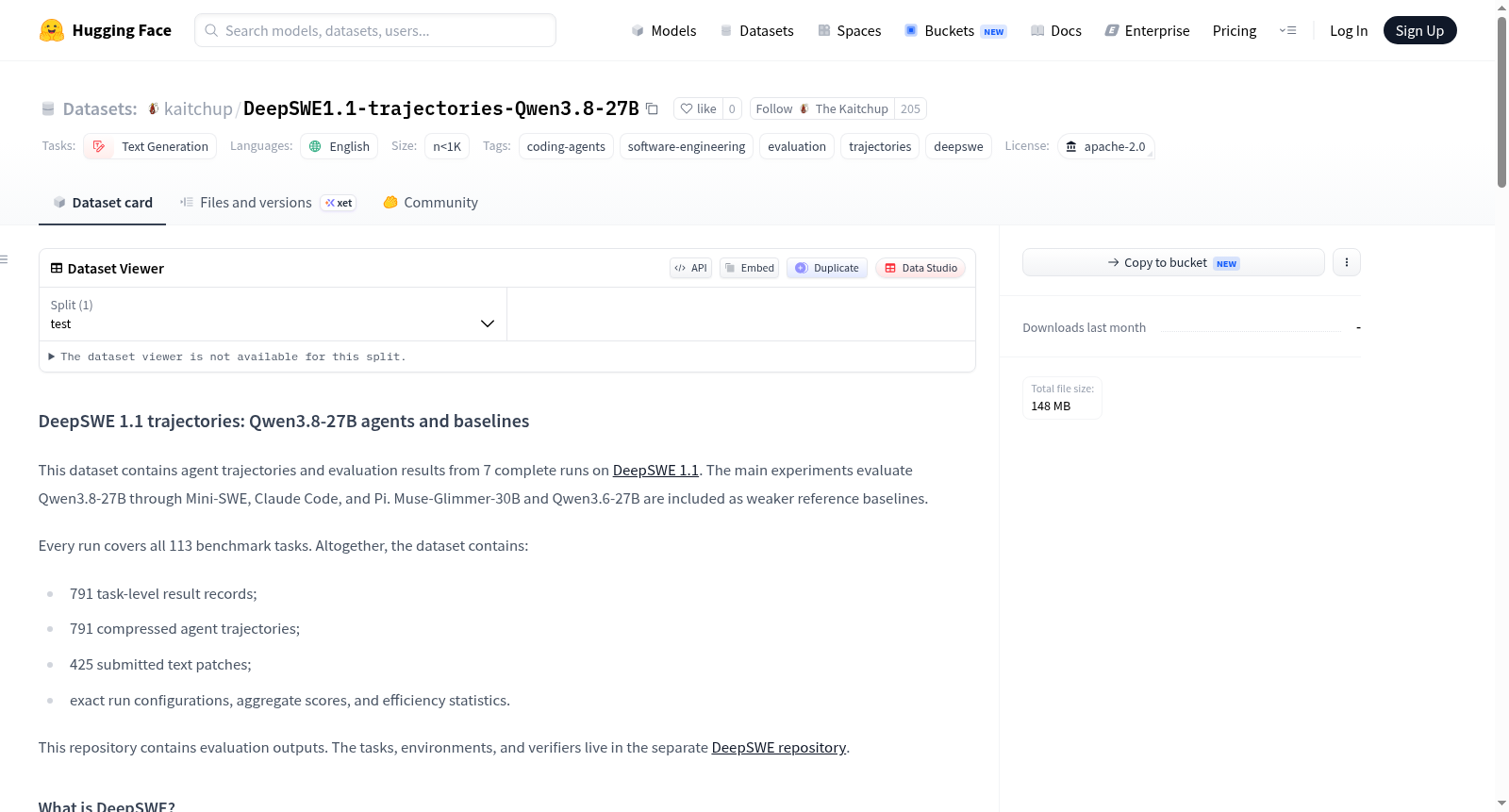
The dataset "DeepSWE 1.1 Agent Trajectories — Qwen3.8-27B" contains agent trajectories and evaluation results from 7 complete runs on the DeepSWE 1.1 benchmark. The main experiments use the Qwen3.8-27B model evaluated across three agent frameworks: Mini-SWE, Claude Code, and Pi, with Muse-Glimmer-30B and Qwen3.6-27B as weaker baselines. Each run covers all 113 benchmark tasks, totaling 791 task-level result records, 791 compressed agent trajectories, 425 submitted text patches, along with precise run configurations, total scores, and efficiency statistics. The DeepSWE benchmark measures agent performance on 113 original, long-range software engineering tasks sourced from active TypeScript, Go, Python, JavaScript, and Rust projects. In each task, the agent receives an isolated repository and a natural language request, requiring it to examine code, implement the desired behavior, run tests, and submit a patch. DeepSWE then applies the patch to a clean copy and scores it with held-out tests. Each task result includes score, status, duration, usage metrics, and artifact availability; trajectories include task prompts, assistant messages, reasoning traces, tool calls, tool outputs, and usage information. This dataset is suitable for evaluating and comparing the coding capabilities of medium-sized language models on complex software engineering tasks across different agent frameworks, and for analyzing agent reasoning trajectories and performance differences.
DeepSWE 1.1 Agent Trajectories — Qwen3.8-27B 数据集总结
基本信息
- 数据集名称:DeepSWE 1.1 Agent Trajectories — Qwen3.8-27B
- 语言:英语(en)
- 许可证:Apache-2.0
- 任务类别:文本生成(text-generation)
- 标签:coding-agents、software-engineering、evaluation、trajectories、deepswe
- 数据规模:n<1K
数据集概述
该数据集包含来自 DeepSWE 1.1 上 7 次完整运行的智能体轨迹与评估结果。主要实验通过 Mini-SWE、Claude Code 和 Pi 评估 Qwen3.8-27B。Muse-Glimmer-30B 和 Qwen3.6-27B 作为较弱的参考基线纳入。
每次运行覆盖全部 113 个基准任务。数据集共包含:
- 791 条任务级结果记录
- 791 条压缩的智能体轨迹
- 425 个提交的文本补丁(patch)
- 精确的运行配置、聚合分数与效率统计
该仓库仅包含评估输出。任务、环境与验证器位于独立的 DeepSWE 仓库中。
什么是 DeepSWE
DeepSWE 在 113 个原创、长周期软件工程任务上衡量编码智能体,任务取自活跃的 TypeScript、Go、Python、JavaScript 和 Rust 项目。每个任务中,智能体获得一个隔离的仓库和自然语言请求,必须检查代码、实现所需行为、运行测试并提交补丁。DeepSWE 随后将该补丁应用到干净副本并用留出测试进行评分。
实验结果
| 模型 | 智能体 | 推理 | F2P (%) | 奖励 (%) | 解决数 | 执行错误 |
|---|---|---|---|---|---|---|
| Muse-Glimmer-30B | Mini-SWE | xhigh | 39.43 | 5.31 | 6/113 | 19 |
| Qwen3.6-27B | Pi | thinking on | 63.44 | 3.54 | 4/113 | 1 |
| Qwen3.8-27B | Mini-SWE | xhigh | 77.42 | 41.59 | 47/113 | 0 |
| Qwen3.8-27B | Claude Code | xhigh | 88.52 | 42.48 | 48/113 | 0 |
| Qwen3.8-27B | Pi | low | 86.47 | 39.82 | 45/113 | 0 |
| Qwen3.8-27B | Pi | medium | 84.10 | 43.36 | 49/113 | 1 |
| Qwen3.8-27B | Pi | xhigh | 86.65 | 46.02 | 52/113 | 3 |
执行错误指智能体阶段以错误结束,并非获得零奖励的任务数量。精确的模型、采样、上下文窗口、输出限制、超时、重试和智能体版本设置可通过链接的 run.json 文件获取。
仓库结构
text README.md
summary/ main-results.csv efficiency-quantiles.csv
runs/ <run-id>/ run.json tasks/ <task-id>/ result.json trajectory.json.gz model.patch # 当可用时
run.json:包含运行配置、聚合分数、效率分布以及所有任务的索引。result.json:包含单个任务的分数、状态、时长、使用指标和产物可用性。trajectory.json.gz:包含任务提示、助手消息、推理轨迹、工具调用、工具输出和使用信息。不同智能体接口的消息细节略有不同。model.patch:425 个任务可用,补丁可用性记录在每个任务的result.json中。
数据加载
下载本地快照:
python from pathlib import Path from huggingface_hub import snapshot_download
root = Path(snapshot_download( repo_id="kaitchup/DeepSWE1.1-trajectories-Qwen3.8-27B", repo_type="dataset", ))
读取结果表和一条轨迹:
python import csv import gzip import json
with (root / "summary" / "main-results.csv").open() as file: runs = list(csv.DictReader(file))
run_dir = root / "runs" / "qwen3.8-27b-pi-xhigh" task_dir = sorted((run_dir / "tasks").iterdir())[0] result = json.loads((task_dir / "result.json").read_text())
with gzip.open(task_dir / "trajectory.json.gz", "rt", encoding="utf-8") as file: trajectory = json.load(file)
print(result["task_name"], result["verifier"]) print("trajectory steps:", len(trajectory["steps"]))
局限性
- 每个配置仅有一次运行,因此在没有重复的情况下,微小差异不应被视为具有统计显著性。
- 智能体接口在提示、工具、上下文管理、重试策略和输出限制方面存在差异,因此这不是受控的仅模型比较。
low、medium和xhigh是配置标签,并非跨不同智能体或模型的标准化推理计算量。- Token 和轮次计数来自不同的智能体适配器,可能无法完全可比。
致谢
Verda 提供了用于运行这些实验的 RTX Pro 6000 和 H200。
许可证与第三方代码
该数据集以 Apache-2.0 发布。基准任务使用各自许可证下的第三方开源项目。轨迹和补丁可能包含这些项目的摘录或修改,这些材料仍受其适用的上游许可证约束。