
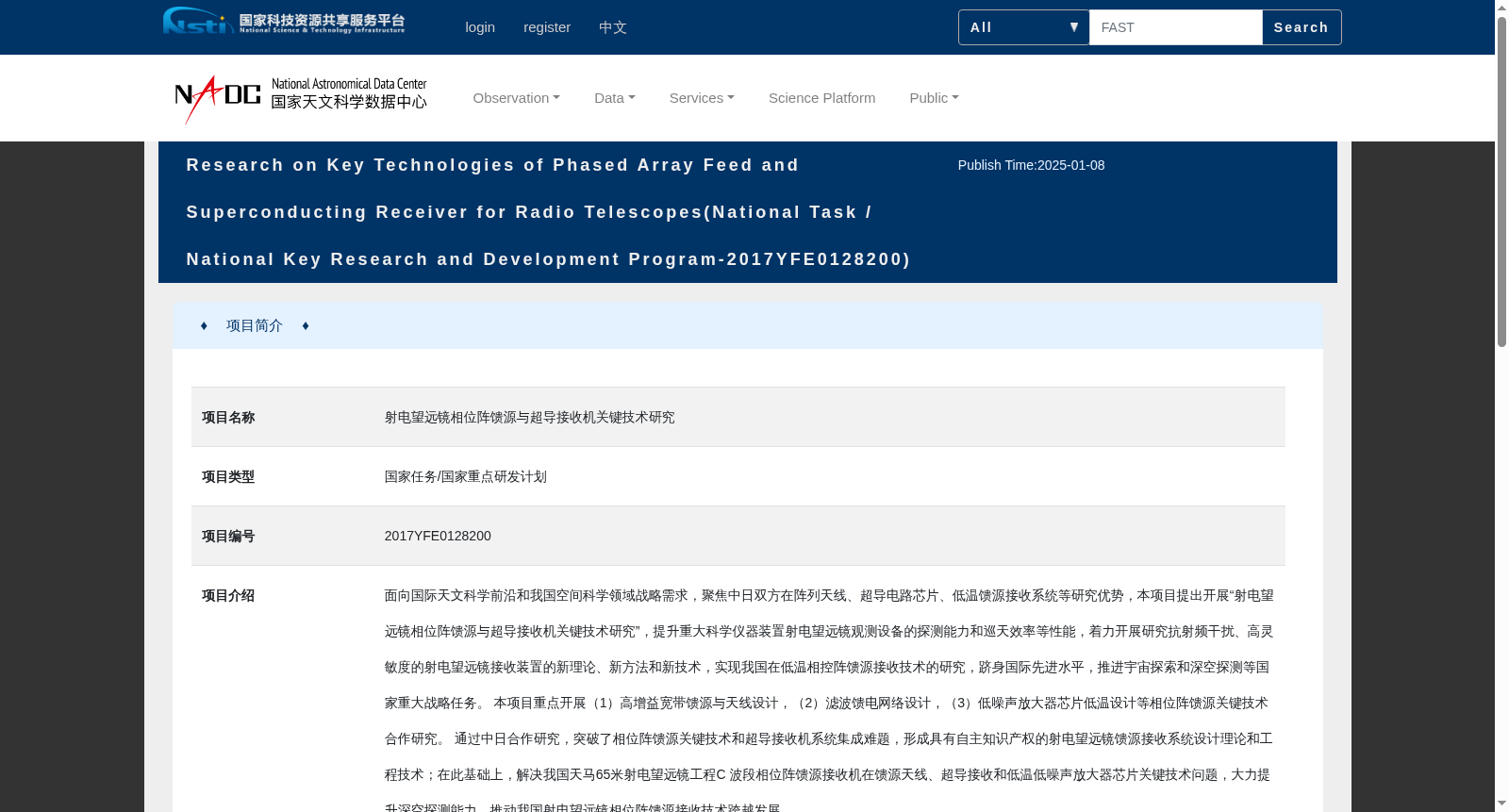
射电望远镜相位阵馈源与超导接收机关键技术研究(国家重点研发计划-2017YFE0128200)项目数据
收藏国家天文科学数据中心2025-01-18 收录
下载链接:
https://nadc.china-vo.org/res/r100801/
下载链接
链接失效反馈官方服务:
资源简介:
项目中科学数据内容主要包括实验测试数据、论文和专利等原始数据,具体包括:(1)高增益宽带馈源与天线设计,建立馈源天线阵列的低旁瓣和波束一致性协同设计方法。针对射电天文高灵敏度和极化不敏感特征,研究并揭示双极化高增益Vivaldi天线阵列的旁瓣降低机理和E/H 面波束一致性保持技术,提高天线接收灵敏度、降低馈源极化敏感度。项目考核指标:C波段天线阵列法向最大增益22dB、波束宽度12.5°、波束扫描角度±45°。数据内容:来自第三方测试单位报告射电望远镜馈源天线阵列性能测试参数和论文发表的天线阵列性能参数。(2)滤波馈电网络设计 建立基于人工表面等离子激元(SPPs)技术的天线解耦和噪声抑制方法。针对互耦导致的天线性能下降,提出新型人工SPPs传输线设计天线阵列馈电网络,揭示人工SPPs 的强电磁束缚特性抑制天线互耦及其低通特性对高次模干扰信号抑制机理,降低高集成度馈源的端口耦合和抑制干扰噪声。项目考核指标:滤波馈电网络端口互耦≦-20 dB、陷波深度-40dB、带内插损≦0.15dB、带内驻波≦1.2,最小带外抑制-40dB。数据内容:论文发表的射电望远镜馈源滤波馈电网络电磁传播性能参数。(3)低噪声放大器芯片低温设计等相位阵馈源关键技术合作研究。建立SiGe 和GaAs工艺低噪声放大器LNA 低温建模设计理论。通过低温纳米晶体管小信号电路模型及其参数提取方法,研究低温纳米晶体管小信号噪声模型;通过低温晶体管噪声形成机理,揭示主要噪声源与晶体管物理结构关键设计参数之间的关系,建立精准的晶体管等效电路模型。项目考核指标:放大器增益大于30dB,噪声温度小于14K,功耗小于10mW。数据内容:论文发表的射电望远镜馈源放大器电性能参数。
The scientific data in this project mainly includes original data such as experimental test data, academic papers and patents, which are specifically divided into the following three parts:
1. High-gain broadband feed and antenna design
A co-design method for low sidelobe and beam consistency of feed antenna arrays is established. Aiming at the high sensitivity and polarization-insensitive characteristics of radio astronomy, the sidelobe reduction mechanism of dual-polarized high-gain Vivaldi antenna arrays and the beam consistency maintenance technology for E/H planes are studied and revealed, so as to improve the receiving sensitivity of antennas and reduce the polarization sensitivity of feeds.
Project assessment indicators: For the C-band antenna array, the normal maximum gain is 22 dB, the beamwidth is 12.5°, and the beam scanning angle is ±45°.
Data content: Performance test parameters of radio telescope feed antenna arrays from third-party testing institution reports, and antenna array performance parameters published in academic papers.
2. Filtered feed network design
An antenna decoupling and noise suppression method based on artificial surface plasmon polaritons (SPPs) technology is established. Aiming at the antenna performance degradation caused by mutual coupling, a novel artificial SPPs transmission line is proposed to design the antenna array feed network. The strong electromagnetic confinement property of artificial SPPs for suppressing antenna mutual coupling and the low-pass characteristics' mechanism for suppressing high-order mode interference signals are revealed, so as to reduce the port coupling of highly integrated feeds and suppress interference noise.
Project assessment indicators: The port mutual coupling of the filtered feed network ≤ -20 dB, the notch depth -40 dB, the in-band insertion loss ≤ 0.15 dB, the in-band standing wave ratio ≤ 1.2, and the minimum out-of-band rejection -40 dB.
Data content: Electromagnetic propagation performance parameters of radio telescope feed filtered feed networks published in academic papers.
3. Collaborative research on key technologies of low-temperature design of low-noise amplifier chips and quasi-phase array feeds
A low-temperature modeling and design theory for low-noise amplifiers (LNA) based on SiGe and GaAs processes is established. Through the small-signal circuit model of low-temperature nanoscale transistors and its parameter extraction method, the small-signal noise model of low-temperature nanoscale transistors is studied. Through the noise formation mechanism of low-temperature transistors, the relationship between the main noise sources and the key design parameters of the physical structure of transistors is revealed, and an accurate transistor equivalent circuit model is established.
Project assessment indicators: The amplifier gain > 30 dB, the noise temperature < 14 K, and the power consumption < 10 mW.
Data content: Electrical performance parameters of radio telescope feed amplifiers published in academic papers.
搜集汇总
数据集介绍
背景与挑战
背景概述
该数据集来自国家重点研发计划项目“射电望远镜相位阵馈源与超导接收机关键技术研究”(编号2017YFE0128200),聚焦于提升射电望远镜的观测性能。数据内容包括高增益宽带馈源天线阵列的性能测试参数、滤波馈电网络的电磁传播性能参数,以及低噪声放大器芯片的低温电性能参数,涉及实验测试和论文发表数据,旨在支持射电天文接收技术的研发与优化。
以上内容由遇见数据集搜集并总结生成


