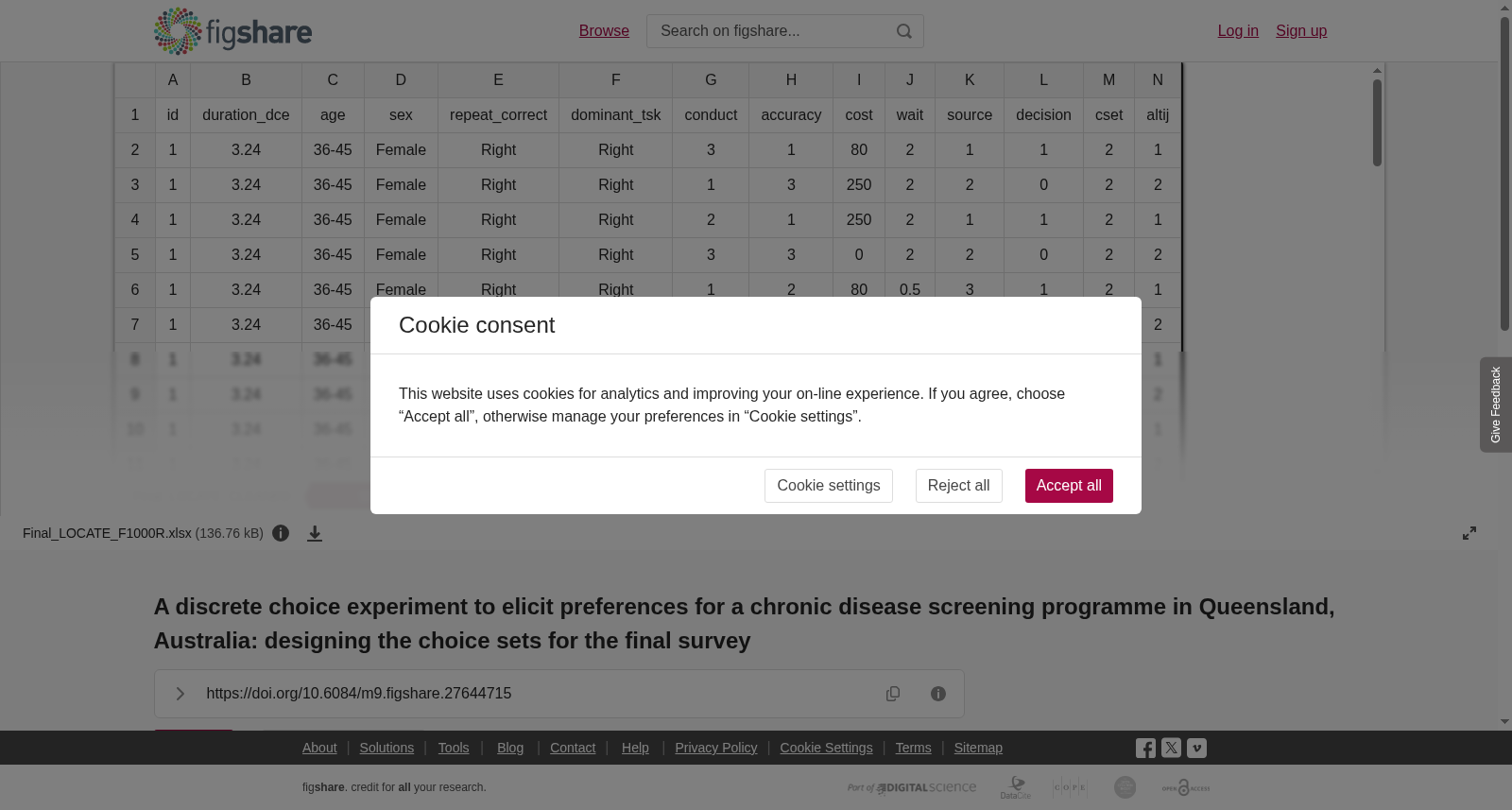
<b>A discrete choice experiment to elicit preferences for a chronic disease screening programme in Queensland, Australia: designing the choice sets for the final survey</b>
收藏资源简介:
<i>Background: </i>Chronic diseases are a significant health concern in Australia. Understanding community preferences for health screening services is vital for enhancing service delivery. We conducted a study to determine community preferences for health screening services for chronic diseases in Australia using a discrete choice experiment (DCE). This paper aims to present the development of the final DCE design using priors estimated from a survey.<i>Methods: </i>A DCE was conducted in Australia. An online survey was administered to a general Australian population over 18. The final attribute list of five attributes with three levels each was designed. A D-efficient design with 30 pair-wise choice tasks was developed using a fractional factorial design. A pre-test was conducted to assess comprehension and understanding of the online DCE survey. The pilot survey aimed to compute priors (i.e. coefficients) associated with attributes. A multinomial logit model was used to analyse the pilot DCE data.<i>Results: </i>The survey included 30 choice tasks in three blocks, with 119 participants responding. The best DCE design was selected based on D-error, with a lower D-error indicating the most efficient design. The pilot survey results indicated a strong preference for highly accurate screening tests, with coefficients for 85% and 95% accuracy being positive. Coefficients estimated from the pilot survey were used as priors to design the DCE choice tasks for the main survey. The final DCE design showed a notable improvement in the attribute level overlap compared to the design used for the pilot survey.<i>Conclusions:</i>A rigorous approach was taken to develop a DCE survey that could effectively determine the preferences of the community for health screening services. The resulting DCE design consisted of 30 choice tasks presented in pairs and was deemed efficient enough to gather comprehensive information in the final survey.
<i>背景:</i>慢性病是澳大利亚面临的重大公共卫生问题。明晰社区人群对健康筛查服务的偏好,对于优化服务供给至关重要。本研究采用离散选择实验(Discrete Choice Experiment,DCE),旨在探究澳大利亚社区针对慢性病健康筛查服务的群体偏好。本文旨在呈现基于预调查估计的先验信息,构建最终DCE设计方案的完整过程。 <i>方法:</i>本研究在澳大利亚境内开展离散选择实验。我们面向18周岁及以上的澳大利亚普通人群实施线上调查,最终确定包含5个属性、每个属性设3个水平的属性集。通过部分因子设计(Fractional Factorial Design),构建了包含30个成对选择任务的D最优(D-efficient)设计方案。同时开展预测试,以评估线上DCE调查的易懂性与接受度。预调查的核心目标是计算各属性对应的先验参数(即系数),并采用多项logit模型(Multinomial Logit Model)对预调查的DCE数据进行统计分析。 <i>结果:</i>本次调查分为3个组块,共设置30个选择任务,最终回收有效问卷119份。本研究以D误差(D-error)作为筛选标准选取最优DCE设计,D误差越低则设计效率越高。预调查结果显示,社区人群对高准确度筛查测试具有显著偏好,准确度为85%和95%的筛查测试对应的系数为正值。我们将预调查估计得到的系数作为先验信息,用于构建正式调查的DCE选择任务。与预调查所用的设计方案相比,最终的DCE设计在属性水平重叠度方面实现了显著优化。 <i>结论:</i>本研究采用严谨的研究方法,构建了可有效测定社区人群健康筛查服务偏好的DCE调查方案。最终的DCE设计包含30个成对呈现的选择任务,其设计效率足以在正式调查中获取全面且可靠的研究数据。