Metadata supporting data files in the published article: <<b>EdgeStyleGAN: An Optimization Approach for Chinese Character Font Generation Based on Font Contours></b>
收藏资源简介:
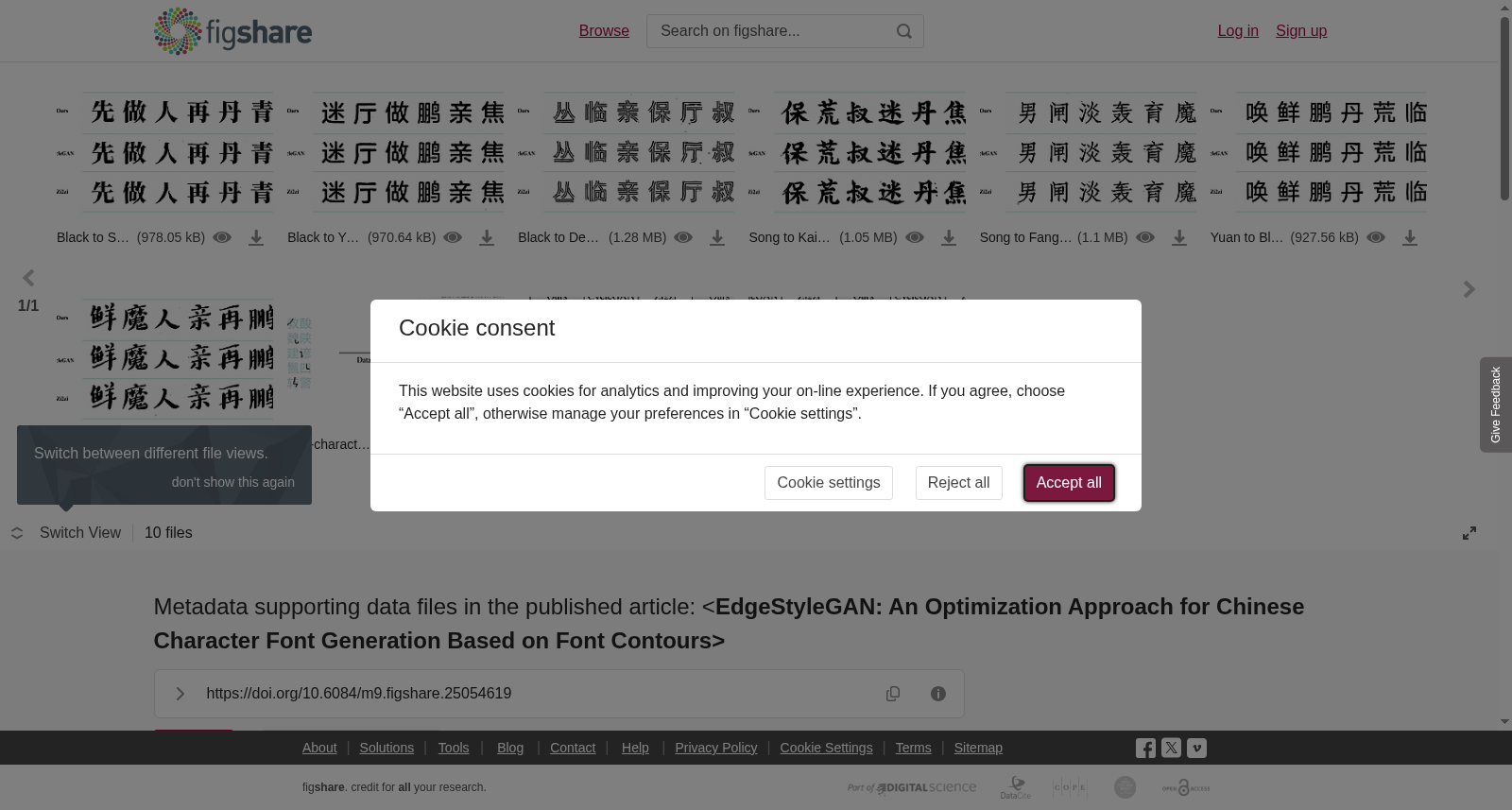
Figure posted on 2024-01-24, 12: 30 authored by Chang Liu, Qiange Wan, Zhi Zheng, Yue Zhao.Our paper proposes a Chinese character font generation method based on font contour information (EdgeStyleGAN). In order to verify the effectiveness of the proposed method, author design a series of generation tasks and comparative experiments to validate the effectiveness of the proposed method. The generation tasks involve learning and generating seven common font styles using our model and comparative models. The experiments consisted of both qualitative and quantitative evaluation experiments. The specific results for generating 7 font styles can be foundin Figure 4 - Figure 10.In constructing our dataset, we drew inspiration from the well-established design process of the industry-leading company Fangzheng Font Library. We opted for a 500-character set as our training dataset, as depicted in Figure 2. These 500 characters are built upon the foundational 50 characters used to establish font styles. These structures encompass not only the 31 strokes of Chinese characters and the morphological variations of each stroke in different positions but also the fundamental structural forms of Chinese characters (e.g., left-right structure, top-bottom structure; enclosure structure, and semienclosure structure). Additionally, this dataset includes the majority of individual characters, compound characters, and most of the radical components. The selection of these 500 characters is pivotal in determining the overall consistency requirements for the entire font library.We utilized data from seven common font styles commonly employed in font design in the experiments. These styles include 1 Song style (Song), 1 Hei style (Black), 1 Kai style (Kai), 1 Fang Song style (FangSong), 1 Yuan style (Yuan), 1 Handwriting style (Handwriting), and 1 Decoration style (Decoration). Following the proposed 500-character dataset in this paper, datasets for these seven fonts were individually created. The fonts were downloaded in ttf or otf format from the respective font manufacturers' official websites. Python code was then used to preprocess the images into 256px*256px white-background black-font RGB images, forming seven sets of paired training datasets, each containing 500 characters. These datasets served as the source and target fonts in the model's comparative experiments to assess the model's style transfer capabilities. Additionally, 30 characters were randomly selected from the GB2312 character set, excluding the initial 500 characters, to form a test dataset for model inference and generation evaluation. The training was conducted on a cloud processor utilizing an NVIDIA RTX 3090 graphics processing unit (GPU), 60 GB of memory, and a 6-core Intel Xeon Gold 6142 processor (CPU). The experiments were run using PyCharm with remote connectivity to the cloud server. The experimental environment was configured with Python 3.10 and the torch 2.0 framework.The Song style font is downloaded from https://source.typekit.com/source-han-serif/cn/The Hei style font is downloaded from https://www.hanyi.com.cn/productdetail?id=831The Kai style font is downloaded from https://www.foundertype.com/index.php/FontInfo/index/id/241The Fang Song style font is downloaded from https://www.hanyi.com.cn/productdetail?id=10726The Yuan style font is downloaded from https://www.foundertype.com/index.php/FontInfo/index/id/219The Handwriting style font is downloaded from https://www.hanyi.com.cn/productdetail.php?id=9053&type=0The Decoration style font is downloaded from https://www.hanyi.com.cn/productdetail.php?id=608&type=0In common tasks involving character generation in seven typical Chinese character styles, the method and dataset employed in this paper demonstrate excellent generation results, demonstrating the superiority of the proposed method over the baseline method. For qualitative assessment, we visualized the results generated by the proposed model in Figures 2 to 9 and incorporated them into a questionnaire. As shown in Table 1, The final result indicate that the images generated by the proposed model surpass those generated by the other models for all 5 criteria. In particular, the model achieved the highest score in edge clarity evaluation, providing preliminary evidence that the proposed model optimizes character contour edges and enhances font generation quality. The models used in this study include ground truth font images for their respective tasks so the quantitative evaluation was conducted using image similarity metrics. Four image similarity evaluation metrics were employed to ensure the objectivity and reliability of the results: the structural similarity index (SSIM), feature similarity index (FSIM), peak signal-to-noise ratio (PSNR), and root mean square error (RMSE). A higher SSIM, FSIM, or PSNR indicates greater similarity between the generated and target images. Conversely, a smaller RMSE indicates lower dissimilarity and greater similarity between the generated and target images. As shown in Table 2, the proposed model obtained superior image similarity results compared to those of the comparative models in the 7 different style font generation tasks. On at least 6 out of the 7 experimental datasets, our proposed method achieved larger SSIM, FSIM, and PSNR values and smaller RMSE values, more objectively demonstrating the effectiveness of EdgeStyleGAN in optimizing character contour edges and font style transfer capabilities.For more details on the methodology, please read the related published article.The code is available from the corresponding author by request.<br>
本图发布于2024年1月24日12:30,作者为刘畅、万千阁、郑智、赵越。本文提出了一种基于字体轮廓信息的汉字字体生成方法(EdgeStyleGAN)。为验证所提方法的有效性,作者设计了一系列生成任务与对比实验以验证其性能。本次生成任务涵盖使用本文模型与对比模型学习并生成7种常见字体风格。实验包含定性与定量评估两类实验,7种字体风格的具体生成结果可见于图4至图10。 在数据集构建环节,本文的设计灵感源自行业领先企业方正字库成熟的字体设计流程。本文选取500字集作为训练数据集,如图2所示。该500字集以构建字体风格所需的基础50字为核心构建而成,其结构不仅包含汉字的31种笔画及不同位置下各笔画的形态变化,还涵盖了汉字的基本结构形式(如左右结构、上下结构;包围结构与半包围结构)。此外,该数据集包含绝大多数独体字、合体字以及多数偏旁部首。这500字的选取对于确保整个字库的整体一致性要求至关重要。 本次实验采用字体设计中常用的7种常见字体风格,分别为宋体(Song)、黑体(Hei)、楷体(Kai)、仿宋(FangSong)、圆体(Yuan)、手写体(Handwriting)与装饰体(Decoration)。本文基于上述500字集,分别为这7种字体构建了对应数据集。上述字体均从各字体厂商官方网站以TTF或OTF格式下载获取。随后使用Python代码将字体图像预处理为256px×256px的白底黑字RGB图像,共形成7组配对训练数据集,每组包含500个汉字。这些数据集将作为模型对比实验中的源字体与目标字体,用于评估模型的风格迁移能力。此外,从GB2312字符集中随机选取除初始500字外的30个汉字,组成测试数据集用于模型推理与生成效果评估。 训练过程在云端处理器上完成,所用硬件配置为NVIDIA RTX 3090图形处理器(GPU)、60GB内存以及6核英特尔至强Gold 6142处理器(CPU)。实验通过PyCharm远程连接云端服务器运行,实验环境配置为Python 3.10与Torch 2.0框架。 宋体字体下载自https://source.typekit.com/source-han-serif/cn/ 黑体字体下载自https://www.hanyi.com.cn/productdetail?id=831 楷体字体下载自https://www.foundertype.com/index.php/FontInfo/index/id/241 仿宋字体下载自https://www.hanyi.com.cn/productdetail?id=10726 圆体字体下载自https://www.foundertype.com/index.php/FontInfo/index/id/219 手写体字体下载自https://www.hanyi.com.cn/productdetail.php?id=9053&type=0 装饰体字体下载自https://www.hanyi.com.cn/productdetail.php?id=608&type=0 在7种典型汉字风格的字体生成任务中,本文所采用的方法与数据集展现出优异的生成效果,证明了所提方法相较于基线模型的优越性。在定性评估环节,我们将本文模型生成的结果可视化于图2至图9中,并将其纳入问卷调研。如表1所示,最终结果表明,本文模型生成的图像在全部5项评价标准上均优于其他模型生成的图像。尤其在边缘清晰度评估项中,本模型获得了最高分,这初步证明了所提模型优化了汉字轮廓边缘,提升了字体生成质量。本研究中使用的模型包含对应任务的真实字体图像作为参照,因此定量评估采用图像相似度指标进行。本文采用4项图像相似度评价指标以确保结果的客观性与可靠性:结构相似性指数(Structural Similarity Index, SSIM)、特征相似性指数(Feature Similarity Index, FSIM)、峰值信噪比(Peak Signal-to-Noise Ratio, PSNR)以及均方根误差(Root Mean Square Error, RMSE)。SSIM、FSIM或PSNR数值越高,代表生成图像与目标图像的相似度越高;反之,RMSE数值越小,则代表生成图像与目标图像的差异越小、相似度越高。如表2所示,在7种不同风格字体的生成任务中,本文所提模型获得了更优的图像相似度结果。在7组实验数据集的至少6组中,本文方法取得了更高的SSIM、FSIM与PSNR数值,以及更低的RMSE数值,更客观地证明了EdgeStyleGAN在优化汉字轮廓边缘与字体风格迁移能力上的有效性。 若需了解方法的更多细节,请查阅相关已发表论文。代码可根据要求向通讯作者获取。