
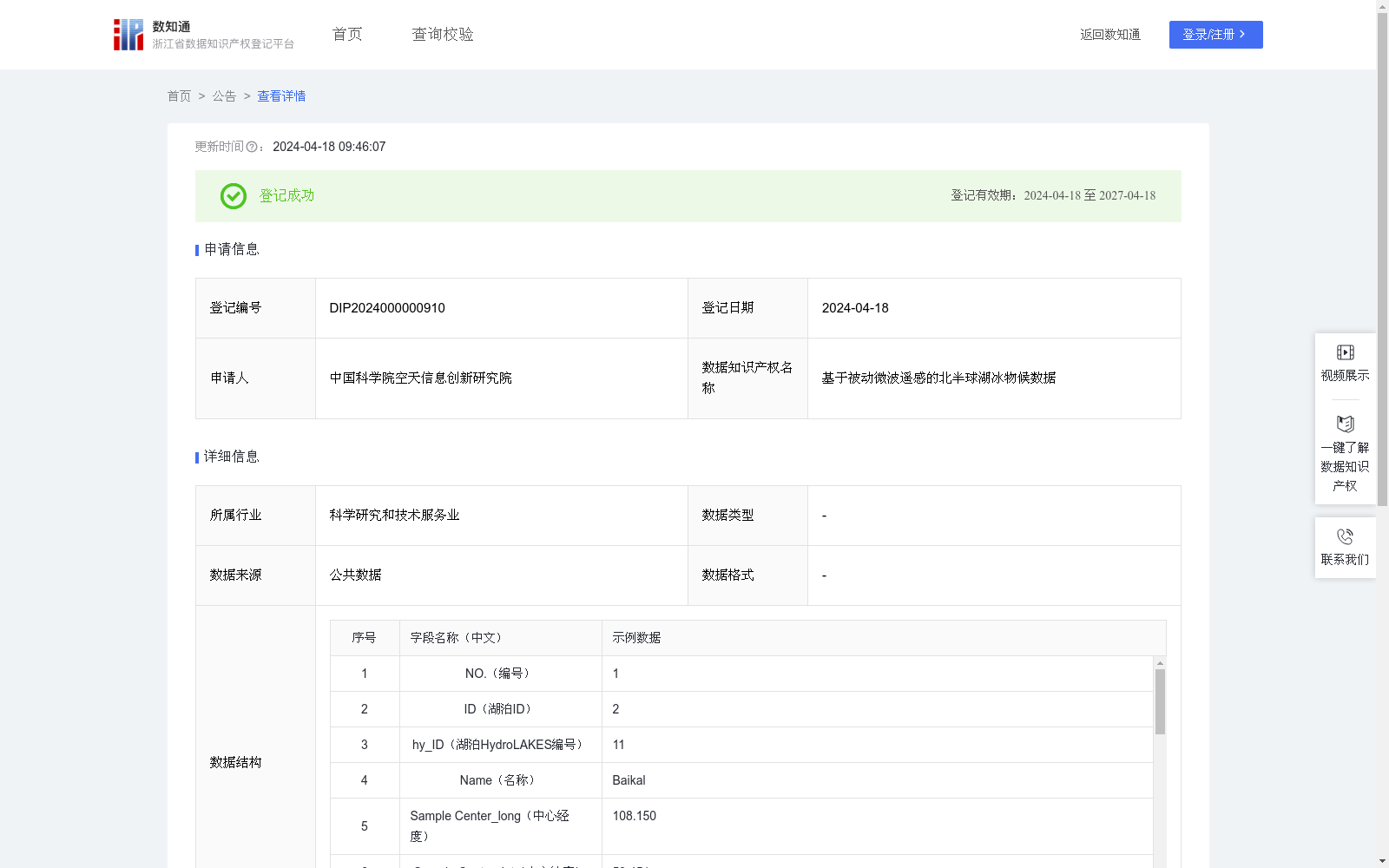
基于被动微波遥感的北半球湖冰物候数据
收藏浙江省数据知识产权登记平台2024-04-18 更新2024-05-08 收录
下载链接:
https://www.zjip.org.cn/home/announce/trends/32538
下载链接
链接失效反馈官方服务:
资源简介:
为理解湖冰物候的变化,需在时空上实现具有连续性和持续性的观测。现有湖冰物候监测主要包括地面站点观测与遥感监测。地面观测受到观测经验、观测位置等限制,仅可实现目视范围内的湖泊冻融观测,对于面积大的湖泊,无法实现对整个湖泊的监测,且观测点少。随着遥感数据的不断积累,为长时间序列湖冰信息的获取及回溯提供了重要的数据源,特别是微波遥感不受天气影响,且具有很好的时间连续性,部分传感器的历史积累可达到40年之久。该数据集可为北半球寒区气候、水文和生态等研究提供陆地水体冻融状态及变化数据,支撑地球三极变化特征分析,是开展三极时空多样性、相互关联性和遥相关机制研究的数据基础。采用被动微波遥感数据作为湖冰物候判别的基础,根据不同传感器类型,采用增强分辨率被动微波遥感数据,包括SMMR、SSM/I、AMSR-E、MWRI、AMSR2等,时间范围为1978年至2020年;最近邻方法获取湖泊所在位置的湖泊被动微波亮温数据(亮温数据即被动微波遥感数据,均可合法在对应官网获取),获取逐日亮温信号;秋冬季节气温降低,湖泊开始冻结,此时湖泊亮温值逐渐变大,湖泊完全冻结后亮温保持稳定;春夏季节湖泊开始融化,亮温信号开始逐渐下降,直至湖泊完全融化亮温信号保持稳定;基于上述的亮温变化特征,利用经验方法构建湖泊物候参数判别规则,最终获得湖冰物候参数记录。最终获得753个湖泊的开始冻结日期(FO)、完全冻结日期(CIC)、开始融化日期(MO)和完全融化日期(CIF)等参数。
To understand the changes in lake ice phenology, continuous and sustained observations across space and time are required. Existing lake ice phenology monitoring mainly includes ground-based station observations and remote sensing monitoring. Ground-based observations are restricted by factors such as observation experience and station locations, and can only monitor the freeze-thaw status of lakes within the visual range. For large lakes, full-lake monitoring is impossible, and the number of observation stations is limited. With the continuous accumulation of remote sensing data, important data sources have been provided for the acquisition and retrospective analysis of long-time-series lake ice information. Particularly, microwave remote sensing is unaffected by weather and has excellent temporal continuity; the historical records of some sensors can span up to 40 years. This dataset can provide freeze-thaw status and change data of terrestrial water bodies for studies on climate, hydrology, and ecology in the cold regions of the Northern Hemisphere, support the analysis of change characteristics of Earth's three poles, and serve as the data foundation for research on the spatiotemporal diversity, interconnection, and teleconnection mechanisms of the three poles. This dataset uses passive microwave remote sensing data as the basis for lake ice phenology discrimination. Enhanced-resolution passive microwave remote sensing data are adopted according to different sensor types, including SMMR, SSM/I, AMSR-E, MWRI, AMSR2, etc., with a time span from 1978 to 2020. The nearest neighbor method is used to obtain passive microwave brightness temperature data (brightness temperature data refers to passive microwave remote sensing data, which can be legally obtained from the corresponding official websites) of lakes at their locations, to acquire daily brightness temperature signals. When temperatures drop in autumn and winter, lakes begin to freeze, and the lake brightness temperature values gradually increase. After the lake is completely frozen, the brightness temperature remains stable. When lakes begin to thaw in spring and summer, the brightness temperature signal gradually decreases until it stabilizes once the lake is completely thawed. Based on the above brightness temperature variation characteristics, empirical methods are used to establish discrimination rules for lake phenology parameters, and finally lake ice phenology parameter records are obtained. A total of 753 lakes are finally obtained with parameters including the start of freeze date (FO), complete ice cover date (CIC), start of melt date (MO), and complete ice-free date (CIF).
提供机构:
中国科学院空天信息创新研究院
创建时间:
2024-04-03
搜集汇总
数据集介绍
以上内容由遇见数据集搜集并总结生成


